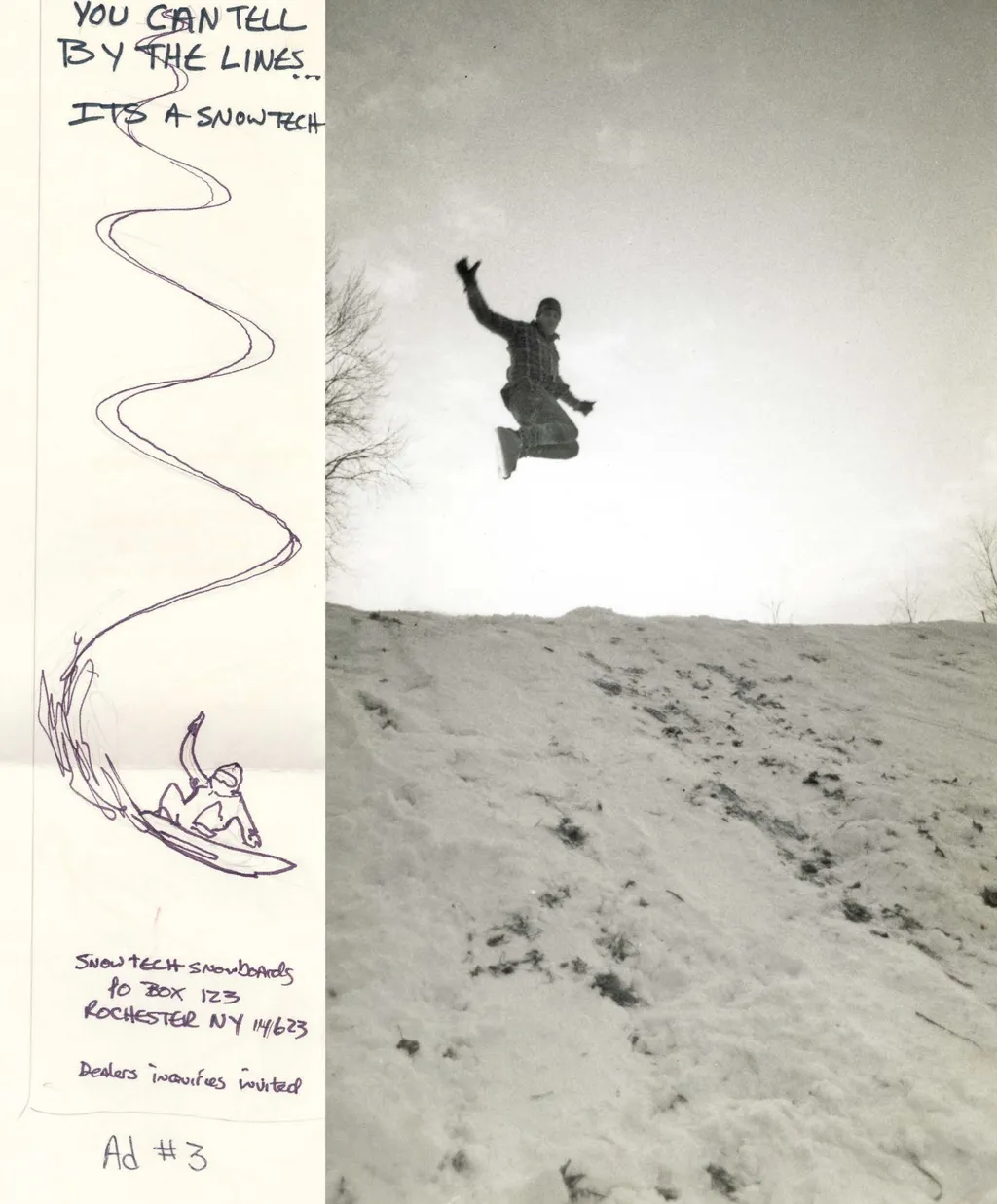
LEFT TO RIGHT Doug Baxendell drew up this idea for an advertise-ment. Our original boards left a really distinct pattern in the snow as you rode them, hence the slogan. Art: DeLost Archives This part of Durand Eastman Golf Course was near a water treatment plant. It was a double-roller tee box—you picked up speed off the first roll and could launch off the second one. Sometimes we would build a kicker at the top of the second roller. Here I am catching air in the early ’80s. Photo: DeLost Archives KICKTAILS AND A CHICKEN COOP Born in Pennsylvania, Ernie grew up in Rochester, NY with two older siblings: his sister, Karen, and brother, Fredd. His mother, Sarah, still lives there, but his father, Fred, passed away when Ernie was 17. His dad had been an Army man and was a skilled athlete partial to base-ball. He was on active duty during the Korean War but was never called into action, and spent his time on the diamond while stationed in Japan. Upon his return to America, Fred obtained a degree in busi-ness administration and settled down at a nine-to-five helping manage various local companies, although Ernie wasn’t convinced his father was ever totally satisfied with his work. “He was a real brilliant guy and I know he wished he had his own business,” Ernie says. “He told us, ‘It doesn’t matter what you do—if you want to dig a ditch, go for it, but strive to be the best damn ditchdigger around. You’re going to spend a large majority of your life working, so it better be doing something you really love.’” When Ernie was 10 years old, his dad bought him a clay-wheeled skateboard with a flat deck. It consumed him, and he had a knack for it. About the same time, Doug Baxendell was opening the area’s first skate-board store, Off The Wall Skates, in the neighboring town of Brock-port, NY. Doug recruited Ernie for the shop’s team and the two got to work building a modular halfpipe for shop demos. This was the first of many times Ernie worked with fiberglass and it served as the initial spark for applying his engineering ingenuity to standing sideways. In the winter of 1974, the skate shop received a couple of Bob We-ber’s Skiboard, also known as the “Yellow Banana.” Although Roch-ester is mostly flat, lake effect graces the area with plenty of snow. Ernie, Doug and the other skaters rode those Skiboards incessantly, their biggest problem being there weren’t enough to go around. “So,” Ernie says, “Doug and I were like, ‘Hell, why don’t we just make some of our own?’” Doug and Ernie dry-walled the old, unused chicken coop in Doug’s parents backyard, converting it into one of the first DIY snowboard factories in the United States. The coop was about 10x12 feet with a six-foot-tall ceiling, and lacked the ventilation needed to deem the chemical-filled confine a safe work environment. But a mini-ramp was stationed in the barn next door, so it was ideal. “Back then, when ads said, ‘garage manufactured,’ it was true,” Ernie says. “We didn’t have the Internet, so we learned on our own. And as kids, we weren’t thinking much about our health and definitely breathed in a lot of bad shit.” Maybe that’s where some of Ernie’s creativity comes from. In 1977, the two formed Snowtech, and by ’81 they went to mar-ket. Snowtech’s early models were constructed of fiberglass and had rubber straps, oversized staples and golf spikes in place of bindings, which were very much in their rudimentary stages. With roots in skateboarding and a strong desire to ride fakie, Ernie and Doug built the first kicktail ever seen on a snowboard, premiering the feature on their Omega model. One night they received a call from some board builders out west heckling them about the new design. “We ran some ads in an early Thrasher magazine touting the kicktail on our snow-boards,” Ernie recalls. “We got a call from these guys saying, ‘What are you going to do, ride it backward?’ We were like, ‘Yeah, that’s the whole point!’” Ernie had always been intrigued by how things work and thought he’d pursue a college degree in engineering. A class field trip to the Kodak headquarters during Ernie’s senior year of high school altered that desire abruptly. Upon conversing with an engineer there, Ernie discovered that for the two years’ prior, the man had spent all of his time working on just one small piece of the company’s newest com-mercial camera. Ernie wanted to be involved in the entirety of the design process, from start to finish. In 1982, he graduated high school and instead of buying textbooks, he used his entire student loan to purchase P-Tex for Snowtech boards. He also failed to attend a single lecture that semester. “I think I finished that year of college with a 0.0 GPA,” the self-taught engineer says. During Snowtech’s first several years, Ernie and his friends were limited to riding hills around town, mostly building banks, berms and impromptu quarterpipes on golf courses. In the spring of 1982, he headed south of Rochester to Swain Ski Area to try his luck on the lifts. A skeptical employee denied Ernie a lift ticket and sent him to see the mountain’s owner, Robin Smith. Smith looked at Ernie, then at the fiberglass board he was holding, then at Ernie, and then the board again. “Well,” Smith said with a smirk, “if you’ve got the balls to do it, buy a lift ticket and go try it.” With a three-dimensional contoured base and no metal edges, Ernie spent most of the day spinning out of control on chewed-up, slushy chunder. This led to building a more traditional model with flatter bottoms rigid enough to hold an edge. “That’s when we started fooling around with a type of design that was more similar to the planks you see now,” Ernie says. By 1985 Snowtech was producing 1,500 boards annually, their numbers only topped by the likes of Burton in Vermont. Snowboard-ing’s growing popularity caught the attention of George Powell, who convinced Ernie to move west and spearhead a snow program at Pow-ell Peralta, one of the world’s largest skateboard manufacturers at the time. Although the snowboard side of things never took off at Powell Peralta, Ernie’s move to Santa Barbara, CA led him to meet a guy he still calls his best friend: Chuck Barfoot. ERNIE DELOST 043
The Snowboarder's Journal frequency 14.1: Page 43