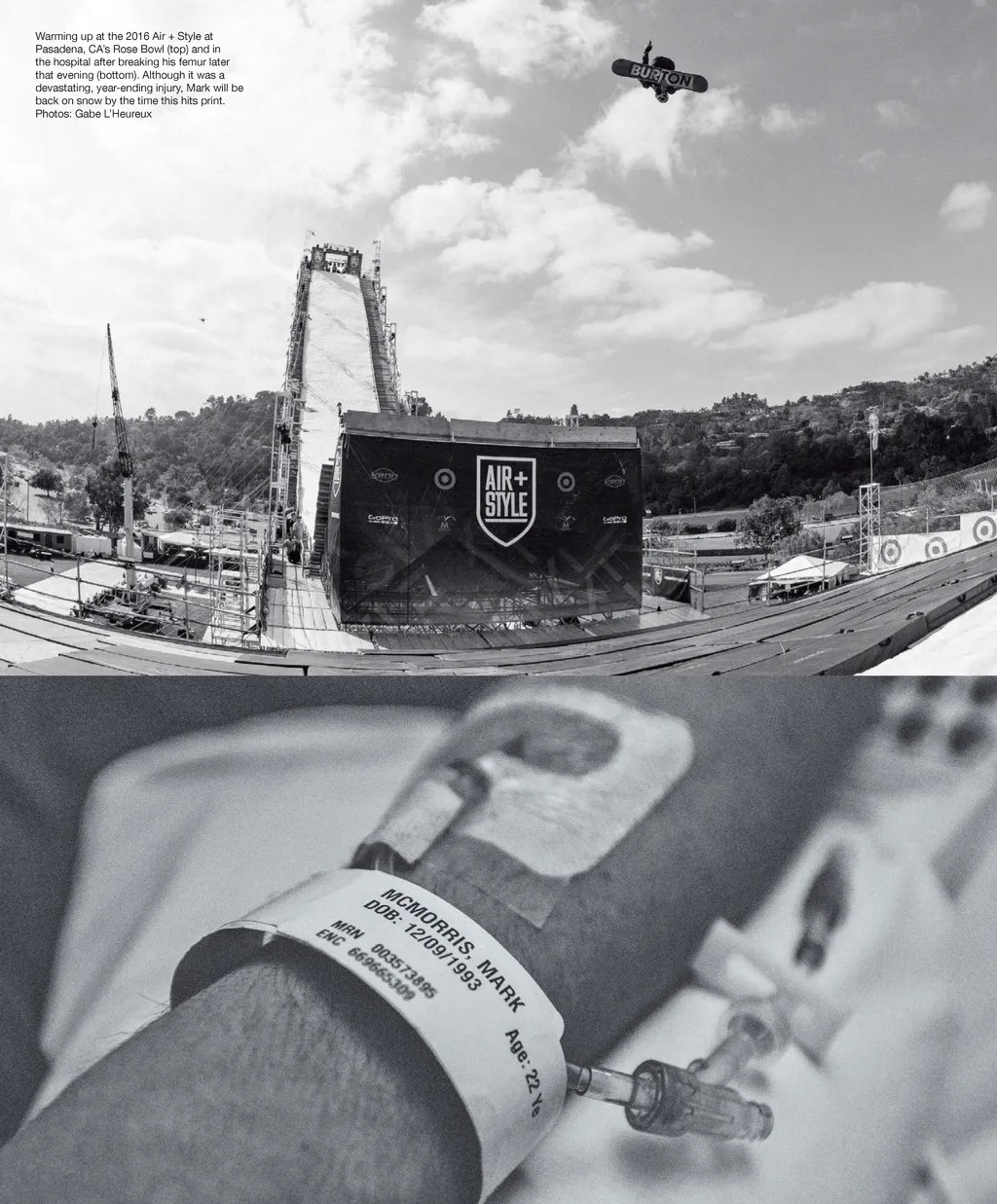
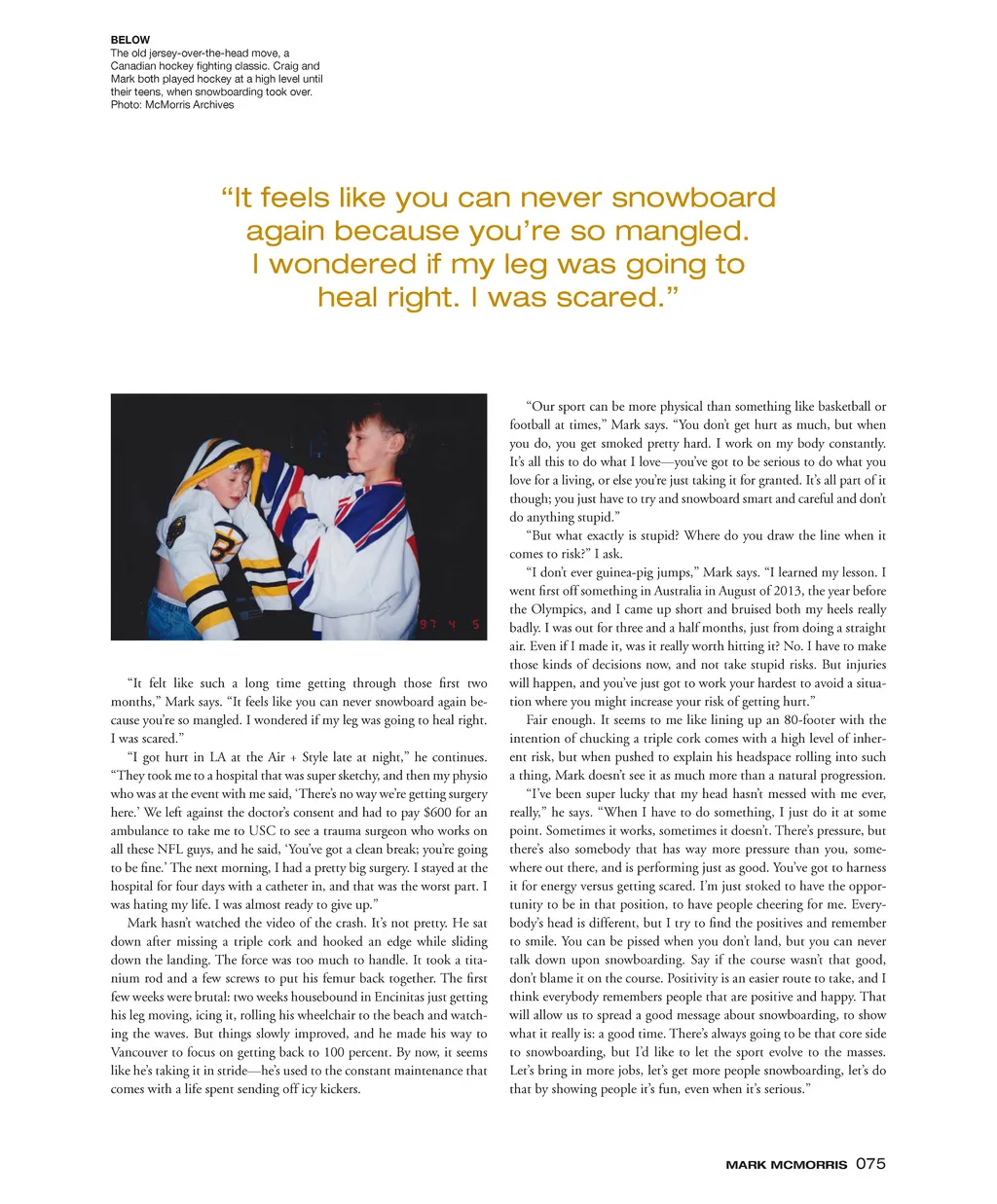
BELOW The old jersey-over-the-head move, a Canadian hockey fighting classic. Craig and Mark both played hockey at a high level until their teens, when snowboarding took over. Photo: McMorris Archives “It feels like you can never snowboard again because you’re so mangled. I wondered if my leg was going to heal right. I was scared.” “It felt like such a long time getting through those first two months,” Mark says. “It feels like you can never snowboard again be-cause you’re so mangled. I wondered if my leg was going to heal right. I was scared.” “I got hurt in LA at the Air + Style late at night,” he continues. “They took me to a hospital that was super sketchy, and then my physio who was at the event with me said, ‘There’s no way we’re getting surgery here.’ We left against the doctor’s consent and had to pay $600 for an ambulance to take me to USC to see a trauma surgeon who works on all these NFL guys, and he said, ‘You’ve got a clean break; you’re going to be fine.’ The next morning, I had a pretty big surgery. I stayed at the hospital for four days with a catheter in, and that was the worst part. I was hating my life. I was almost ready to give up.” Mark hasn’t watched the video of the crash. It’s not pretty. He sat down after missing a triple cork and hooked an edge while sliding down the landing. The force was too much to handle. It took a tita-nium rod and a few screws to put his femur back together. The first few weeks were brutal: two weeks housebound in Encinitas just getting his leg moving, icing it, rolling his wheelchair to the beach and watch-ing the waves. But things slowly improved, and he made his way to Vancouver to focus on getting back to 100 percent. By now, it seems like he’s taking it in stride—he’s used to the constant maintenance that comes with a life spent sending off icy kickers. “Our sport can be more physical than something like basketball or football at times,” Mark says. “You don’t get hurt as much, but when you do, you get smoked pretty hard. I work on my body constantly. It’s all this to do what I love—you’ve got to be serious to do what you love for a living, or else you’re just taking it for granted. It’s all part of it though; you just have to try and snowboard smart and careful and don’t do anything stupid.” “But what exactly is stupid? Where do you draw the line when it comes to risk?” I ask. “I don’t ever guinea-pig jumps,” Mark says. “I learned my lesson. I went first off something in Australia in August of 2013, the year before the Olympics, and I came up short and bruised both my heels really badly. I was out for three and a half months, just from doing a straight air. Even if I made it, was it really worth hitting it? No. I have to make those kinds of decisions now, and not take stupid risks. But injuries will happen, and you’ve just got to work your hardest to avoid a situa-tion where you might increase your risk of getting hurt.” Fair enough. It seems to me like lining up an 80-footer with the intention of chucking a triple cork comes with a high level of inher-ent risk, but when pushed to explain his headspace rolling into such a thing, Mark doesn’t see it as much more than a natural progression. “I’ve been super lucky that my head hasn’t messed with me ever, really,” he says. “When I have to do something, I just do it at some point. Sometimes it works, sometimes it doesn’t. There’s pressure, but there’s also somebody that has way more pressure than you, some-where out there, and is performing just as good. You’ve got to harness it for energy versus getting scared. I’m just stoked to have the oppor-tunity to be in that position, to have people cheering for me. Every-body’s head is different, but I try to find the positives and remember to smile. You can be pissed when you don’t land, but you can never talk down upon snowboarding. Say if the course wasn’t that good, don’t blame it on the course. Positivity is an easier route to take, and I think everybody remembers people that are positive and happy. That will allow us to spread a good message about snowboarding, to show what it really is: a good time. There’s always going to be that core side to snowboarding, but I’d like to let the sport evolve to the masses. Let’s bring in more jobs, let’s get more people snowboarding, let’s do that by showing people it’s fun, even when it’s serious.” MARK MCMORRIS 075
The Snowboarder's Journal frequency 14.1: Page 75