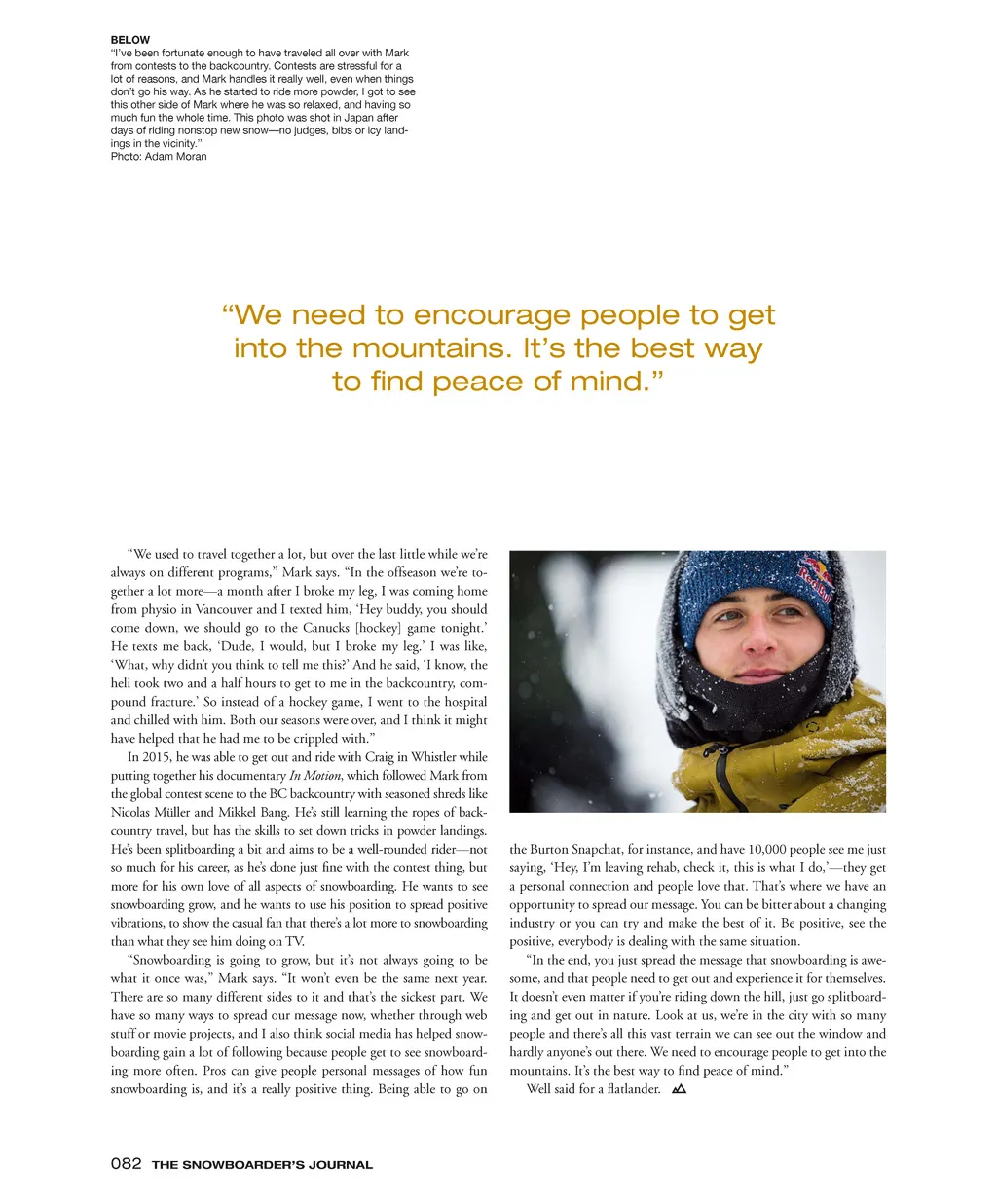
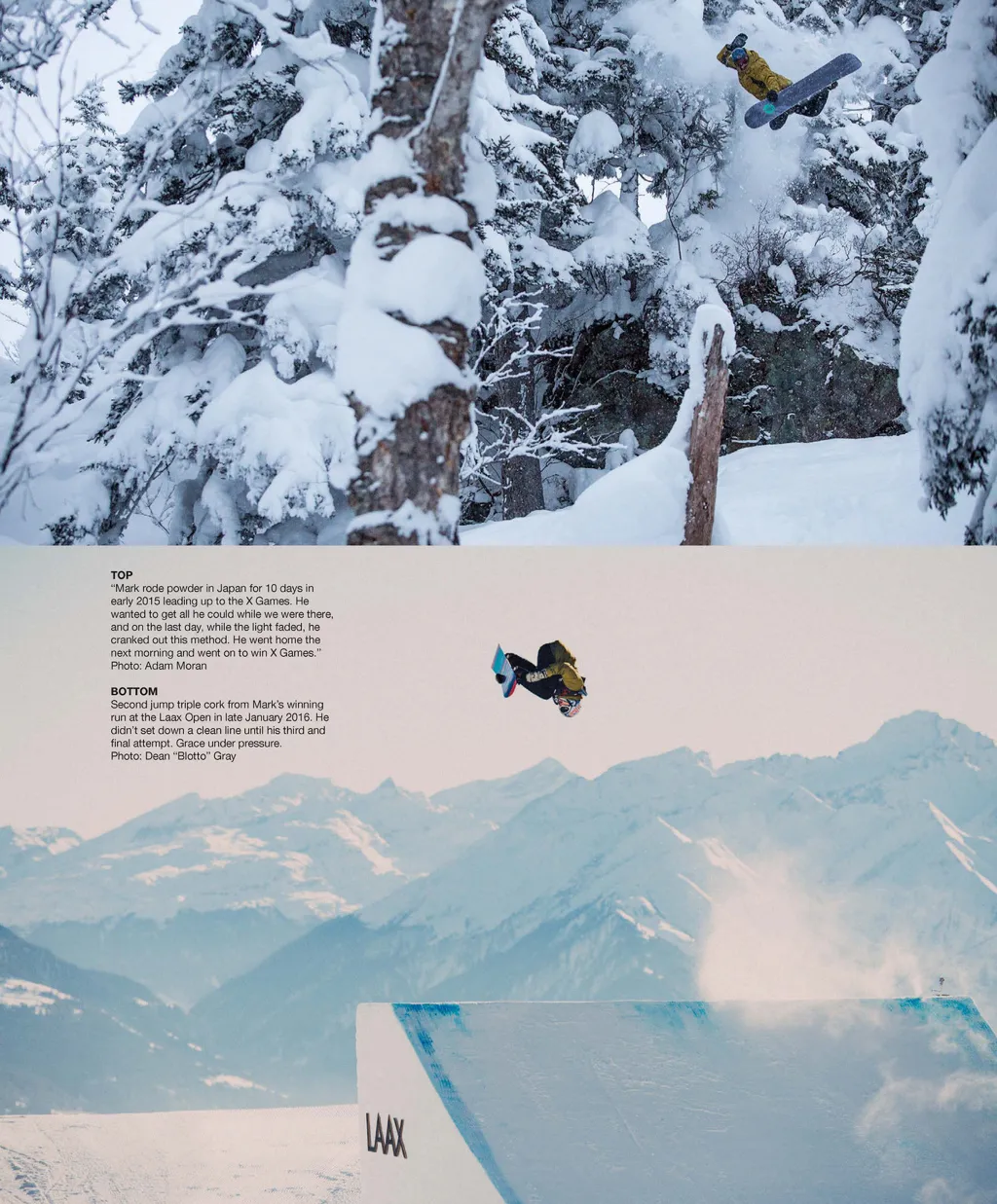
BELOW “I’ve been fortunate enough to have traveled all over with Mark from contests to the backcountry. Contests are stressful for a lot of reasons, and Mark handles it really well, even when things don’t go his way. As he started to ride more powder, I got to see this other side of Mark where he was so relaxed, and having so much fun the whole time. This photo was shot in Japan after days of riding nonstop new snow—no judges, bibs or icy land-ings in the vicinity.” Photo: Adam Moran “We need to encourage people to get into the mountains. It’s the best way to find peace of mind.” “We used to travel together a lot, but over the last little while we’re always on different programs,” Mark says. “In the offseason we’re to-gether a lot more—a month after I broke my leg, I was coming home from physio in Vancouver and I texted him, ‘Hey buddy, you should come down, we should go to the Canucks [hockey] game tonight.’ He texts me back, ‘Dude, I would, but I broke my leg.’ I was like, ‘What, why didn’t you think to tell me this?’ And he said, ‘I know, the heli took two and a half hours to get to me in the backcountry, com-pound fracture.’ So instead of a hockey game, I went to the hospital and chilled with him. Both our seasons were over, and I think it might have helped that he had me to be crippled with.” In 2015, he was able to get out and ride with Craig in Whistler while putting together his documentary In Motion , which followed Mark from the global contest scene to the BC backcountry with seasoned shreds like Nicolas Müller and Mikkel Bang. He’s still learning the ropes of back-country travel, but has the skills to set down tricks in powder landings. He’s been splitboarding a bit and aims to be a well-rounded rider—not so much for his career, as he’s done just fine with the contest thing, but more for his own love of all aspects of snowboarding. He wants to see snowboarding grow, and he wants to use his position to spread positive vibrations, to show the casual fan that there’s a lot more to snowboarding than what they see him doing on TV. “Snowboarding is going to grow, but it’s not always going to be what it once was,” Mark says. “It won’t even be the same next year. There are so many different sides to it and that’s the sickest part. We have so many ways to spread our message now, whether through web stuff or movie projects, and I also think social media has helped snow-boarding gain a lot of following because people get to see snowboard-ing more often. Pros can give people personal messages of how fun snowboarding is, and it’s a really positive thing. Being able to go on the Burton Snapchat, for instance, and have 10,000 people see me just saying, ‘Hey, I’m leaving rehab, check it, this is what I do,’—they get a personal connection and people love that. That’s where we have an opportunity to spread our message. You can be bitter about a changing industry or you can try and make the best of it. Be positive, see the positive, everybody is dealing with the same situation. “In the end, you just spread the message that snowboarding is awe-some, and that people need to get out and experience it for themselves. It doesn’t even matter if you’re riding down the hill, just go splitboard-ing and get out in nature. Look at us, we’re in the city with so many people and there’s all this vast terrain we can see out the window and hardly anyone’s out there. We need to encourage people to get into the mountains. It’s the best way to find peace of mind.” Well said for a flatlander. 082 THE SNOWBOARDER’S JOURNAL
The Snowboarder's Journal frequency 14.1: Page 82