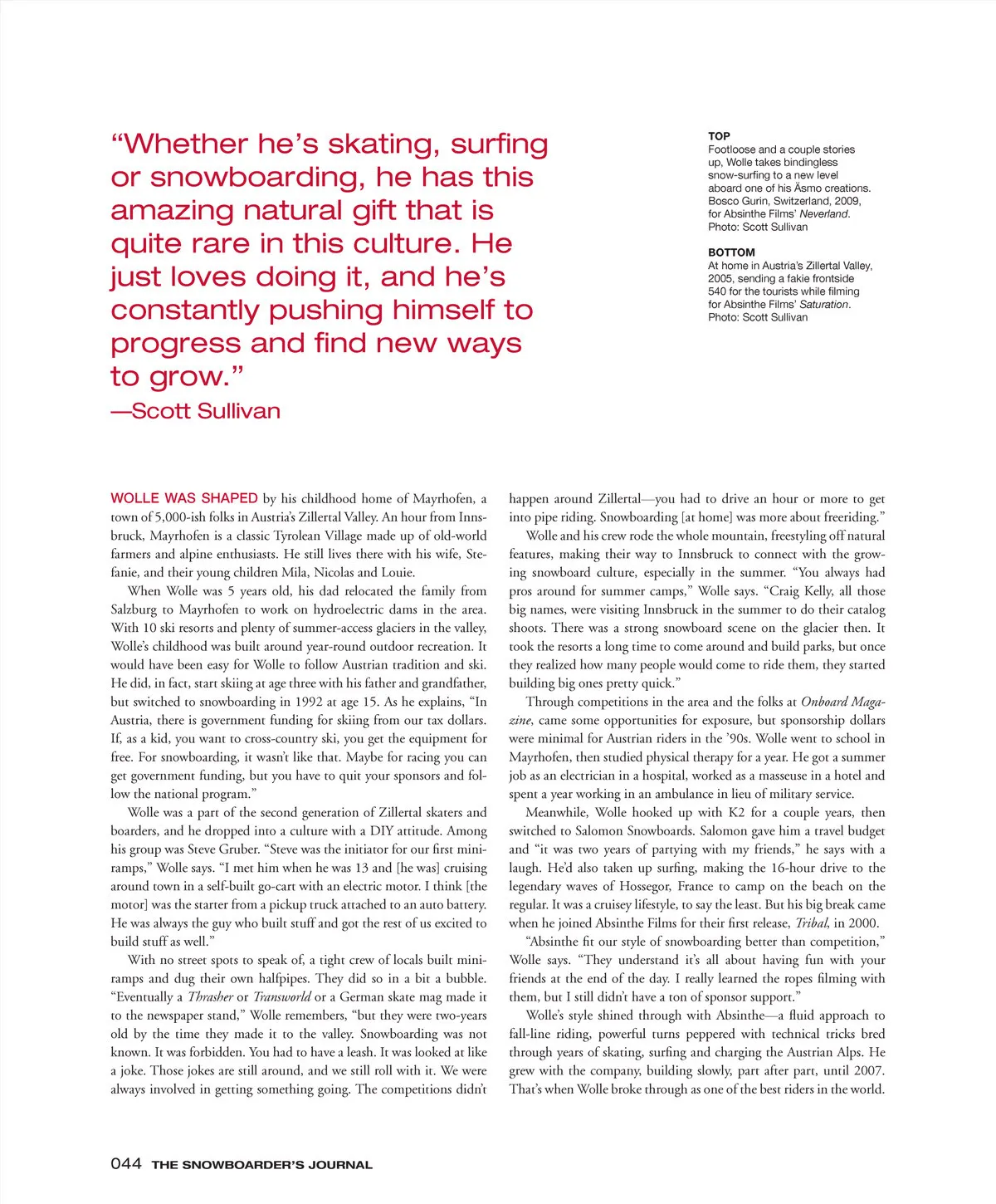
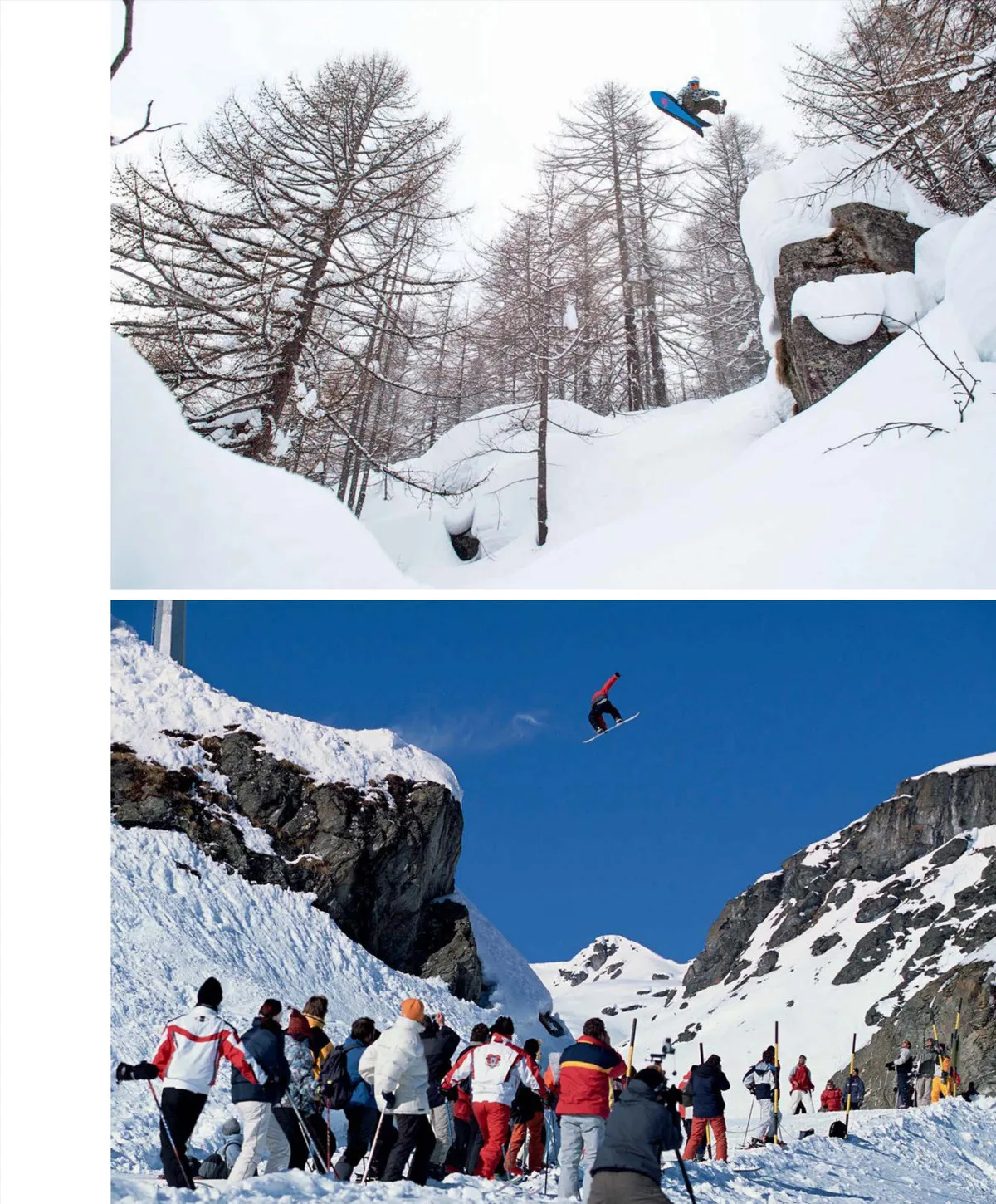
“Whether he’s skating, surfing or snowboarding, he has this amazing natural gift that is quite rare in this culture. He just loves doing it, and he’s constantly pushing himself to progress and find new ways to grow.” —Scott Sullivan TOP Footloose and a couple stories up, Wolle takes bindingless snow-surfing to a new level aboard one of his Äsmo creations. Bosco Gurin, Switzerland, 2009, for Absinthe Films’ Neverland . Photo: Scott Sullivan BOTTOM At home in Austria’s Zillertal Valley, 2005, sending a fakie frontside 540 for the tourists while filming for Absinthe Films’ Saturation . Photo: Scott Sullivan WOLLE WAS SHAPED by his childhood home of Mayrhofen, a town of 5,000-ish folks in Austria’s Zillertal Valley. An hour from Inns-bruck, Mayrhofen is a classic Tyrolean Village made up of old-world farmers and alpine enthusiasts. He still lives there with his wife, Ste-fanie, and their young children Mila, Nicolas and Louie. When Wolle was 5 years old, his dad relocated the family from Salzburg to Mayrhofen to work on hydroelectric dams in the area. With 10 ski resorts and plenty of summer-access glaciers in the valley, Wolle’s childhood was built around year-round outdoor recreation. It would have been easy for Wolle to follow Austrian tradition and ski. He did, in fact, start skiing at age three with his father and grandfather, but switched to snowboarding in 1992 at age 15. As he explains, “In Austria, there is government funding for skiing from our tax dollars. If, as a kid, you want to cross-country ski, you get the equipment for free. For snowboarding, it wasn’t like that. Maybe for racing you can get government funding, but you have to quit your sponsors and fol-low the national program.” Wolle was a part of the second generation of Zillertal skaters and boarders, and he dropped into a culture with a DIY attitude. Among his group was Steve Gruber. “Steve was the initiator for our first mini-ramps,” Wolle says. “I met him when he was 13 and [he was] cruising around town in a self-built go-cart with an electric motor. I think [the motor] was the starter from a pickup truck attached to an auto battery. He was always the guy who built stuff and got the rest of us excited to build stuff as well.” With no street spots to speak of, a tight crew of locals built mini-ramps and dug their own halfpipes. They did so in a bit a bubble. “Eventually a Thrasher or Transworld or a German skate mag made it to the newspaper stand,” Wolle remembers, “but they were two-years old by the time they made it to the valley. Snowboarding was not known. It was forbidden. You had to have a leash. It was looked at like a joke. Those jokes are still around, and we still roll with it. We were always involved in getting something going. The competitions didn’t happen around Zillertal—you had to drive an hour or more to get into pipe riding. Snowboarding [at home] was more about freeriding.” Wolle and his crew rode the whole mountain, freestyling off natural features, making their way to Innsbruck to connect with the grow-ing snowboard culture, especially in the summer. “You always had pros around for summer camps,” Wolle says. “Craig Kelly, all those big names, were visiting Innsbruck in the summer to do their catalog shoots. There was a strong snowboard scene on the glacier then. It took the resorts a long time to come around and build parks, but once they realized how many people would come to ride them, they started building big ones pretty quick.” Through competitions in the area and the folks at Onboard Maga-zine , came some opportunities for exposure, but sponsorship dollars were minimal for Austrian riders in the ’90s. Wolle went to school in Mayrhofen, then studied physical therapy for a year. He got a summer job as an electrician in a hospital, worked as a masseuse in a hotel and spent a year working in an ambulance in lieu of military service. Meanwhile, Wolle hooked up with K2 for a couple years, then switched to Salomon Snowboards. Salomon gave him a travel budget and “it was two years of partying with my friends,” he says with a laugh. He’d also taken up surfing, making the 16-hour drive to the legendary waves of Hossegor, France to camp on the beach on the regular. It was a cruisey lifestyle, to say the least. But his big break came when he joined Absinthe Films for their first release, Tribal , in 2000. “Absinthe fit our style of snowboarding better than competition,” Wolle says. “They understand it’s all about having fun with your friends at the end of the day. I really learned the ropes filming with them, but I still didn’t have a ton of sponsor support.” Wolle’s style shined through with Absinthe—a fluid approach to fall-line riding, powerful turns peppered with technical tricks bred through years of skating, surfing and charging the Austrian Alps. He grew with the company, building slowly, part after part, until 2007. That’s when Wolle broke through as one of the best riders in the world. 044 THE SNOWBOARDER’S JOURNAL
The Snowboarder's Journal frequency 15.2: Page 44