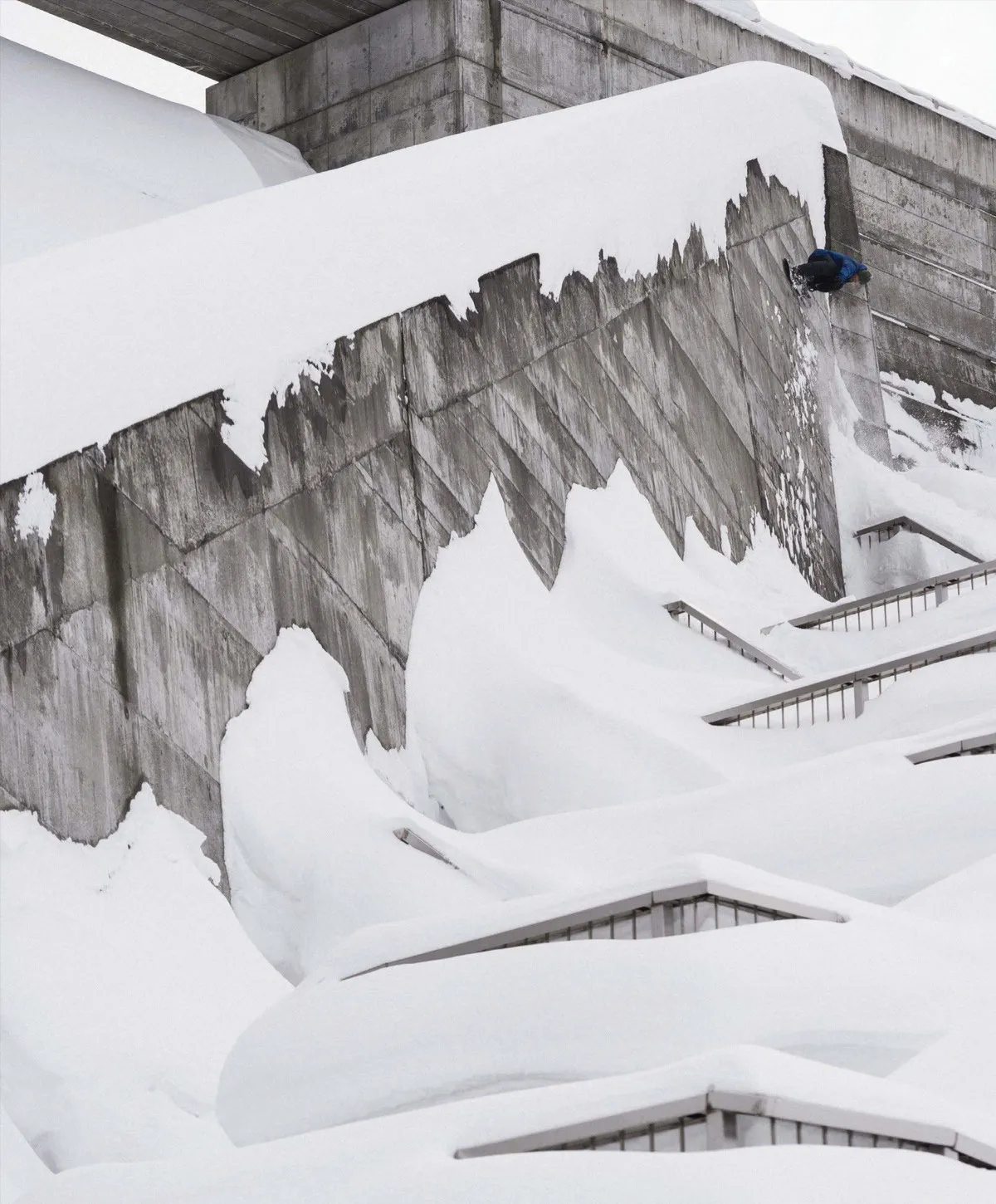
“With snowboarding, you’re free, like dancing. I’m a bad dancer, but I love snowboarding.” —Wolle Nyvelt Backside wallride at a notorious spot in the Hokkaido, Japan backcountry. Well into his 30s, Wolle still rides it all. Photo: Oli Gagnon STAYING MOTIVATED —it’s an interesting notion in a snowboard world dominated by the three-minute part and the next big thing. How do you keep it fresh two decades into the game? Photographer Scott Sullivan has been shooting with Wolle since the early 2000s, and he appreciates Wolle’s multifaceted approach. “In a way, Wolle’s become ageless because he always seems to keep it new school with the stuff he’s doing,” Sullivan says. “Whether through his Äsmo pow surfers or through his board designs with Salomon, he’s been able to push the progression of skate and surf style in snowboard-ing. He’s bringing stuff to the table that people haven’t seen before, constantly. He’s had the same sponsors for most of his career because he’s not greedy. He gets paid less than some of the top dogs, but he’s avoided cuts on his end when the budgets are getting cut.” “He’s also really smart and aware and calculated, while, at the same time, he’s mellow,” Sullivan continues. “He doesn’t try to force things. Whether he’s skating, surfing, or snowboarding, he has this amazing natural gift that is quite rare in this culture. He just loves doing it, and he’s constantly pushing himself to progress and find new ways to grow. He’s not trying to be better than everybody or this or that. He’s really just trying to spread the joy and make it better for people who live their lives in a healthy way out in the mountains and in nature.” Wolle’s design tendencies also budded in the mid-2000s. That’s when he and Gruber launched Äsmo—in 2006, to be exact. Wolle had been riding a traditional snowskate in the early 2000s with a skate deck on top and ski on the bottom, but found it lacked control when the terrain got steeper and the snow got deep. “In 2006, because of lack of snow, we started working on the Äsmo boards,” Wolle says. “We thought riding without bindings was a great concept to bring back. We saw so much potential with what the first snowboard builders were doing in the late ’70s, but it’s not a retro thing. There are so many new things you can do with the design of these boards. So, we started experi-menting with different shapes and different depths of channels to add grip and leverage for steeper slopes and powder riding.” By 2010, Gruber and Wolle had purchased a CNC machine so they could create designs in AutoCAD and apply them to the shapes and a press. “It’s not like shaping a surfboard out of foam,” Wolle says. “You put all of those layers together and then press them like a snowboard.” Äsmo boards have become a coveted commodity in the snowboard underground, with each deck taking 8-10 hours to produce and only about 100 rolling out of their small Mayrhofen factory each year. The boards certainly aren’t toys. Check Wolle’s video parts from the past half-dozen years and you’ll see him ripping pillow lines, airing gaps, spinning, cracking methods—all aboard his finely tuned binding-less creations. It’s not a lucrative endeavor, but it’s one that allows him to expand his mind along with his riding. It allows him to think about snow-sliding in a new and inventive way, whether conceptualizing be-hind a computer screen or dropping into lines with nothing but a leash connecting him to his sled. It’s also allowed him to spend summers close to home with his young family. “I can’t imagine my life without kids anymore,” Wolle says. “I’ve got an awesome wife, she’s down with snowboarding—we all love the mountains, we ride together, and they are down for adven-tures. I think it’s just about being happy, you know? And trying to be a good example and going out and charging and then passing that onto your kids. It’s all about whatever makes them happy.” Snow-sliding makes Wolle happy. Perhaps he keeps it fresh by necessity, to ensure he remains as enthralled with snowboarding now as he was 25 years ago when he first strapped in. At age 39, he’s continuing to grow and evolve as a snowboarder, as a designer, as a human. “Why did I do this? Because it makes me feel good,” Wolle says. “And there’s so much to learn; there’s so much interesting history. There’s building boards, the whole artistic side of it, going filming, shooting photos. You work with all these different people and it’s like a team sport in a way, but you can express yourself. With snowboarding, you’re free, like dancing. I’m a bad dancer, but I love snowboarding.” WOLLE NYVELT 051
The Snowboarder's Journal frequency 15.2: Page 51