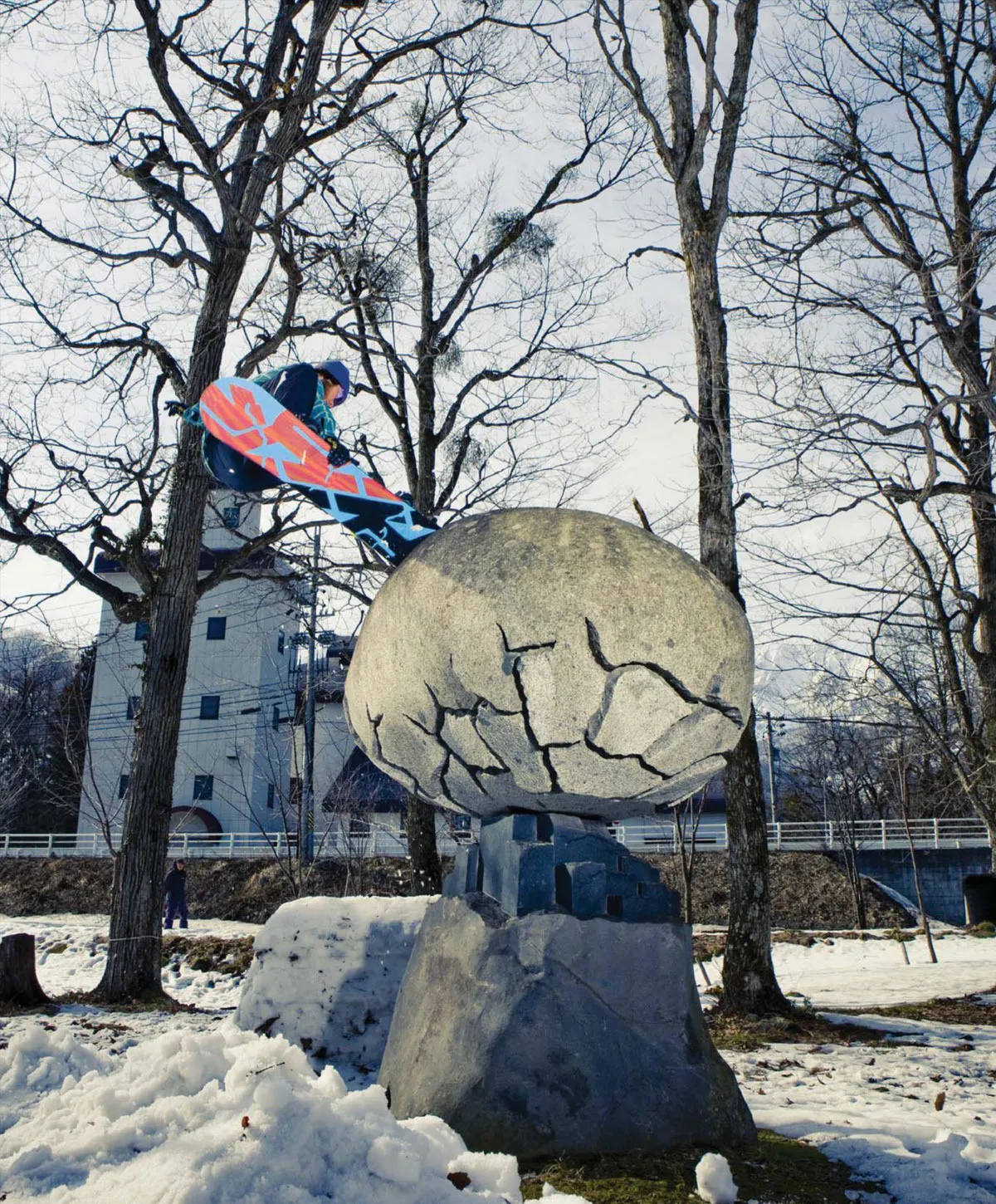
“On the final day of a snowboard trip, motivation can be at an all-time low. But occasionally, you’ll score a buzzer beater. On this day, the last one of a trip to Japan with Think Thank, the air had warmed up and very little snow was left in town to do any sort of jibbing. As we aimlessly scoured the streets, we stumbled upon this sculpture in the middle of a park. We scrounged every bit of slush and snow to build the in-run and jump to the ‘egg’. Both Tim and Jesse Burtner went work on this feature, and we bagged some of my favorite shots of the trip. Tim Eddy, frontside 360, circa 2009.” Photo: Mike Yoshida The Snowboarder’s Journal: You were born in Massachusetts? Tim Eddy: I was born in a place called Concord, just outside of Boston. I lived there till I was 4, and then my family migrated west, to Sacramento, CA. Can you tell me about your family? I’ve got a brother, Brian, who’s two years older than me, and a half-sister, Jess, who is 46. My mom Lynette lives down in Reno, and my dad Robert passed seven years ago, in 2010. My parents met in college at U-Mass. My mom was work-ing a graveyard shift, going to school, and raising my sister as a single mom. Then she met my dad at the cafe where she worked. They moved in together, graduated, moved to Boston, and they just couldn’t hang with the weather, so they moved out west. My mom was an aerobics instructor; my dad was a stock broker. My mom started doing tons of volunteer work, and now she has her master’s in social work, and she’s been kicking butt. She’s got this nonprofit and all the homeless youth in Reno have a resource center that she started. It helps them get jobs, education, clothing, food, shelter… she’s been doing that for a while. And she’s work-ing on a Housing First project down in Reno for the homeless. Tell me about your childhood. [Claps] Childhood! My childhood was fun. My parents were really into the outdoors, and we were halfway to the ocean, halfway to the moun-tains. Every single weekend we’d go camp, all year-round. Friday, right after school, we’d drive and hit every state park in California. Me and my brother started skateboarding when I was 11. I started snowboarding shortly after that, when I was 13. I had some friends who snowboarded, but being in Sacramento, you didn’t really know what snowboarding was. I thought it was like ski-racing. Then they showed me a snowboard movie, and I was just like, “Ohhhh, so you guys are skating on snow, but doing all the stuff we wished we could do on our skateboards.” The next weekend we went snowboarding, and, from that point on, all I wanted to do was snowboard. Every single weekend we’d figure out a way to get to the hill, go night boarding after school. My brother was old enough to drive so he’d take us a lot. Two years later, my parents decided that we were gonna move to the mountains and we went to Truckee. You were riding Boreal first? Boreal was the only mountain I rode for the first three years. It was like a skatepark, and it was the closest to Sacramento. Passes were super cheap. When we moved, I started riding Squaw [Valley] and Alpine [Meadows] and the other places around North Lake Tahoe. You got sponsored early on? I got my first local sponsor through the rep when I was 15. That lasted a season, then I was on the am team. I went to a charter school here in Truckee and I could snowboard every day. I did my junior and senior years in seven months and graduated when I was 16. Then I was riding Boreal all day, jibbin’. It was the early 2000s and snow-board parks were going off. We were hitting wooden rails in front of people’s houses—there are so many vacant houses here—jibbin’ what-ever we could find. There was tons of snow in town every winter. As I got older, I matured a little and realized that there’s more to it than just jibbing, and you could do whatever you wanted. There was a moment when the light bulb turned on in that regard? My team manager was dictating the way I was gonna be as a snow-boarder. He was like, “This is what’s marketable right now; this is what’s in; this is the kind of snowboarder you’re gonna be. You’re gonna fill this niche [on our team]. You’re gonna ride this board, and you’re gonna wear this outerwear, and ride with this style, and these are the kind of guys you’re gonna be looking up to.” And for a 15-year-old, you’re like, “Yeah, I guess this is what it takes to be a pro snowboarder. I’ll just do whatever they tell me, cause I’m getting free snowboards.” As I got older, I started seeing other snowboarders that I looked up to weren’t obeying those rules. And I was like, “Oh, OK. That’s not how it works.” I started going against the wishes of my sponsor. That caused a lot of conflict, so I just bailed. Quit. It was kind of wild to throw away all that work, but then things picked up again because I think people could see that resonating in my riding. How old were you then? From 15 to 18 I was drinking the Kool-Aid. When I started snow-boarding on my own terms, we would go ride the resort, trying to find transition, little side hits, little doubles, little walls to turn on— we were seeking transition. It was a way to go out all day and laugh at stuff. We would try to find the humor in everything we could. That’s how I would snowboard off the camera. When I quit my sponsors, Travis Parker reached out because they were just starting Airblaster. He was from Tahoe and through friends of friends I met him, rode with him a little bit, and we connected with our approach to snow-boarding. I finally felt like I was riding with my dudes. 074 THE SNOWBOARDER’S JOURNAL
The Snowboarder's Journal frequency 15.2: Page 74