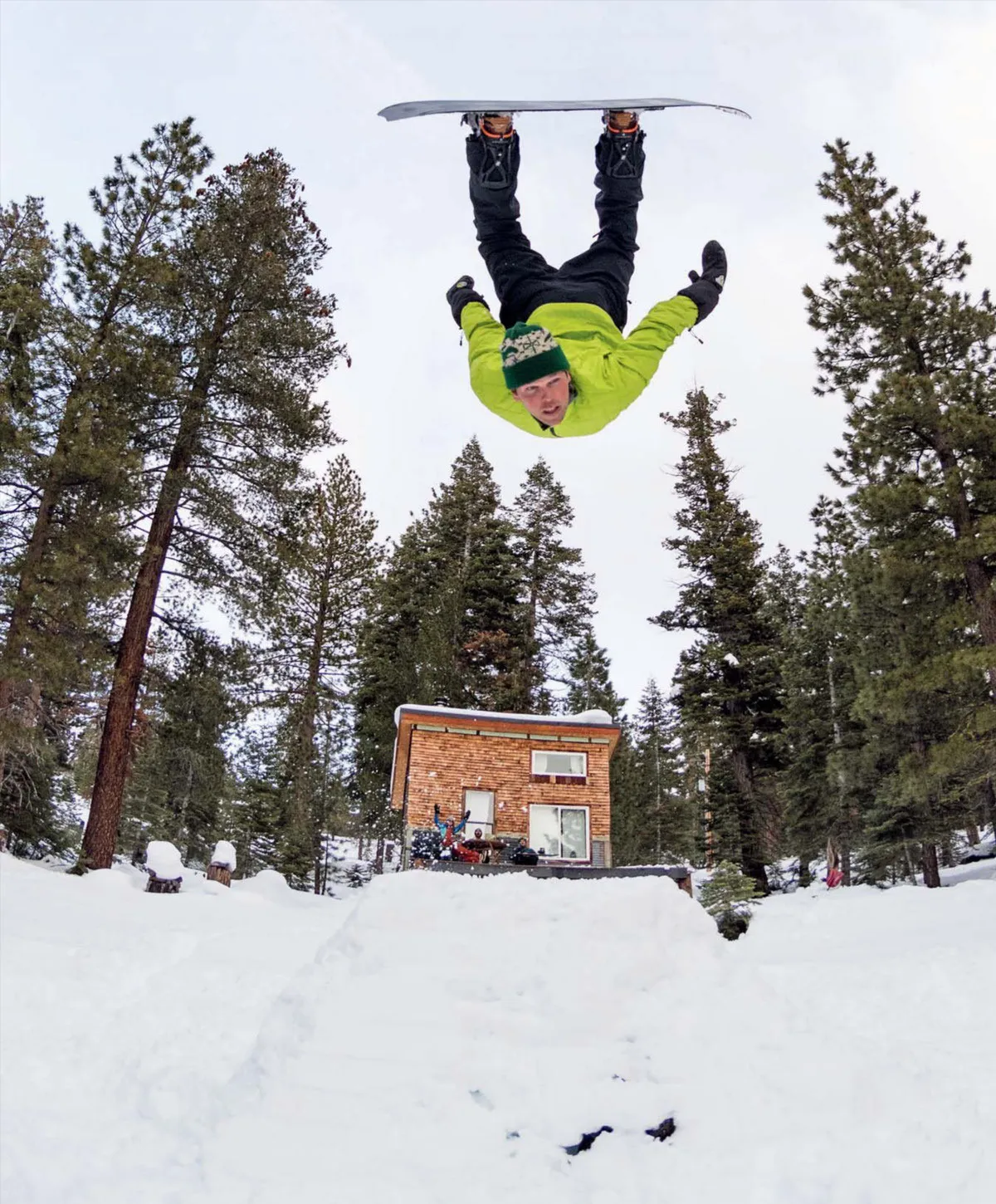
“On the first day of a week-long trip to Tahoe this February, warm temps sent us to Tim and Hannah Eddy’s former property above Truckee, CA, known as the ‘Chillderness.’ Although they recently had to sell it due to some coding issues, the place was an off-the-grid oasis with their home-built cabin, a concrete skate bowl, and 20-plus acres of land to explore. On this day, we built a rhythm section in the front yard and Tim backflipped the final hit a few times. If you look closely, you can see his wife Hannah on the cabin deck alongside Johnny Brady Jr. and Kael Martin.” Photo: Colin Wiseman Tell me about how that frees up your life. The biggest shift was when we downsized big time. Both our parents were dealing with financial issues when the economy crashed seven or eight years ago. We saw the negatives it was causing, not only in our families, but with everyone at that time. We never wanted to get into that situation. We sold our condo and sold out of that lifestyle of bills and being locked into a certain routine that was dictating our lives. Our lifestyle became so simple that it didn’t take anything to sustain it. But we were battling some permitting issues by trying to live fully off the grid and the man finally won. So, we’ve embraced this next chapter and just bought an 800-square-foot base camp in Reno with a workshop/art studio, garden space and 12 solar panels. It’s biking dis-tance to an awesome co-op. There’s room for the truck camper to park when we’re taking breaks from our adventures, so there are no worries. Breaking your back in 2011 gave you some perspective as well? I freakin’ shattered my tailbone at Mt. Baker. I was laid up for three months. Couldn’t sit, couldn’t…anything. It was a year after my dad passed away, and I had a lot of time to think. From that point, my life has gone in a new direction, a direction that just makes total sense. I feel like I’m in the groove, in the energy source, doing what I want to be doing and everything’s working out. To get more perspective on where I was coming from, my dad was battling depression for years and years. He ended up committing sui-cide. That was a heavy wake-up call. Essentially, his depression [had to do] with a lot of financial issues, and all these things led to a crazy downward spiral, and then he took his life. Then I got injured, and I was really starting to question my position in the world. I was like, “What does snowboarding even mean to me? What am I doing?” Suicide is this unspoken thing. People don’t really want to come out and talk about it. But it’s relevant. It’s obvious. Mental illness is a huge, huge thing. I was selling all my dad’s stuff after he passed away, cleaning out his office. He had a brand-new printer; I was selling it on Craigslist, and this guy called. He was asking me why I’m selling this brand-new printer; what’s wrong with it; and I’m like, “It’s all good, it’s in a box, my dad just passed away, I’m cleaning out his office.” This guy got a little more in depth and said, “Do you mind if I asked how your dad passed away?” I explained that he was battling depression, and it was overwhelming, and, you know, he took his own life. And that has been a theme in my family—there’s a lot of depression, and since then there’s been multiple suicides. It’s kind of littered throughout my whole family along with drug addiction, and all these crazy things. This dude happened to be a geneticist in Reno at the university. He was doing an international study on depression and genetics, and the correlation that they’ve found between families where they’re seeing [de-pression] show up just as much as hair color and eye color and height and weight. He explained how the only successful way that they’ve seen people overcome depression and continue beating it is through finding a passion, and following that, rather than medications and things like that. The medications help, but it’s not a sustained solution. Then he goes, “How do you feel? Do you have any depression issues or mental illness issues?” And I was honestly like, “I can’t even really understand or comprehend depression—which has been hard because it’s in my family—and I don’t really know how to relate because I feel so lucky to be so positive. I feel great.” And he goes, “Well, what’s your lifestyle about?” And I explain that I love snowboarding, skating, surfing, camping, biking, all these things that inspire me. Before he hung up with me, he goes, “Don’t ever give that stuff up. Follow your passions. Don’t give it up for anything else. For money, for whatever, a stable life. Just follow your passions. Because those could be what’s keeping you alive. Doctor’s orders.” Growing up, you generally get the sense that adults are waiting for you to figure it out, get a real job, and start pursuing a career outside of your hobbies. But hearing that from him was this huge eye-opener where I was like, “You know what, I owe it to myself, I owe it to my family. I’m just gonna keep pursuing these passions.” I gave up the whole notion that I would ever sacrifice even a moment on my snowboard for it being my job. And I was just like, “Every time you strap in, do what you want to do 100 percent of the time.” From that point on, my snowboarding really took off, and my career solidified. Everyone was just like, “Whoa, there’s new energy in Tim’s snowboarding, and his whole perspective.” So, in my professional life I was getting rewarded for doing what I wanted to do. That’s when Hannah and I decided we were gonna give up everything that was holding us back and pursue that life of simplic-ity, where material things don’t dictate our choices, and we make our choices based on what we feel is right. That’s when we sold our place, got the property, and built the cabin. We felt more comfortable with our relationship with the environment and it was this cool combination—it was benefiting the environment, but also benefiting our lifestyle. From that point on, our life just sky-rocketed, and we’ve been on this path of awesomeness ever since. In one year, my dad passed away, and also my cousin committed suicide, my grandma died, I blew my knee out, broke my tailbone…It was a rough year. And I wouldn’t change it for anything. Because I feel like my dad is in a better place now—he’s not dealing with his demons; he’s finally at peace mentally. Wherever he is now, at least he’s not in pain like he was. I was able to catapult my life into a direction of authenticity. It made me realize you can’t base your decisions on anything except for what you think is right, and what feels good, and what makes sense to you. The right things have been showing up at the right time ever since. My whole viewpoint now is to share that, you know? And be like, “You can make decisions based on what you want to do and what you think is right. You can be true to yourself, and the universe will respect it.” So that’s the goal now. With my snowboarding, with Do Radical [ Ed: See more from Tim and Hannah on Instagram @doradical ], and everything, we’re just trying to inspire people to pursue what they want to do, regardless of what it is. 078 THE SNOWBOARDER’S JOURNAL
The Snowboarder's Journal frequency 15.2: Page 78