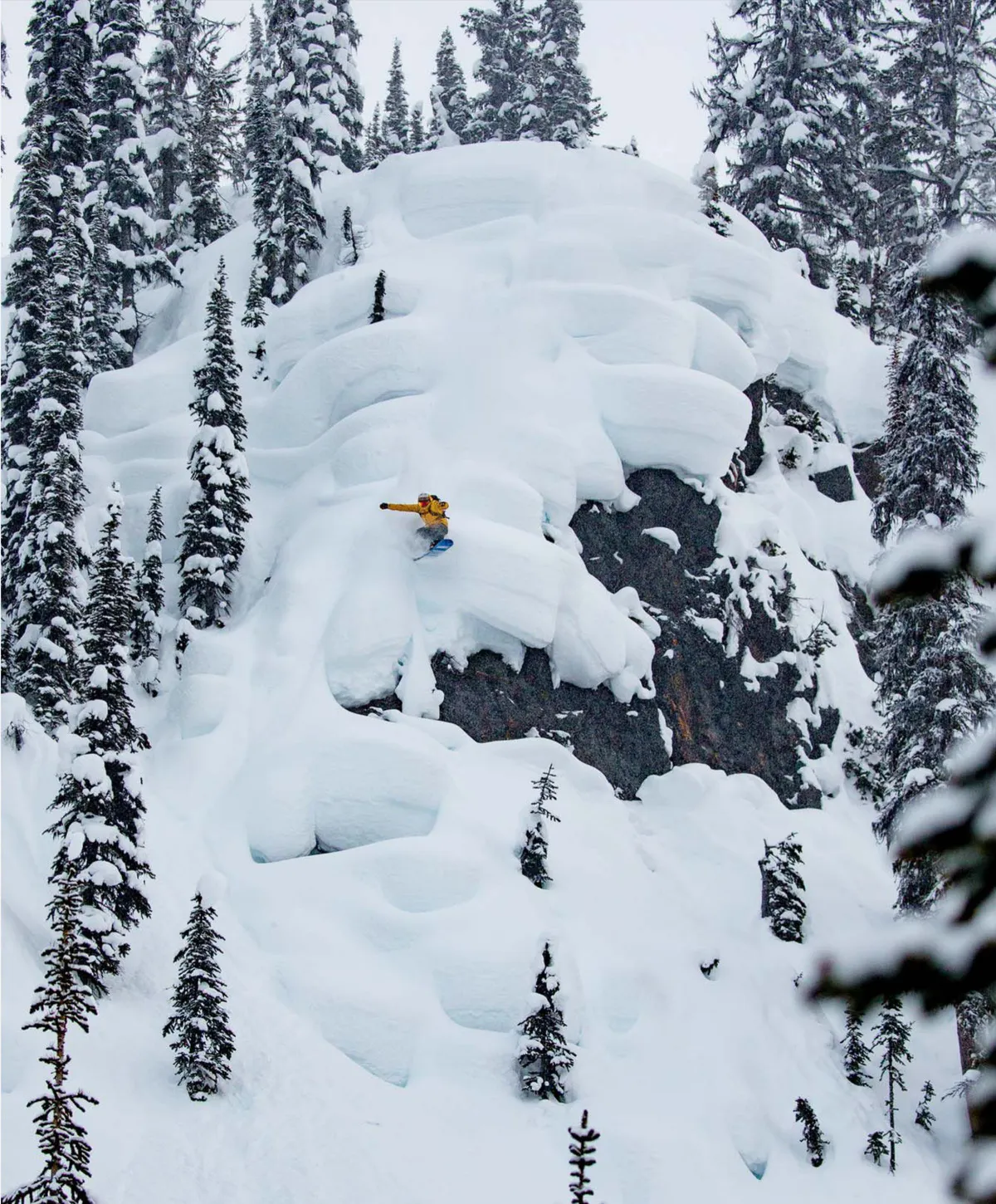
“There’s no shortage of stacks in Galena, BC. The Depth Perception crew got the unique opportunity to sample Canadian Mountain Holidays’ coveted tenure this past season. The typical ski clients in this area stick to the mellower pow-der fields, leaving most, if not all, of the featured and steeper terrain completely untouched. It was a field day of firsts and the local guides were fired up to see Bryan and crew finally tapping into this terrain, which they had been looking at for years, but never even considered riding.” Photo: Andrew Miller The Snowboarder’s Journal: Where did it all start for you? Bryan Fox: I was born outside of San Diego in a town called Ra-mona to two parents who do not ski, snowboard, surf or skateboard. My mom was a first-grade teacher and my dad owned Fox’s Ramona RV, which did repairs on RVs and vans. His entrepreneurial spirit rubbed off on me, for sure. We were middle class; we lived in a small country town in a nice home and our parents provided a good life for us. My mom was born in Hawaii, so she just loved being at the beach. She would take my older brother Stephen and I—he’s two years older than me—to the beach all the time. Eventually we started body boarding little-kid style, then started surfing. It was the early ’90s and skateboarding was pretty big in San Diego, so my parents bought us skateboards. It was a pretty standard story of get-ting into board sports. When I was 13, a kid I knew showed me [Mack Dawg’s] The MeltDown Project and it was mesmerizing. My life changed right there. I could draw a picture of the kid’s living room, his TV, exactly where I sat when I watched the movie—it was such a huge turning point in my life. It’s kind of embarrassing because you think that there’d be bigger decision makers I guess, but that completely altered my path. The next year a friend and I went to Mt. High. Snowboarding was easy com-pared to surfing or skateboarding, but it made sense, it was a perfect extension of the two. We did weekend trips with my mom a couple times, then my brother turned 16 and started driving us to Big Bear. It was three hours away, so it was still a mission. We were bad—we weren’t kid phenoms or anything. I worked at Active Ride Shop which is a snow, skate and surf shop. That helped me understand the industry. I started to get some stuff from this dude Kevin who worked at Forum [Snowboards]. A more important part of my career than getting good at a young age was figuring out how the industry worked and how [snowboarding] could be a job. Then you moved to Portland? My brother went to a small Liberal Arts school in Oregon, Lewis and Clark College. I came to visit him when I was 17 and it was a full pow day at Mt. Hood Meadows. To me, it was magic land. It was mind blowing to see snow-caked evergreens—it’s hard to explain coming from a desert town. It didn’t seem real and pushed me to move there. I moved to Mt. Hood the day after I graduated high school, with Josh Mills. We lived in the parking lot at Timberline. That was the biggest turning point in my life. By fully committing to something, it turned out well. It’s good to just commit to one path. These days there are way too many influences pulling people in different directions. Yet within snowboarding, you’ve had a wide range of experiences with different groups of riders. I’ve been lucky that way. But the two people that helped me get in with the first film company that I worked with, NeoProto, were Scot-ty Wittlake and Louie Fountain. I randomly met them snowboarding at Mt. Hood. Scotty was friends with [NeoProto collaborators] Pierre Minhondo and Justin Eeles. Scotty knew I wanted to become a pro snowboarder, he knew I wanted to film a video part, and we were working construction together at the time. He talked to Justin and gave me the opportunity to film with those guys. I worked hard—I’m not as talented at the actual act of snow-boarding. I remember seeing [Jake] Blauvelt and Travis Kennedy and Pat Moore, kids that were a similar age to me, riding at Windell’s [at Timberline, OR]. They were on such a different level from me, but I wanted the same job that they had. I remember thinking, “This is gonna be a hard sell.” So, when the opportunity came up I worked really hard to make up for my lack of skill. When I started filming with Pierre that first year, my whole entire life went away. I gave it one-thousand percent and spent all my money to make it happen. My parents were amazing too. I had a small college fund, so my brother sat my parents down and was like, “Bryan’s trying to be a pro snowboarder. I think he can be. You guys gave me five grand for college, you should give him his college fund to go toward this career that he wants to have.” My parents followed through with blind faith and gave me some cash to pay rent that winter. Where did it go from there? I filmed with NeoProto, which became People, then Videograss for a couple years. Working with [Joe] Carlino or Hayden [Rensch] or Justin Meyer, I was lucky to be onboard with different production companies that I really respected. I also made little films like The Rascals with Scotty and it was this super-fun and creative outlet that goes along with the act of snowboarding—I could dictate the music and the vibe and the aesthetic of a film. It gave me satisfaction when I’d talk to random people and they’d say how they had my video on repeat, knowing that I’ve created something that inspires someone else. 070 THE SNOWBOARDER’S JOURNAL
The Snowboarder's Journal frequency 15.3 : Page 70