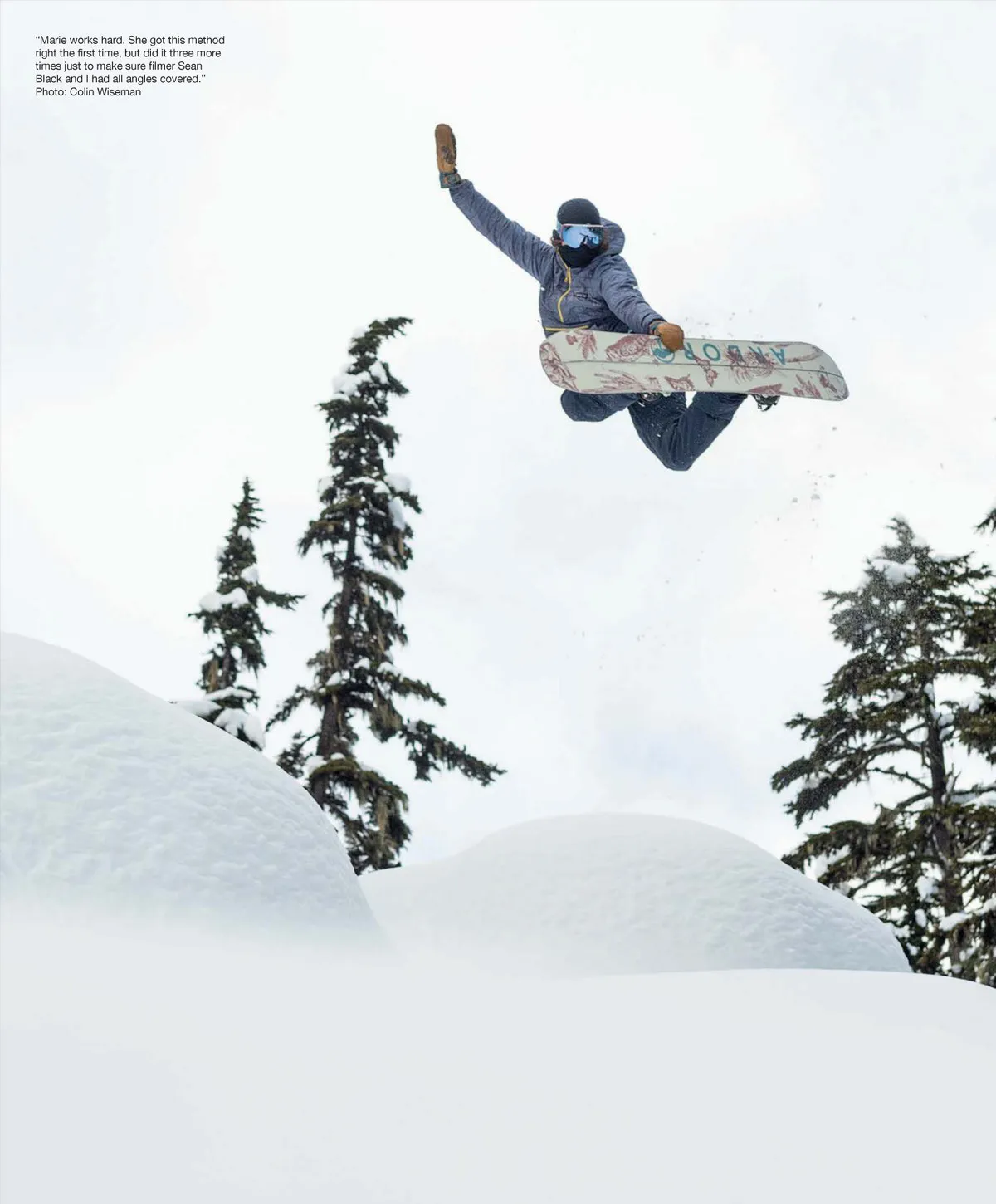
So that guilt was coming from being told what to do, not riding in your own way? Exactly. It felt so purposeless. I felt like giving back and being myself within snowboarding, which is still something I’m trying to figure out—I still don’t think I’ve found my true gift of giving back. I’m not that good at snowboarding, that’s the other thing that gives me guilt, I’m not naturally talented at it. Really? [Ed: We think she’s a very talented snowboarder.] I don’t think so. My brothers were naturally talented. But I’m more like what [former Canadian pro rider] Natasza Zurek always said: “What you don’t have in talent, you can make up for with hard work.” How did it feel to make a movie with a message? I don’t feel a lot of purpose filming a standard part. I would like to work on projects that go beyond that. I’m just stoked to be in a space where there is more to it than just getting gnarly. How many more movies can we make, how much bigger can people go? More creative content can connect people to nature and other things that matter in life. Which is? Whatever makes you happy, in a way. To me, it’s finding respect for others and the environment, and trying to find your own fulfillment too. But it can be anything! And purpose and passion—it makes me sad that so many kids can’t find that. They seem to be swimming in a sea of over-entertainment and overstimulation that leads to bad stuff. And we’re too busy being insular and secure versus going out and exploring life. Especially for girls. If I can be somewhat of a role model for girls to just go after something that truly makes them happy besides their looks—it’s about giving them something to be genuinely stoked on, and supporting that. Women aren’t at the same level as men in action sports, they might not be doing the gnarliest shit, but if you’re encouraging more women to get out there, it’s better for the whole society. It makes them more confident, grows their self-esteem, keeps them healthy mentally and physically and that makes for better children. I don’t think people understand that concept enough—sup-porting anyone to achieve their full potential will enhance the whole world, no matter their background, gender, or age. I’ve been really lucky. We’re so lucky to just have been born here, in Canada. And to be able to snowboard for a living, to do something I feel passionate about and that’s admired, it’s a huge privilege. So, if I can even just lead by example, at least I’m giving something back, to help other people find their own source of growth and happiness. With snowboarding being so big in the media compared to how many people actually do it, does that give us enough of a platform to lead by example? Especially if we move beyond the standard of a three-minute, action-focused part that’s only for other snowboarders? Some brands seem to stay focused on the same formats and recipes that we’ve had for so long and aren’t open to much change outside of the core culture. But they don’t see that the brands are actually hurt-ing themselves because it’s not reaching enough people outside of its own little bubble. I believe that keeping the core is super important but sometimes snowboarding has been kind of shooting itself in the foot by being so unwelcoming and rebellious. Then they’re like, “Oh, nobody is buying snowboards.” Maybe the messaging needs to evolve because the culture has evolved. Your average snowboarder isn’t a 14-year-old teenager who smokes cigarettes and hates the police anymore. Which is cool in a way—I like the punk attitude of snowboarding’s culture, but at the same time it can be much more diverse. And if we can reach a more diverse group of people through media or market-ing or even individually, that’s awesome. It’s weird that some brands are scared of sending environmental messages. When I did The Little Things , I approached some brands who said, “Well, if we talk about [environmental responsibility] everybody is gonna look at us and pinpoint all the things we don’t do right.” It’s the same as the guilt I had, where I felt I couldn’t claim I care about the environment as a pro snowboarder. It’s hypocritical, and I still get that guilt all the time. I still have people criticizing me for using snowmobiles and helicopters. I sold my snowmobile, but that’s not gonna have a huge impact. We can encourage people to make small changes that add up, like making helicopters and airplanes more efficient, or maybe traveling less than they used to. It’s not gonna change overnight. But at least we’re raising a voice for change and all the critics are doing is talking shit on our efforts. It’s not productive. We need major action and we need it now. Cli-mate change is too big of a problem to be fixed overnight by one per-son, but the negativity is slowing down the evolution of our thinking in a very big way. It’s humanity’s biggest challenge and it can’t be black and white like that. Even if I can’t live without a considerable footprint, at least I can have a small voice encouraging people to care about the environment. If you try to have a voice, there are always going to be people that try to oppose your voice, no matter how big or small. It takes a lot of energy and courage to make a statement. It’s important to keep a balance in your life. Some people have been at this [environmental] fight for a very long time and it got too heavy and they quit. To be fighting up front and protesting, I admire that, but I think there are also other ways to encourage change. Influencing people to get out there more and appreciate the value of nature, that’s also very valuable, even if it takes some resources to do it. And it’s easier in a way—it’s not as offensive to some people. You’re not just at war with your words, but you’re trying to fight for nature with love. MARIE-FRANCE ROY 087
The Snowboarder's Journal frequency 15.4: Page 87