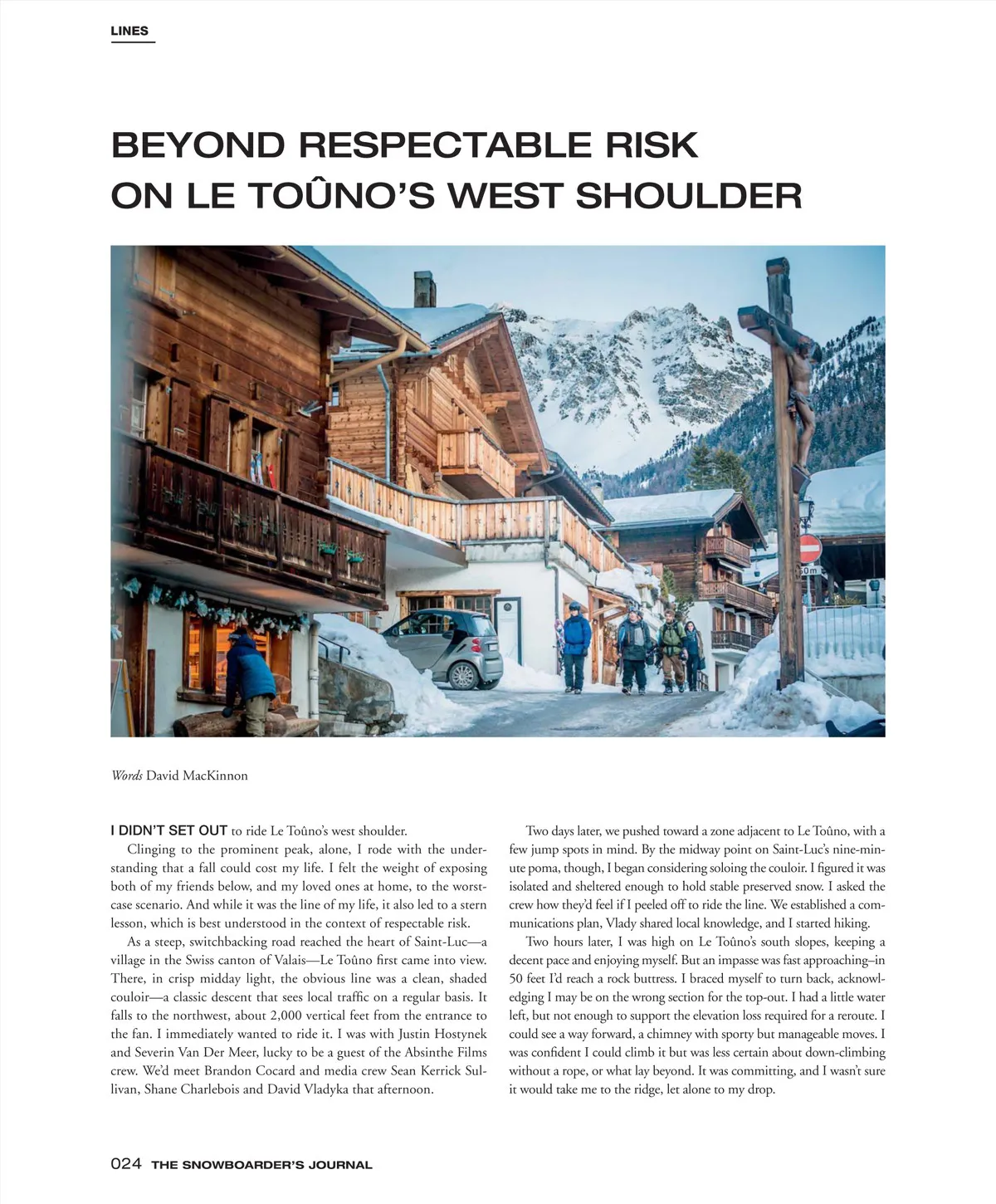
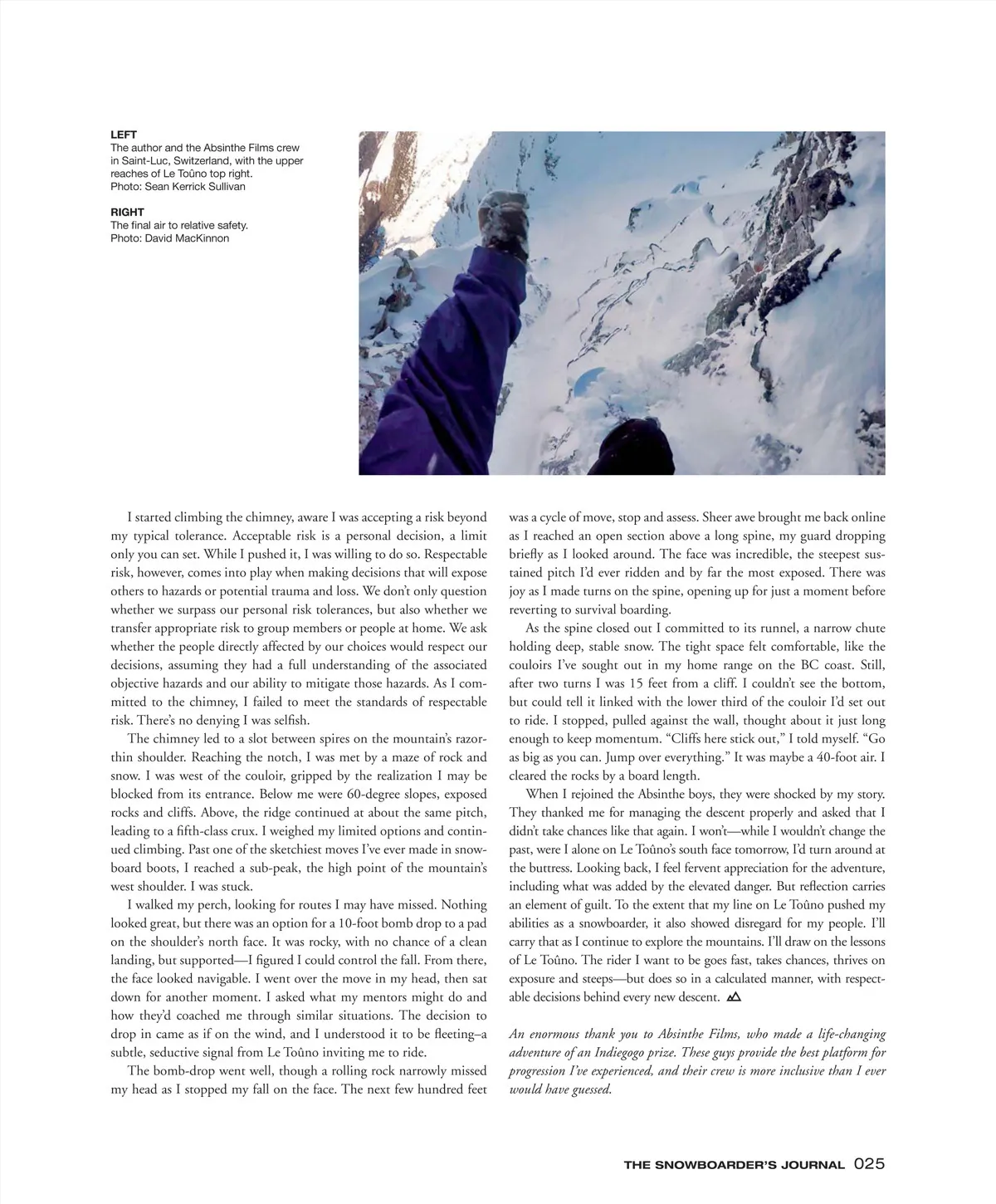
LEFT The author and the Absinthe Films crew in Saint-Luc, Switzerland, with the upper reaches of Le Toûno top right. Photo: Sean Kerrick Sullivan RIGHT The final air to relative safety. Photo: David MacKinnon I started climbing the chimney, aware I was accepting a risk beyond my typical tolerance. Acceptable risk is a personal decision, a limit only you can set. While I pushed it, I was willing to do so. Respectable risk, however, comes into play when making decisions that will expose others to hazards or potential trauma and loss. We don’t only question whether we surpass our personal risk tolerances, but also whether we transfer appropriate risk to group members or people at home. We ask whether the people directly affected by our choices would respect our decisions, assuming they had a full understanding of the associated objective hazards and our ability to mitigate those hazards. As I com-mitted to the chimney, I failed to meet the standards of respectable risk. There’s no denying I was selfish. The chimney led to a slot between spires on the mountain’s razor-thin shoulder. Reaching the notch, I was met by a maze of rock and snow. I was west of the couloir, gripped by the realization I may be blocked from its entrance. Below me were 60-degree slopes, exposed rocks and cliffs. Above, the ridge continued at about the same pitch, leading to a fifth-class crux. I weighed my limited options and contin-ued climbing. Past one of the sketchiest moves I’ve ever made in snow-board boots, I reached a sub-peak, the high point of the mountain’s west shoulder. I was stuck. I walked my perch, looking for routes I may have missed. Nothing looked great, but there was an option for a 10-foot bomb drop to a pad on the shoulder’s north face. It was rocky, with no chance of a clean landing, but supported—I figured I could control the fall. From there, the face looked navigable. I went over the move in my head, then sat down for another moment. I asked what my mentors might do and how they’d coached me through similar situations. The decision to drop in came as if on the wind, and I understood it to be fleeting–a subtle, seductive signal from Le Toûno inviting me to ride. The bomb-drop went well, though a rolling rock narrowly missed my head as I stopped my fall on the face. The next few hundred feet was a cycle of move, stop and assess. Sheer awe brought me back online as I reached an open section above a long spine, my guard dropping briefly as I looked around. The face was incredible, the steepest sus-tained pitch I’d ever ridden and by far the most exposed. There was joy as I made turns on the spine, opening up for just a moment before reverting to survival boarding. As the spine closed out I committed to its runnel, a narrow chute holding deep, stable snow. The tight space felt comfortable, like the couloirs I’ve sought out in my home range on the BC coast. Still, after two turns I was 15 feet from a cliff. I couldn’t see the bottom, but could tell it linked with the lower third of the couloir I’d set out to ride. I stopped, pulled against the wall, thought about it just long enough to keep momentum. “Cliffs here stick out,” I told myself. “Go as big as you can. Jump over everything.” It was maybe a 40-foot air. I cleared the rocks by a board length. When I rejoined the Absinthe boys, they were shocked by my story. They thanked me for managing the descent properly and asked that I didn’t take chances like that again. I won’t—while I wouldn’t change the past, were I alone on Le Toûno’s south face tomorrow, I’d turn around at the buttress. Looking back, I feel fervent appreciation for the adventure, including what was added by the elevated danger. But reflection carries an element of guilt. To the extent that my line on Le Toûno pushed my abilities as a snowboarder, it also showed disregard for my people. I’ll carry that as I continue to explore the mountains. I’ll draw on the lessons of Le Toûno. The rider I want to be goes fast, takes chances, thrives on exposure and steeps—but does so in a calculated manner, with respect-able decisions behind every new descent. An enormous thank you to Absinthe Films, who made a life-changing adventure of an Indiegogo prize. These guys provide the best platform for progression I’ve experienced, and their crew is more inclusive than I ever would have guessed. THE SNOWBOARDER’S JOURNAL 025
The Snowboarder's Journal frequency 16.1: Page 25