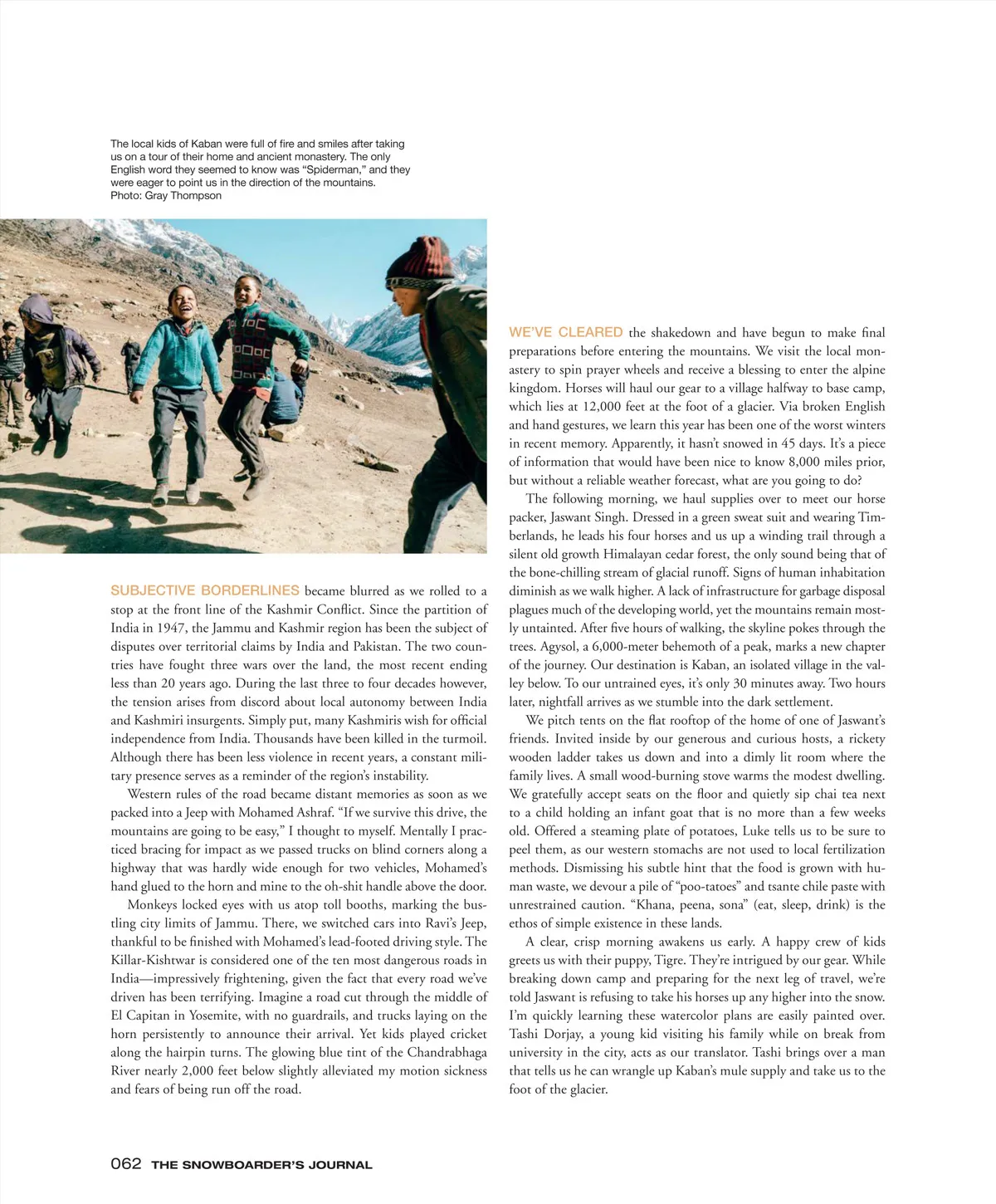
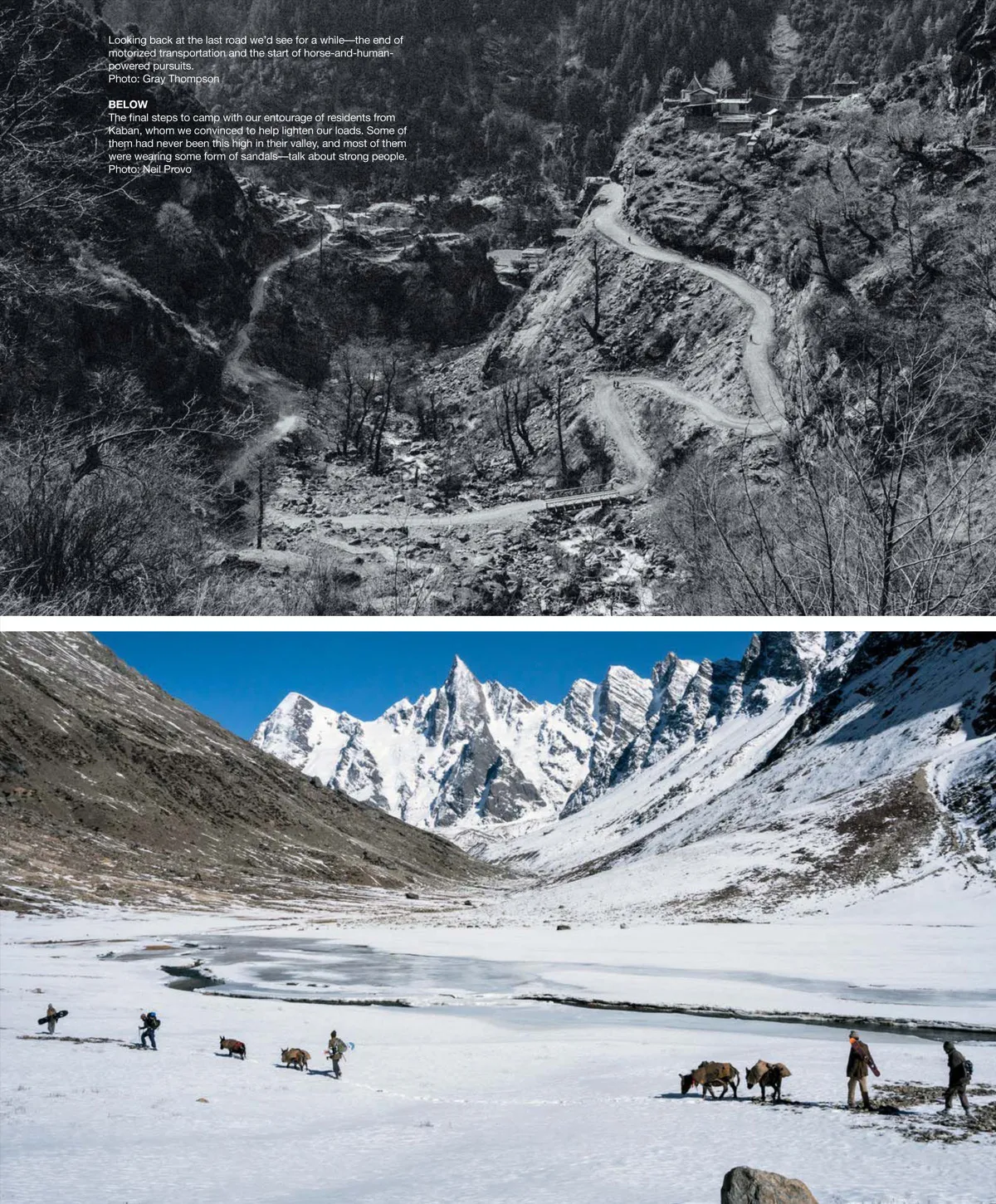
The local kids of Kaban were full of fire and smiles after taking us on a tour of their home and ancient monastery. The only English word they seemed to know was “Spiderman,” and they were eager to point us in the direction of the mountains. Photo: Gray Thompson SUBJECTIVE BORDERLINES became blurred as we rolled to a stop at the front line of the Kashmir Conflict. Since the partition of India in 1947, the Jammu and Kashmir region has been the subject of disputes over territorial claims by India and Pakistan. The two coun-tries have fought three wars over the land, the most recent ending less than 20 years ago. During the last three to four decades however, the tension arises from discord about local autonomy between India and Kashmiri insurgents. Simply put, many Kashmiris wish for official independence from India. Thousands have been killed in the turmoil. Although there has been less violence in recent years, a constant mili-tary presence serves as a reminder of the region’s instability. Western rules of the road became distant memories as soon as we packed into a Jeep with Mohamed Ashraf. “If we survive this drive, the mountains are going to be easy,” I thought to myself. Mentally I prac-ticed bracing for impact as we passed trucks on blind corners along a highway that was hardly wide enough for two vehicles, Mohamed’s hand glued to the horn and mine to the oh-shit handle above the door. Monkeys locked eyes with us atop toll booths, marking the bus-tling city limits of Jammu. There, we switched cars into Ravi’s Jeep, thankful to be finished with Mohamed’s lead-footed driving style. The Killar-Kishtwar is considered one of the ten most dangerous roads in India—impressively frightening, given the fact that every road we’ve driven has been terrifying. Imagine a road cut through the middle of El Capitan in Yosemite, with no guardrails, and trucks laying on the horn persistently to announce their arrival. Yet kids played cricket along the hairpin turns. The glowing blue tint of the Chandrabhaga River nearly 2,000 feet below slightly alleviated my motion sickness and fears of being run off the road. WE’VE CLEARED the shakedown and have begun to make final preparations before entering the mountains. We visit the local mon-astery to spin prayer wheels and receive a blessing to enter the alpine kingdom. Horses will haul our gear to a village halfway to base camp, which lies at 12,000 feet at the foot of a glacier. Via broken English and hand gestures, we learn this year has been one of the worst winters in recent memory. Apparently, it hasn’t snowed in 45 days. It’s a piece of information that would have been nice to know 8,000 miles prior, but without a reliable weather forecast, what are you going to do? The following morning, we haul supplies over to meet our horse packer, Jaswant Singh. Dressed in a green sweat suit and wearing Tim-berlands, he leads his four horses and us up a winding trail through a silent old growth Himalayan cedar forest, the only sound being that of the bone-chilling stream of glacial runoff. Signs of human inhabitation diminish as we walk higher. A lack of infrastructure for garbage disposal plagues much of the developing world, yet the mountains remain most-ly untainted. After five hours of walking, the skyline pokes through the trees. Agysol, a 6,000-meter behemoth of a peak, marks a new chapter of the journey. Our destination is Kaban, an isolated village in the val-ley below. To our untrained eyes, it’s only 30 minutes away. Two hours later, nightfall arrives as we stumble into the dark settlement. We pitch tents on the flat rooftop of the home of one of Jaswant’s friends. Invited inside by our generous and curious hosts, a rickety wooden ladder takes us down and into a dimly lit room where the family lives. A small wood-burning stove warms the modest dwelling. We gratefully accept seats on the floor and quietly sip chai tea next to a child holding an infant goat that is no more than a few weeks old. Offered a steaming plate of potatoes, Luke tells us to be sure to peel them, as our western stomachs are not used to local fertilization methods. Dismissing his subtle hint that the food is grown with hu-man waste, we devour a pile of “poo-tatoes” and tsante chile paste with unrestrained caution. “Khana, peena, sona” (eat, sleep, drink) is the ethos of simple existence in these lands. A clear, crisp morning awakens us early. A happy crew of kids greets us with their puppy, Tigre. They’re intrigued by our gear. While breaking down camp and preparing for the next leg of travel, we’re told Jaswant is refusing to take his horses up any higher into the snow. I’m quickly learning these watercolor plans are easily painted over. Tashi Dorjay, a young kid visiting his family while on break from university in the city, acts as our translator. Tashi brings over a man that tells us he can wrangle up Kaban’s mule supply and take us to the foot of the glacier. 062 THE SNOWBOARDER’S JOURNAL
The Snowboarder's Journal frequency 16.1: Page 62