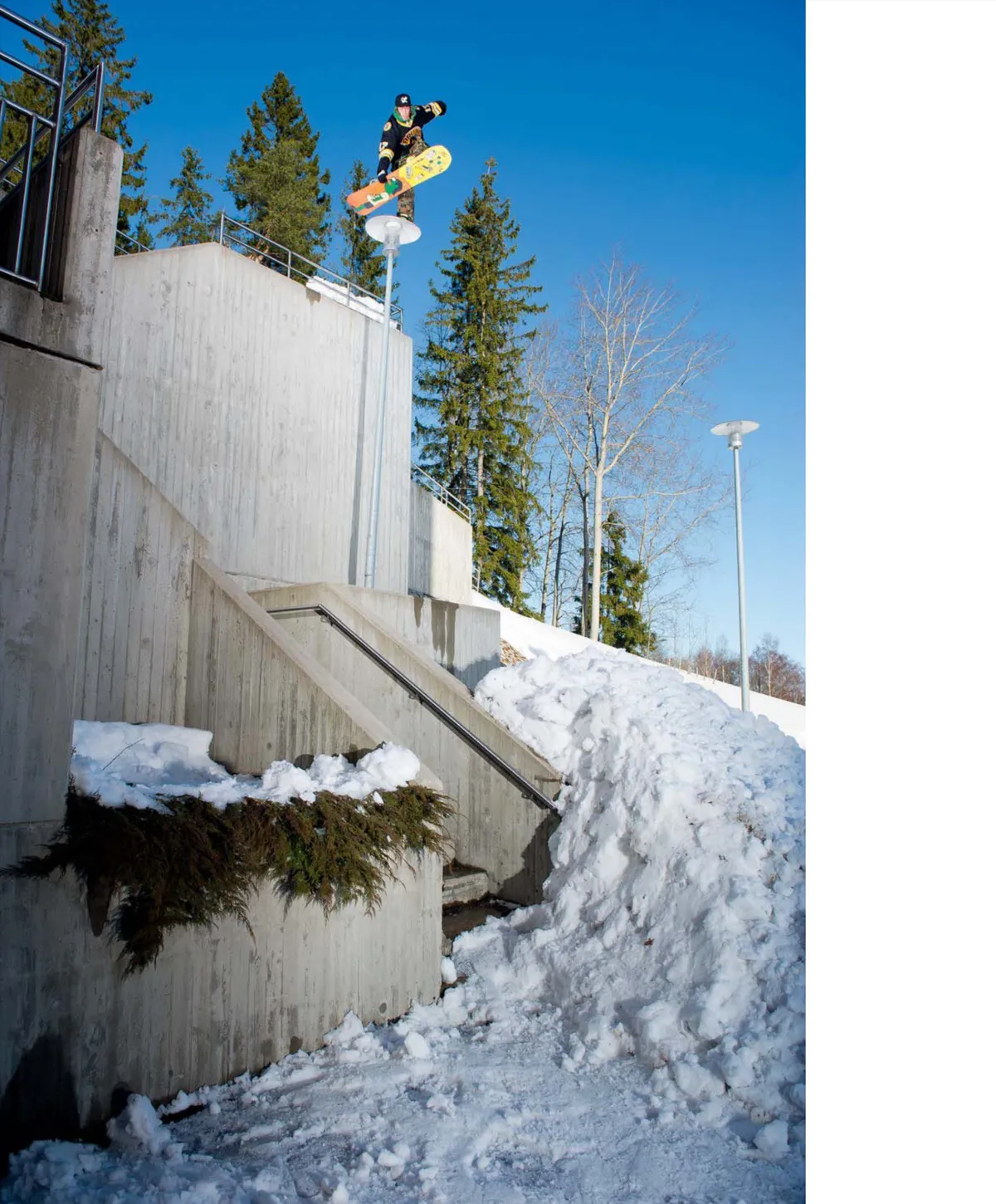
What about when you did the Pull Fart [in 2013]? TJ Schneider was doing online stuff at that time, but the online part wasn’t a standard thing yet. When you film a lot of video parts, it starts to feel redundant, so you want to get away from the norm. I was linking with the Deja Vu crew a lot—we went to Sweden and a few other places. Then I linked with the Absinthe crew for backcountry stuff with Bode [Merrill]. Matt Roberge filmed most of that and then Justin Myers was the one who edited that all together and he did a really good job. At that point I didn’t realize that it was a step forward, but looking back, it was. Now everything is web or Instagram. What’s your take on social media? Social media is a necessary evil for what we do. It gives you this in-stant high—you post something, get excited, get instant gratification from likes and comments, a little endorphin spike. Then it’s pushed down the feed 24 hours later and pretty much forgotten about for the rest of time. Whereas when you film a video part, it’s something that can stand the test of time. It’s more like an album that you can play over and over. When I have kids, I’ll show them a video part, but I’m not gonna pull up an Instagram clip from 2016. There’s no cellphone service at the cabin. We go up there two to three days at a time and work. My general level of stress and hap-piness is way better when compared to being in the city—up there, your interactions are a lot more authentic. People aren’t looking at their phone, trying to film something for social media to put on their story and get instant gratification. It’s a more authentic experience when you enjoy the moment. How did you find the cabin? Alex [Andrews] found it. When he showed me, we were both im-mediately like, “This is it.” The workload would be overwhelming for one person, but having someone else makes it manageable. Alex is the most hard-working guy I know. People get scared of these big projects, but we don’t give ourselves enough credit for what we’re capable of doing. Thinking back, the times when it was the biggest struggle, the worst experience—hot, sweaty, in a dirt pit, building a concrete skate-park—my favorite memories of the whole process is the struggle. It’s given me a different type of gratification from anything I’ve done in snowboarding. It’s a personal achievement. It’s not as hard as you think. We didn’t really know what we were doing, but we went for it and it worked out. Everybody else can do that too; they just gotta get past the fear of doing it and good things will happen. When we started pouring the concrete skatepark, we were intro-duced to a guy named Rob Pikus, who has a concrete company. He said, “You can put it on my tab, you’ll get a much better rate because I buy so much volume—my price per yard is a lot cheaper.” When we got done, I said, “I wanna square up for the concrete,” and he said, “It’s all good, I’m gonna take care of it.” “We rolled up on this spot in Helsinki and found a nice landing all built up for a different feature. It looked like one of the X Games Real Snow athletes had put in some work the night before and, judging from the marks in the snow, had left with a shot in the bag. Chris knew he couldn’t hit the feature the same way as the other rider had and he got the idea to fast plant the top of the street lamp.” Photo: Ethan “E-Stone” Fortier I pretty much started crying—I had already budgeted $20,000 on concrete. I asked if there was anything I could do for him, maybe a logo for his company in the skatepark and he said, “I don’t want anything from you guys. I just think what you guys are doing is cool and I want to be a part of it.” Unconditional giving—that is the ultimate inspiration. He did that for me, and I want to do that for other people now. It’s got a ripple effect, paying it forward. We took this leap of faith and when you dive into the right path, things can just work out. When the passion pours out of you about anything, people generally gravitate toward it. Does it surprise you to see where we’re all at now, 15 years down the road? Looking at where we started from and where we’re at—Bode Merrill, Rider of the Year, he was the goofiest bastard I’ve ever seen. Scott continues to blow minds. You’ve transitioned from snowboarding into a business owner [with Dang Shades]. Granger took a differ-ent route and he’s a master chef. As you get older, we’ve being doing the snowboard thing so long, maybe you can’t go snowboarding one day—you’ve gotta pay bills, mow the lawn, do some life shit. When you’re a kid, all you do is think about snowboarding and skateboard-ing and that’s it—you obsess. As I’ve gotten older, I’m now trying to get back to that state. Sometimes I put everything else aside, let my life fall apart, and just focus on snowboarding. When I go back to that 12-or 15-year-old part of myself where I’m an obsessed little nerd, life’s good. When you start thinking about the patio furniture you gotta buy, the ad-dition on your house, whatever the baloney is you gotta do as an adult—you gotta forget about that sometimes and go back to being a little kid. Then you’re happy. CHRIS GRENIER 081
The Snowboarder's Journal frequency 16.1: Page 81