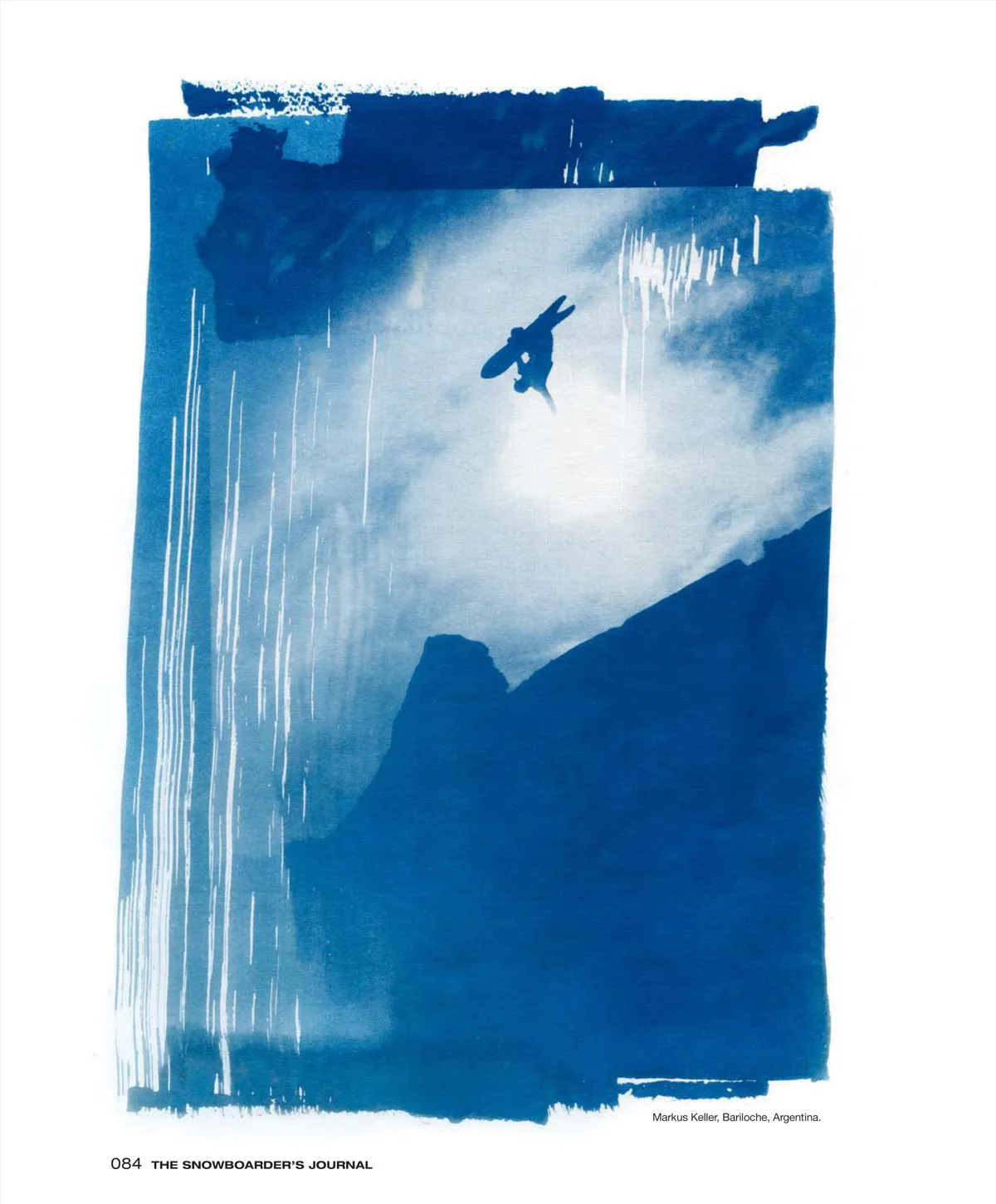
Words and Photos Matt Georges hen shooting snowboarding in the backcountry, we are overwhelmed by a pallet of blue and white. White pow-der, blue sky—the compositional possibilities are end-less, the tones subtle variations on a simple theme. In a cyano-type print, which is also known as a “sunprint,” our subjects are rendered in a blue and white milieu through a process dating back to the 1840s—it’s the ancestor of the photocopier, of the photographic print in general. Once popular with architects and engineers to reproduce blueprints, it’s a low-cost, back-to-the-basics-approach, and it can also provide surprising results. W Since learning to shoot photos 15 years ago, I’ve been curious about different printing processes and have experimented with many meth-ods of transferring negatives onto paper. When I discovered the cya-notype a few years ago, I found its simplicity engaging and surprising at the same time. Simply put, it’s a contact printing process in which a photograph is transferred to paper—or even cotton, wool, and some nonporous surfaces—via a chemical process involving a mixture of the mildly photosensitive chemicals ferric ammonium citrate and potassium fer-ricyanide. These chemicals are applied to the paper sheet, which is then exposed to light in contact with the print surface. You can adjust the tone through subtle manipulation of the chemi-cals, but the final exposure can be a bit of a guessing game because it relies on sunlight. With direct midday light, it takes three or four minutes. When it’s cloudy, maybe 10 minutes or more. Since chemical accidents create a lot of visual accidents, it can quickly become a big mess for the eyes if the original photo has too many details. I generally favor clean compositions and portraits when selecting images for this printing technique, but there are always exceptions to the rule. Every year, I experiment with new-to-me printing techniques, but the cyanotype has held my attention for a while now. I’ve been work-ing on it for two years, and I’ll continue to produce cyanotypes in the future. It’s equal parts frustration in blown prints and happy accidents in white and blue, an antiquated mirror to my current pursuit of snow-board photography. CYANOTYPES 085
The Snowboarder's Journal frequency 16.1: Page 85