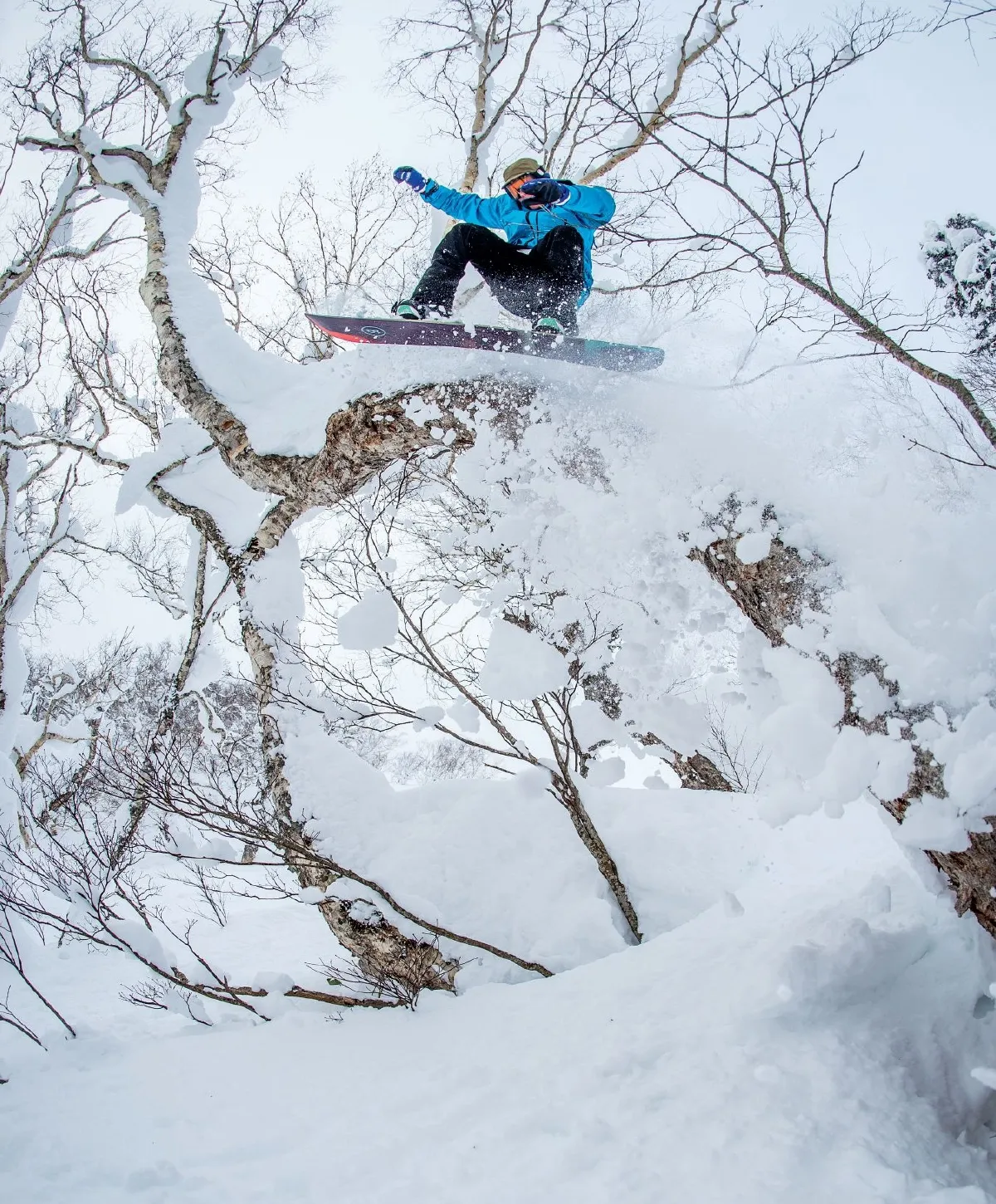
“Beau is one of the most naturally talented snowboarders I’ve ever shot with—the dude lands everything. On this day, we were hiking around Furano on Hokkaido, Japan and found this little area with some downed trees to push up a few kickers. Jake Welch, Dan Liedahl and Beau went to town on it, and Beau wound up with one of the shots of the session.” Photo: Tom Monterosso Claude, the supervisor who’d set him up with the job, took a liking to Beau. “He was this really funny French Canadian dude, who was ba-sically a huge prick to everyone,” Beau says. “But he saw that I worked hard and wasn’t a complete idiot, and he knew the job would let me save money for snowboarding, so he made sure I stuck it out. If I ever complained or showed up hungover, he’d put me in my place. One day I was in pretty rough shape and Claude made me move the 44-foot lad-der from one side of the house to the other by myself. That sucked. But he never sent me home. And going into the next winter with some sav-ings, I was able to snowboard more—that showed me it was worth it.” Soon, Beau was invited on trips, shoots and private sessions. “He joined the Sandbox crew quiet and unassuming,” Kevin Sansalone, Sandbox founder, says. “We didn’t know him too well, but his Ride team manager and some mutual friends gave him the vouch. Our first session with Beau was a heavy one, a big step-down in the Whistler backcountry, filming with a heli. Beau stepped up and stomped four bangers including a double backflip and a cab 9, first try, with all the stress and noise that comes with high-pressure heli shoots. Those riding skills combined with his work ethic and easy-going, humble attitude instantly made Beau one of our favorite riders to have on the crew.” “Goals were becoming realities,” Beau says. “I was like, ‘This might happen—I might actually be able to make this work.’” Then came the crash. It was early March 2011, and Beau was film-ing for Sandbox. He’d been on until that point, his early season footage earning him a shared part. But the knuckle of the notorious Hurley Road Gap in Pemberton, BC ended his season. On the first hit of the session, Beau tried a backside 720 and came up short. The 50-foot fall to flat broke his back and shattered his right heel. The footage is in Sandbox’s Day and Age —Beau’s scream tells the story. Beau thought his pro-snowboarding career was over. He moved back to Ontario and went to Seneca College to study business market-ing. He picked up useful skills in his classes, but it was his rehabilita-tion work with physiotherapist Jesse Awenus that proved pivotal. Jesse convinced the then-25-year-old Beau he could recover. “He was like, ‘You can get better. You’re going to be OK—we just need to work hard and rehab it properly,’” Beau says. “I owe him a lot.” Beau put in the hours—he figures his rehab ran a loss for Jesse’s clinic. “They couldn’t get rid of me. They gave me a monthly mem-bership, which they probably regretted—I’m sure I burned through way more than they charged me in hydro. I had their treadmill pool running for hours.” By the end of his first semester, Beau had decided to move back to Whistler. Doctors warned he might cause permanent, debilitating damage to his ankle. Even his dad questioned Beau’s return to snow-boarding. “He just figured I was lucky not to be paralyzed,” Beau says. “He was—and still is—concerned I might have another big crash. But when he saw how much I wanted it, he got behind it—he knows it’s my life, and he respected my choice.” Beau’s mom, a paramedic, understood the risks. She’d been at his side a day after the injury. Still, she backed his decision. Within a year of returning to Whistler, Beau was stacking for Snow-board Canada’s Glimpse (2013). His part showed he had what it takes to film for a major production company, but the majors were folding. It was a time of transition, when Whistler’s top riders were forming their own crews in response to the changing industry. Beau worked with Trevan Salmon, Andrew Burns and filmer Dave Craig to put out “Turn & Burn.” The series featured boarding from Japan to Alaska built around aggressive Whistler freestyle and lasted from 2014-2017. Beau continued restoring log homes during the summer. He was closing in on a decade at the job when his boss decided to call it quits. “He had reached a point where he needed to leave Whistler and he wanted somebody to take over the company,” Beau says. “He got a few of us together and was like, ‘I want one of you to keep it going.’ It was a hard choice, but I knew it was an insane opportunity, and I knew I could do it. I called my dad and he was like, ‘It’s a no-brainer,’ so I decided to go for it. My old boss was like, ‘We can figure it out. If it takes you five years to pay me, that’s OK.’ And that’s pretty much what I did. It was the nicest thing anyone’s ever done.” His first two summers as owner, Beau worked seven days a week. Ten-hour shifts were bookended by administrative work. But Beau knew the program: Work now, snowboard later. He was setting himself up to be in it for life. 050 THE SNOWBOARDER’S JOURNAL
The Snowboarder's Journal frequency 17.1: Page 50