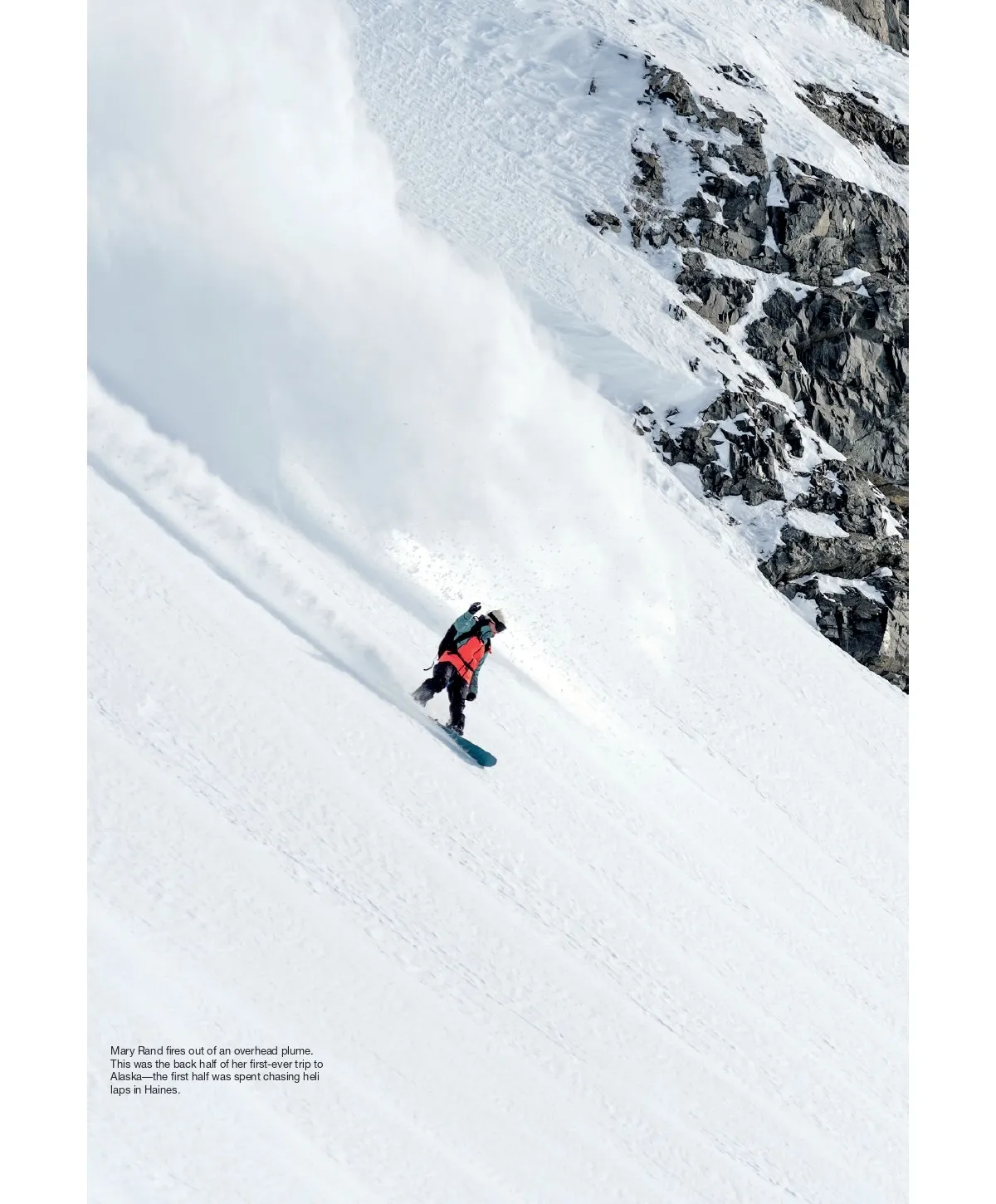
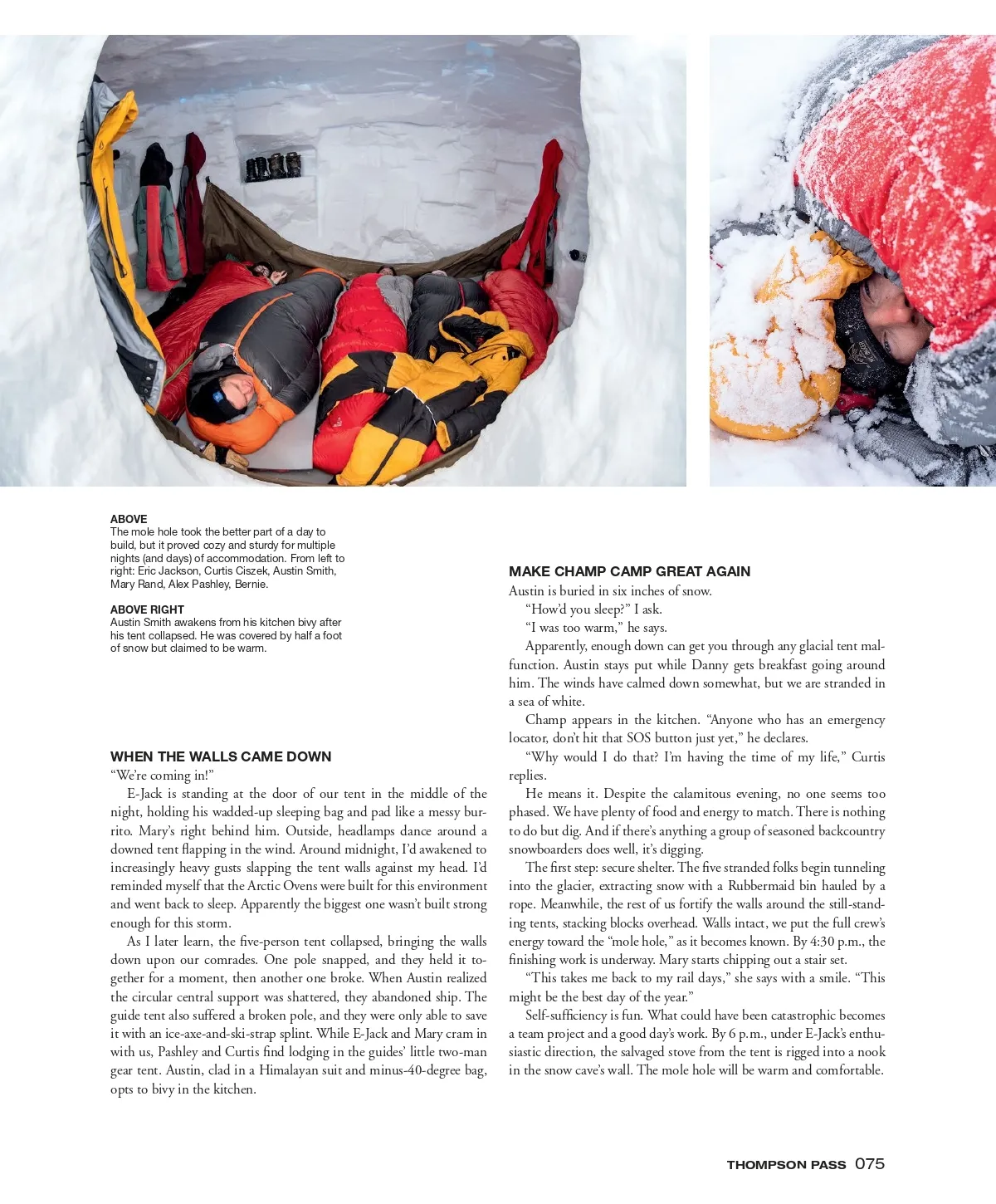
ABOVE The mole hole took the better part of a day to build, but it proved cozy and sturdy for multiple nights (and days) of accommodation. From left to right: Eric Jackson, Curtis Ciszek, Austin Smith, Mary Rand, Alex Pashley, Bernie. ABOVE RIGHT Austin Smith awakens from his kitchen bivy after his tent collapsed. He was covered by half a foot of snow but claimed to be warm. WHEN THE WALLS CAME DOWN “We’re coming in!” E-Jack is standing at the door of our tent in the middle of the night, holding his wadded-up sleeping bag and pad like a messy bur-rito. Mary’s right behind him. Outside, headlamps dance around a downed tent flapping in the wind. Around midnight, I’d awakened to increasingly heavy gusts slapping the tent walls against my head. I’d reminded myself that the Arctic Ovens were built for this environment and went back to sleep. Apparently the biggest one wasn’t built strong enough for this storm. As I later learn, the five-person tent collapsed, bringing the walls down upon our comrades. One pole snapped, and they held it to-gether for a moment, then another one broke. When Austin realized the circular central support was shattered, they abandoned ship. The guide tent also suffered a broken pole, and they were only able to save it with an ice-axe-and-ski-strap splint. While E-Jack and Mary cram in with us, Pashley and Curtis find lodging in the guides’ little two-man gear tent. Austin, clad in a Himalayan suit and minus-40-degree bag, opts to bivy in the kitchen. MAKE CHAMP CAMP GREAT AGAIN Austin is buried in six inches of snow. “How’d you sleep?” I ask. “I was too warm,” he says. Apparently, enough down can get you through any glacial tent mal-function. Austin stays put while Danny gets breakfast going around him. The winds have calmed down somewhat, but we are stranded in a sea of white. Champ appears in the kitchen. “Anyone who has an emergency locator, don’t hit that SOS button just yet,” he declares. “Why would I do that? I’m having the time of my life,” Curtis replies. He means it. Despite the calamitous evening, no one seems too phased. We have plenty of food and energy to match. There is nothing to do but dig. And if there’s anything a group of seasoned backcountry snowboarders does well, it’s digging. The first step: secure shelter. The five stranded folks begin tunneling into the glacier, extracting snow with a Rubbermaid bin hauled by a rope. Meanwhile, the rest of us fortify the walls around the still-stand-ing tents, stacking blocks overhead. Walls intact, we put the full crew’s energy toward the “mole hole,” as it becomes known. By 4:30 p.m., the finishing work is underway. Mary starts chipping out a stair set. “This takes me back to my rail days,” she says with a smile. “This might be the best day of the year.” Self-sufficiency is fun. What could have been catastrophic becomes a team project and a good day’s work. By 6 p.m., under E-Jack’s enthu-siastic direction, the salvaged stove from the tent is rigged into a nook in the snow cave’s wall. The mole hole will be warm and comfortable. THOMPSON PASS 075
The Snowboarder's Journal frequency 17.2: Page 75