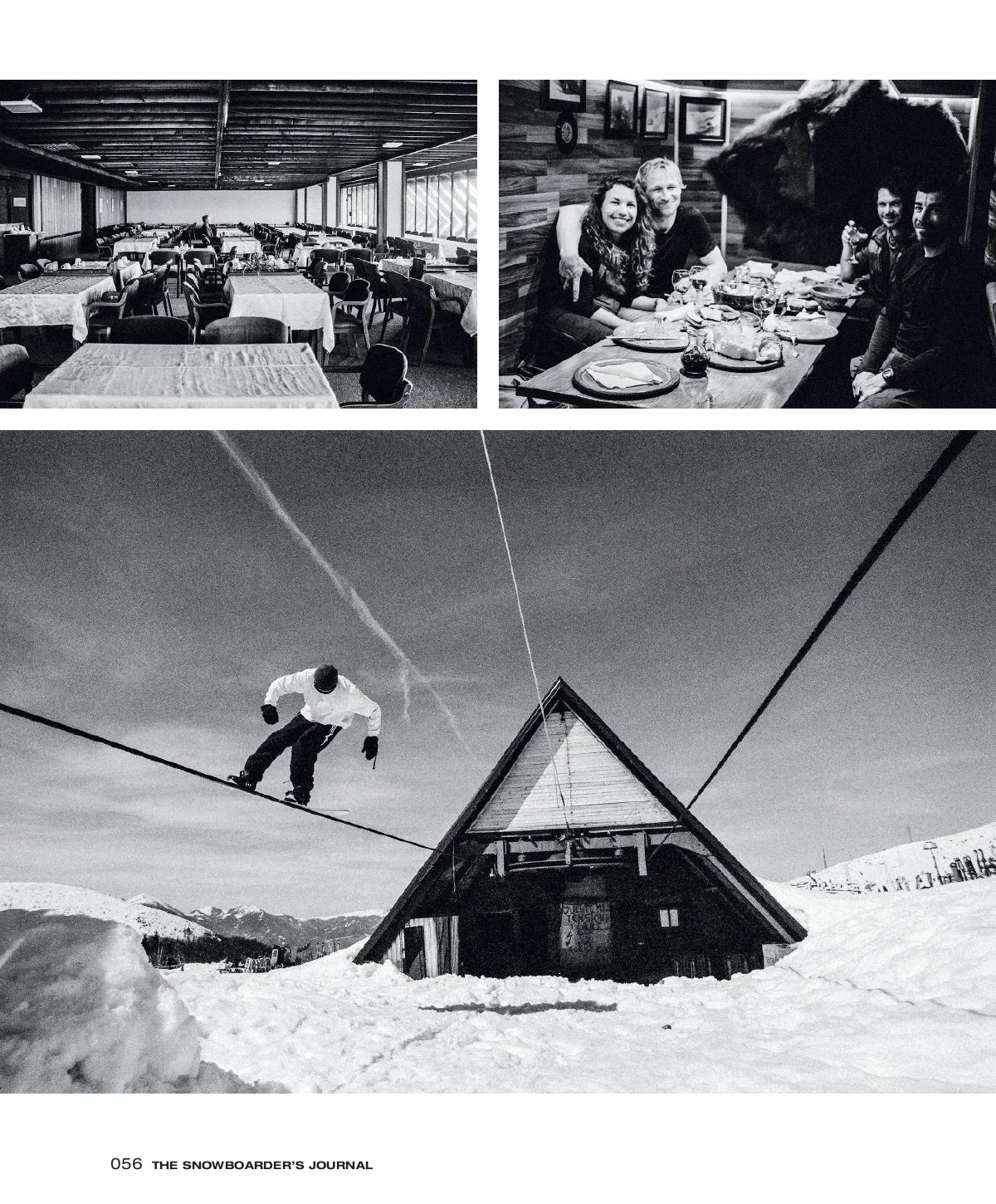
CLOCKWISE FROM TOP LEFT The dining hall at the Hotel Molika. Mostly empty now with a few old men serving occasional customers, it was full of life 30 years ago. Big, cold and lonely, it’s a time capsule from a different era at Brezovica. The crew’s last dinner, cooked by Tina, who owns a local restaurant. She served far more traditional food than anyone could finish. Alex Tank utilizes the cable of a lift that hasn’t run for decades, bringing new life to abandoned infrastructure. LIKE MANY BALKAN NATIONS, the Republic of Kosovo is still recovering from recent conflict. Shoehorned between Albania and North Macedonia to the south, Serbia to the east and north, and Mon-tenegro to the west, Kosovo is officially in limbo, with 100 out of 193 UN nations diplomatically recognizing its sovereignty as of press time. Following a vicious war in 1998 and 1999, the country finally gained independence from Serbia in the early 2010s. In a near-century-long string of complex geopolitical maneuvring, Kosovo once belonged to Yugoslavia, a socialist conglomeration of six ethnically diverse states that existed under multiple names and consti-tutions from 1918 until the early 1990s, when a series of conflicts re-sulted in the dissolution of the overarching government in 2001. This fragmentation led to a protectionist cultural mindset among the former Yugoslavian countries. And although the war ended via NATO interven-tion, a great division within the region remained. While much of Kosovo is populated by those identifying as Albanian, it is also home to Serb nationals. With the war still fresh in many residents’ minds, it can be dif-ficult for disagreeing parties to find common ground. Continuing our drive toward Brezovica, we passed towns draped in flags to indicate their identity. Serbian flags marked Serbian majority towns, which might not accept the Euro as official currency or recognise Kosovo as an independent state. The next town, coloured in red and adorned with the black double-headed eagle, might indicate an Albanian majority. On the final stretch to Brezovica, at the foot of the mountain, sit both a Serb town and an Albanian town. That was where the flags ended. We ascended the mountain, dodging ever-present potholes, and pulled into a makeshift parking lot. With 10-plus feet of snow on the ground, many cars were buried and wouldn’t be coming out for the rest of the season. Others were completely blocked in, with phone numbers left on their windshields in case they needed to be let out. Although we spotted a license plate from Innsbruck, Austria, there were few signs of international visitors outside of our group. The couple hundred visitors at the resort gave us a fashion show spanning bright, ’80s-era retro ski wear to upmarket garb commonly found on mountains in Europe and in the States. However, many riders took to the snow in jeans and casual winter clothes. The young men who offered a snowmobile taxi service from the parking lot to the lifts wore military-styled camo and flat-brimmed baseball hats. Above us, the resort spread out over 10 miles of marked trails, with access to the remote, windlip-strewn backcountry of Sharr Mountain National Park behind it. Once a flourishing mountain retreat, the resort’s ownership has been under contention since the war, and there have been no major investments in infrastructure, leaving the place to become what feels like a time capsule. Abandoned chairlifts lay crumpled and rusting alongside the slopes. The two operating double chairlifts were fitted with wooden benches and simple pull-down bars. Some were missing slats in the seat. Powered by a temperamental gen-erator, they slowly made the 15-minute journey to the summit. At the base sat a couple of recently renovated huts offering accommodation and food. We stepped inside and found hand-carved seats resembling horses. Outside, informal vendors sold beer and soft drinks from a snowbank. Surrounded by friendly chatter, it felt like its own little world beyond the turmoil of Kosovan politics. Along with the huts, there are two main hotels still operating to some degree. Six-story Hotel Molika stands alone atop the mountain, dominating the landscape. At the foot of the mountain, the larger Hotel Narcis evokes another era with its grand, sweeping concrete ar-chitecture that hearkens back to Soviet modernist design. Both hotels are semi-abandoned and haven’t been renovated since the war—they still have ashtrays mounted next to the toilets. KOSOVO 057
The Snowboarder's Journal frequency 17.4: Page 59