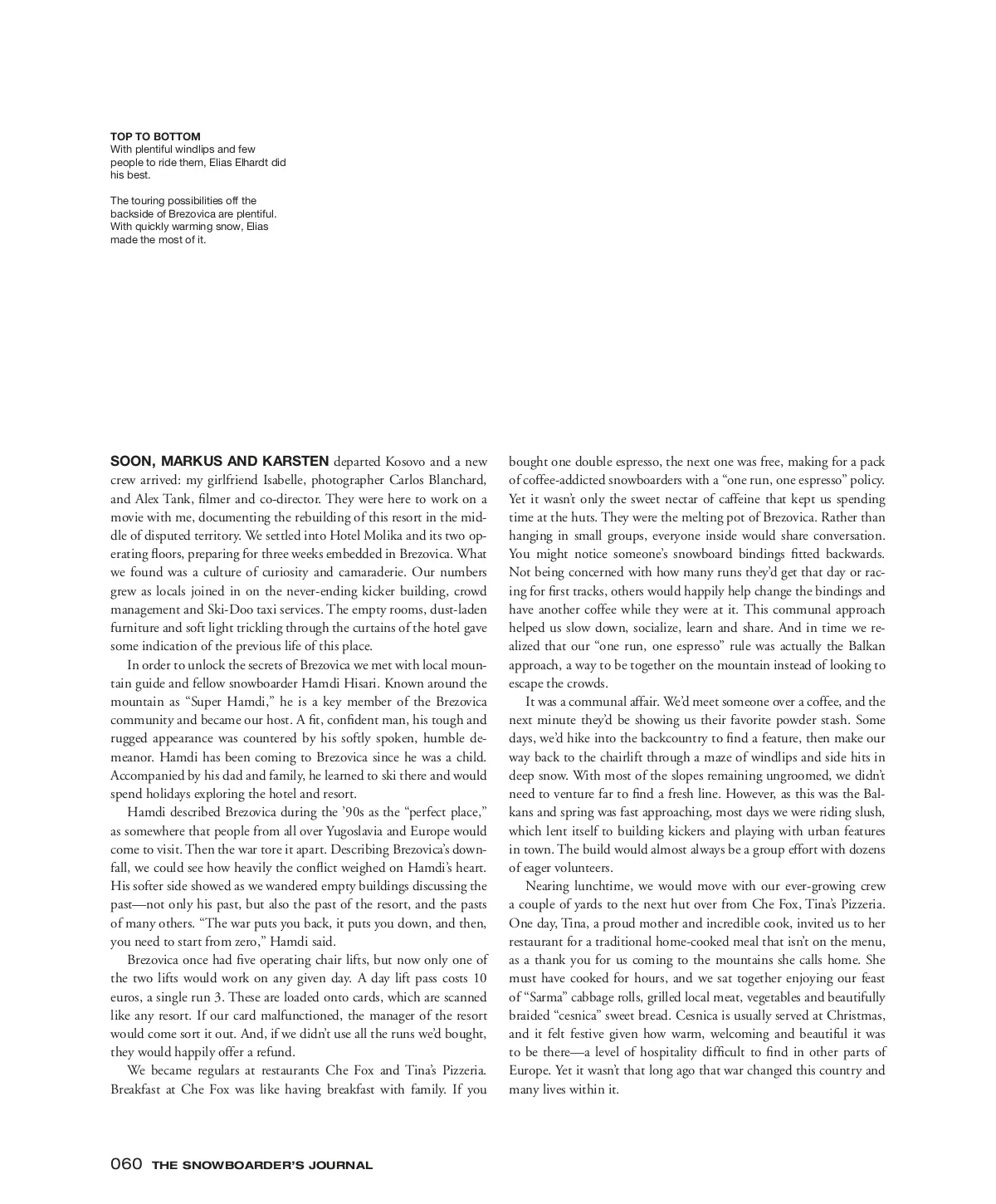
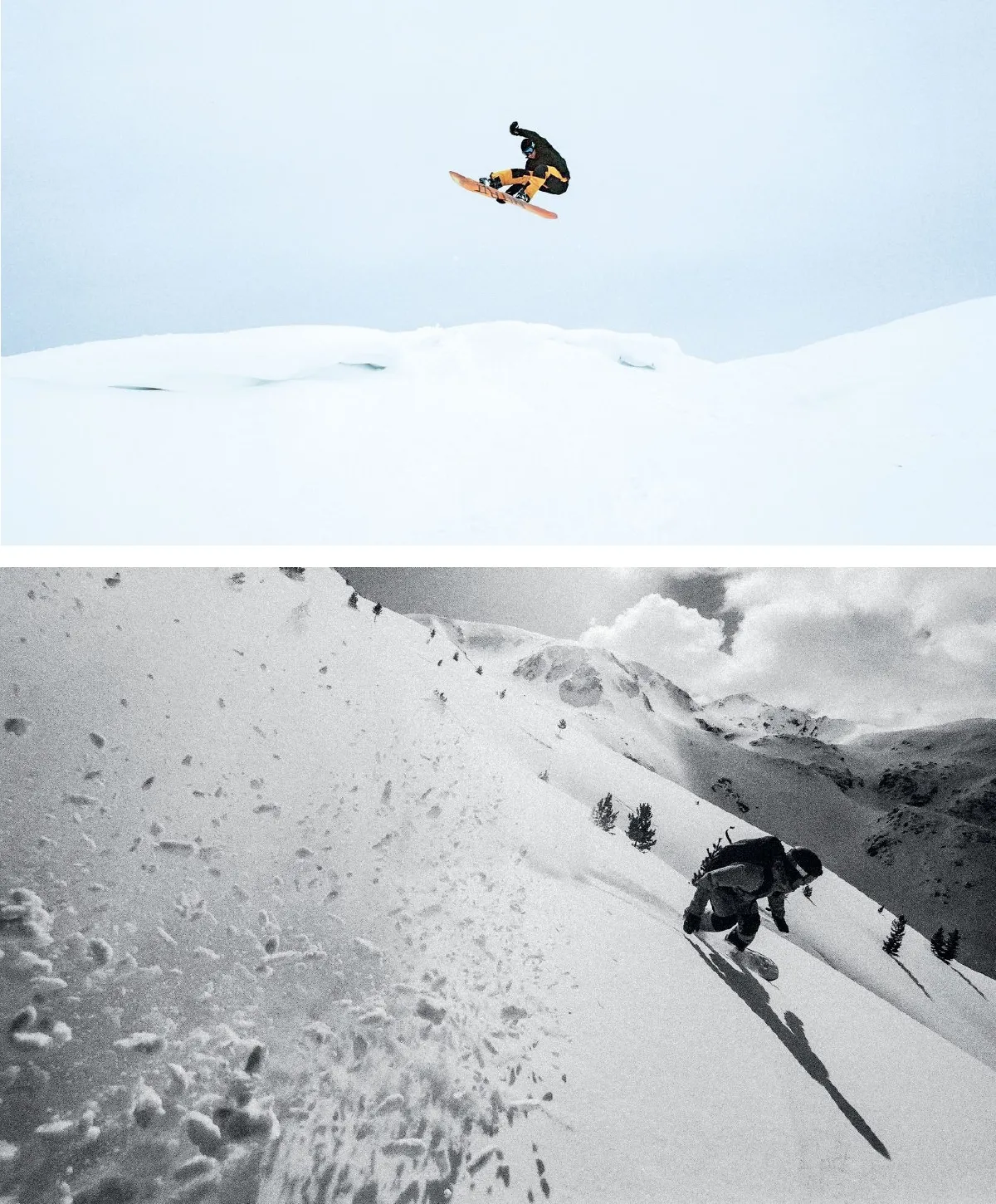
TOP TO BOTTOM With plentiful windlips and few people to ride them, Elias Elhardt did his best. The touring possibilities off the backside of Brezovica are plentiful. With quickly warming snow, Elias made the most of it. SOON, MARKUS AND KARSTEN departed Kosovo and a new crew arrived: my girlfriend Isabelle, photographer Carlos Blanchard, and Alex Tank, filmer and co-director. They were here to work on a movie with me, documenting the rebuilding of this resort in the mid-dle of disputed territory. We settled into Hotel Molika and its two op-erating floors, preparing for three weeks embedded in Brezovica. What we found was a culture of curiosity and camaraderie. Our numbers grew as locals joined in on the never-ending kicker building, crowd management and Ski-Doo taxi services. The empty rooms, dust-laden furniture and soft light trickling through the curtains of the hotel gave some indication of the previous life of this place. In order to unlock the secrets of Brezovica we met with local moun-tain guide and fellow snowboarder Hamdi Hisari. Known around the mountain as “Super Hamdi,” he is a key member of the Brezovica community and became our host. A fit, confident man, his tough and rugged appearance was countered by his softly spoken, humble de-meanor. Hamdi has been coming to Brezovica since he was a child. Accompanied by his dad and family, he learned to ski there and would spend holidays exploring the hotel and resort. Hamdi described Brezovica during the ’90s as the “perfect place,” as somewhere that people from all over Yugoslavia and Europe would come to visit. Then the war tore it apart. Describing Brezovica’s down-fall, we could see how heavily the conflict weighed on Hamdi’s heart. His softer side showed as we wandered empty buildings discussing the past—not only his past, but also the past of the resort, and the pasts of many others. “The war puts you back, it puts you down, and then, you need to start from zero,” Hamdi said. Brezovica once had five operating chair lifts, but now only one of the two lifts would work on any given day. A day lift pass costs 10 euros, a single run 3. These are loaded onto cards, which are scanned like any resort. If our card malfunctioned, the manager of the resort would come sort it out. And, if we didn’t use all the runs we’d bought, they would happily offer a refund. We became regulars at restaurants Che Fox and Tina’s Pizzeria. Breakfast at Che Fox was like having breakfast with family. If you bought one double espresso, the next one was free, making for a pack of coffee-addicted snowboarders with a “one run, one espresso” policy. Yet it wasn’t only the sweet nectar of caffeine that kept us spending time at the huts. They were the melting pot of Brezovica. Rather than hanging in small groups, everyone inside would share conversation. You might notice someone’s snowboard bindings fitted backwards. Not being concerned with how many runs they’d get that day or rac-ing for first tracks, others would happily help change the bindings and have another coffee while they were at it. This communal approach helped us slow down, socialize, learn and share. And in time we re-alized that our “one run, one espresso” rule was actually the Balkan approach, a way to be together on the mountain instead of looking to escape the crowds. It was a communal affair. We’d meet someone over a coffee, and the next minute they’d be showing us their favorite powder stash. Some days, we’d hike into the backcountry to find a feature, then make our way back to the chairlift through a maze of windlips and side hits in deep snow. With most of the slopes remaining ungroomed, we didn’t need to venture far to find a fresh line. However, as this was the Bal-kans and spring was fast approaching, most days we were riding slush, which lent itself to building kickers and playing with urban features in town. The build would almost always be a group effort with dozens of eager volunteers. Nearing lunchtime, we would move with our ever-growing crew a couple of yards to the next hut over from Che Fox, Tina’s Pizzeria. One day, Tina, a proud mother and incredible cook, invited us to her restaurant for a traditional home-cooked meal that isn’t on the menu, as a thank you for us coming to the mountains she calls home. She must have cooked for hours, and we sat together enjoying our feast of “Sarma” cabbage rolls, grilled local meat, vegetables and beautifully braided “cesnica” sweet bread. Cesnica is usually served at Christmas, and it felt festive given how warm, welcoming and beautiful it was to be there—a level of hospitality difficult to find in other parts of Europe. Yet it wasn’t that long ago that war changed this country and many lives within it. 060 THE SNOWBOARDER’S JOURNAL
The Snowboarder's Journal frequency 17.4: Page 62