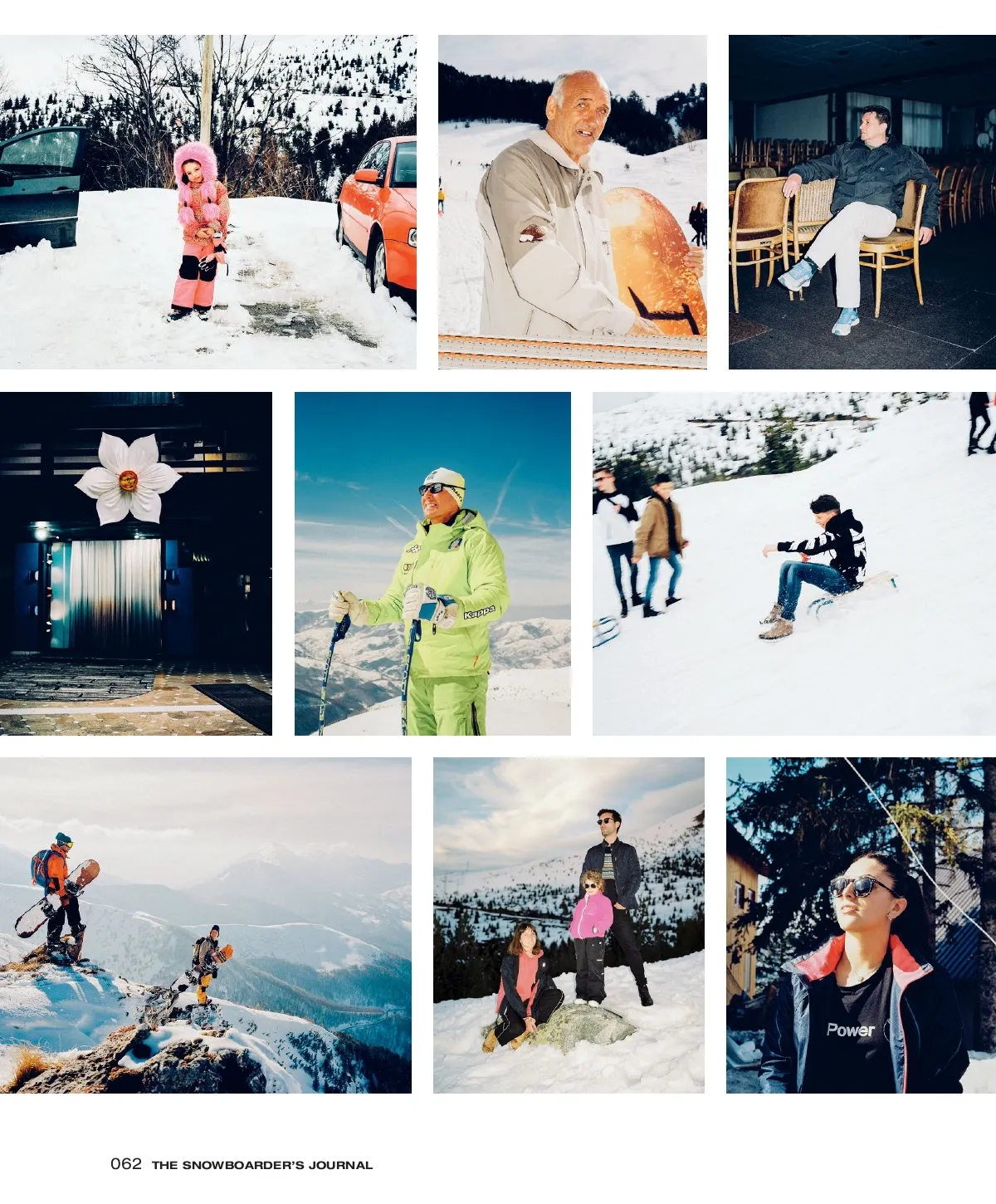
CLOCKWISE FROM TOP LEFT A member of the next generation finding a simple and joyful moment above the politics of Kosovo. Will she be the one to revive the resort in the future? Elias´ advanced snowboarding stu-dent greeted the crew every morning from his small ski rental stand. The former cook of the Hotel Narcis hasn’t had work there in years, but he still cares for his space. Sleds are the main attraction for day-tripping tourists and students from the area. A young local woman displays her “power.” With adversity fading, there is hope for Kosovo’s future. A family portrait: humble and strong people who are full of cheer. Local guide Hamdi Hisari and Elias take a moment before dropping into their last run of the day. After a big storm hit the area, everyone came out to ride the powder. With Hamdi´s local knowledge, the turns were fresh and plentiful. A big Narcis flower greets you when you enter the eponymous hotel, which is now abandoned. “Narcis” is the name of the first flower that blooms after winter, and also the name of the movie Elias and friends made during their stay. To Elias, it’s a metaphor of Kosovo’s continu-ing emergence and recovery from conflict as it relates to Brezovica. Some visitors to Bresovica are dressed in the latest European fashion—this man sported an Italian Ski Team kit. MANY PEOPLE WE TALKED to remembered the former Yugosla-via as a construct much like the European Union. It made me wonder if the current rise of nationalism in Europe and the division between the countries could also dramatically change our futures as it has in the Balkans. The first cost of this shift is closed-mindedness to diversity. No longer can people of varying ethnicities and religions gather in openness and acceptance. Yet at Brezovica we met travellers from across the region. Whether identifying as Albanian or Serbian, or visiting from another of the for-mer Yugoslavian states, they let down their guard and simply enjoyed time in the snow together. We met a man named Benjamin who works for the German government in rural development in the Balkans. He is also a keen backcountry rider and regular at Brezovica. One morning, we set out on splitboards, following bear tracks we thought were snowshoe tracks. During the walk, Benjamin explained the Balkan way. “They weren’t a Western capitalistic country, not an Eastern communistic country—they defined their very own development path,” he said. “Together with a couple of mostly African countries, they developed a movement of a third way… a social market economy. Yugoslavia was very open, very international, people used to follow the fashions. Skiing was one of them. And that’s why nowadays we see some quite old infrastructure from those days. In a way, I find it very symbolic for the country.” Although the divisions that arose from nationalistic ideology tore this path apart, there remains a meeting point where cultural differ-ences can be set aside in the name of enjoying the mountains. There are rumors of investors who will bring modern trappings to the resort, but for now, it is a simple, welcoming place for people from all walks of life. There is a world encapsulated at Brezovica that is determined to leave the past behind. There, snow culture supersedes religion and ethnicity. There, the people of Kosovo find common ground. KOSOVO 063
The Snowboarder's Journal frequency 17.4: Page 65