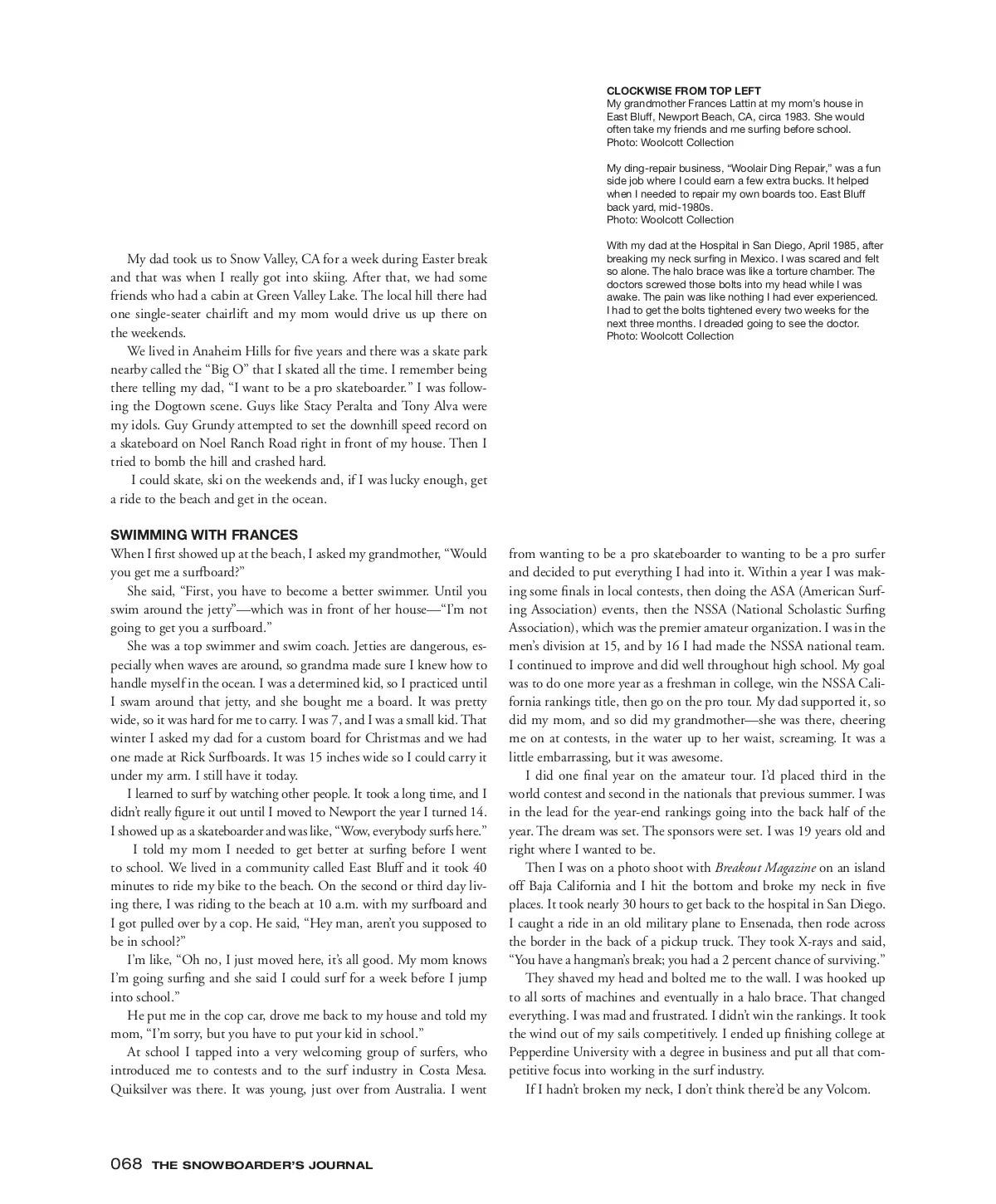
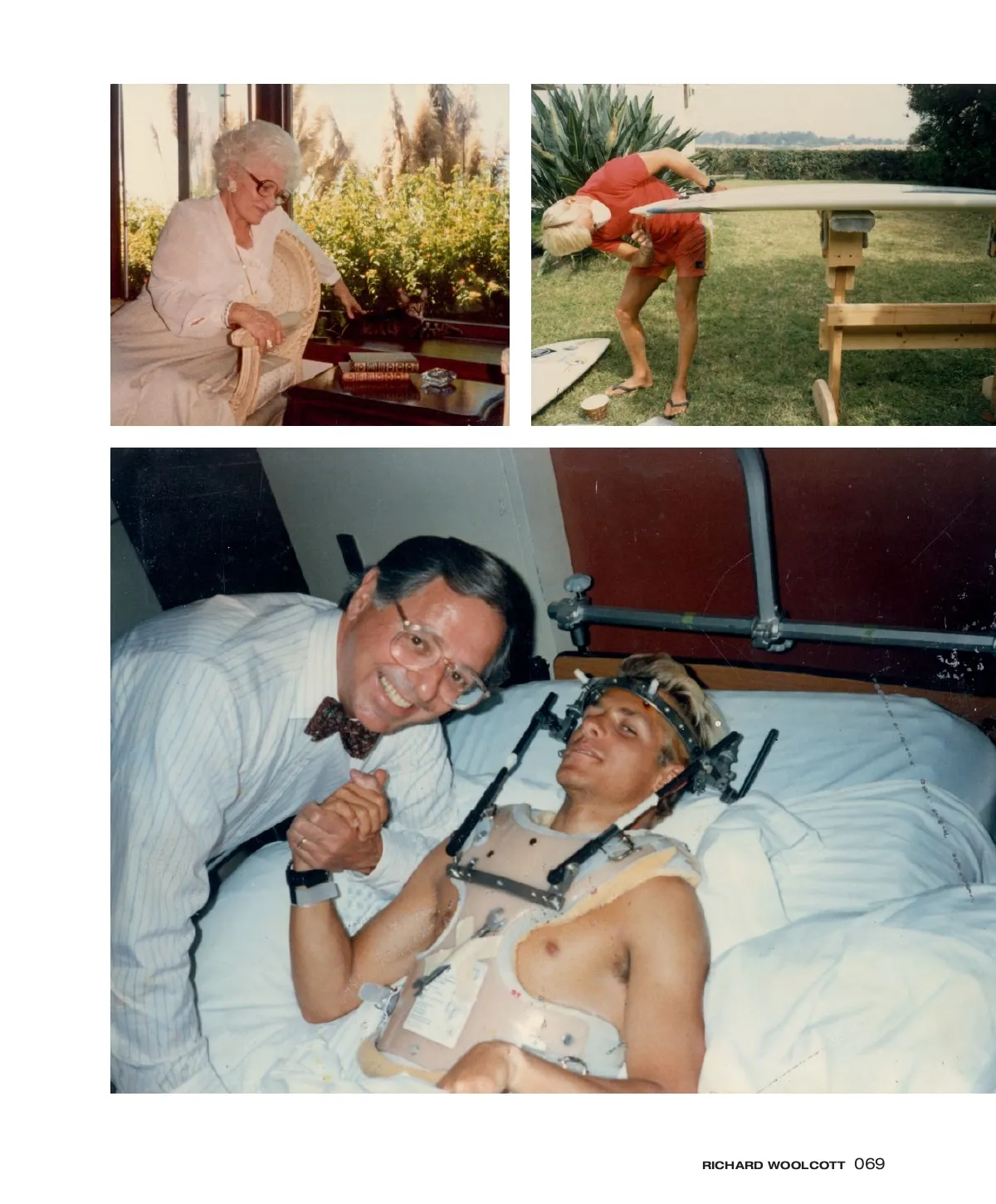
CLOCKWISE FROM TOP LEFT 4`NYHUKTV[OLY-YHUJLZ3H[[PUH[T`TVT»ZOV\ZLPU ,HZ[)S\Ɉ 5L^WVY[)LHJO *( JPYJH f;a;:OL^V\SK VM[LU[HRLT`MYPLUKZHUKTLZ\YÄUNILMVYLZJOVVS 7OV[V!>VVSJV[[*VSSLJ[PVU 4`KPUNYLWHPYI\ZPULZZ ¸>VVSHPY+PUN9LWHPY ¹^HZHM\U ZPKLQVI^OLYL0JV\SKLHYUHML^L_[YHI\JRZ0[OLSWLK ^OLU0ULLKLK[VYLWHPYT`V^UIVHYKZ[VV,HZ[)S\Ɉ IHJR`HYK TPK f;Z 7OV[V!>VVSJV[[*VSSLJ[PVU My dad took us to Snow Valley, CA for a week during Easter break and that was when I really got into skiing. After that, we had some friends who had a cabin at Green Valley Lake. The local hill there had one single-seater chairlift and my mom would drive us up there on the weekends. We lived in Anaheim Hills for five years and there was a skate park nearby called the “Big O” that I skated all the time. I remember being there telling my dad, “I want to be a pro skateboarder.” I was follow-ing the Dogtown scene. Guys like Stacy Peralta and Tony Alva were my idols. Guy Grundy attempted to set the downhill speed record on a skateboard on Noel Ranch Road right in front of my house. Then I tried to bomb the hill and crashed hard. I could skate, ski on the weekends and, if I was lucky enough, get a ride to the beach and get in the ocean. SWIMMING WITH FRANCES When I first showed up at the beach, I asked my grandmother, “Would you get me a surfboard?” She said, “First, you have to become a better swimmer. Until you swim around the jetty”—which was in front of her house—“I’m not going to get you a surfboard.” She was a top swimmer and swim coach. Jetties are dangerous, es-pecially when waves are around, so grandma made sure I knew how to handle myself in the ocean. I was a determined kid, so I practiced until I swam around that jetty, and she bought me a board. It was pretty wide, so it was hard for me to carry. I was 7, and I was a small kid. That winter I asked my dad for a custom board for Christmas and we had one made at Rick Surfboards. It was 15 inches wide so I could carry it under my arm. I still have it today. I learned to surf by watching other people. It took a long time, and I didn’t really figure it out until I moved to Newport the year I turned 14. I showed up as a skateboarder and was like, “Wow, everybody surfs here.” I told my mom I needed to get better at surfing before I went to school. We lived in a community called East Bluff and it took 40 minutes to ride my bike to the beach. On the second or third day liv-ing there, I was riding to the beach at 10 a.m. with my surfboard and I got pulled over by a cop. He said, “Hey man, aren’t you supposed to be in school?” I’m like, “Oh no, I just moved here, it’s all good. My mom knows I’m going surfing and she said I could surf for a week before I jump into school.” He put me in the cop car, drove me back to my house and told my mom, “I’m sorry, but you have to put your kid in school.” At school I tapped into a very welcoming group of surfers, who introduced me to contests and to the surf industry in Costa Mesa. Quiksilver was there. It was young, just over from Australia. I went >P[OT`KHKH[[OL/VZWP[HSPU:HU+PLNV (WYPS f;c; HM[LY IYLHRPUNT`ULJRZ\YÄUNPU4L_PJV0^HZZJHYLKHUKMLS[ ZVHSVUL;OLOHSVIYHJL^HZSPRLH[VY[\YLJOHTILY;OL KVJ[VYZZJYL^LK[OVZLIVS[ZPU[VT`OLHK^OPSL0^HZ H^HRL;OLWHPU^HZSPRLUV[OPUN0OHKL]LYL_WLYPLUJLK 0OHK[VNL[[OLIVS[Z[PNO[LULKL]LY`[^V^LLRZMVY[OL UL_[[OYLLTVU[OZ0KYLHKLKNVPUN[VZLL[OLKVJ[VY 7OV[V!>VVSJV[[*VSSLJ[PVU from wanting to be a pro skateboarder to wanting to be a pro surfer and decided to put everything I had into it. Within a year I was mak-ing some finals in local contests, then doing the ASA (American Surf-ing Association) events, then the NSSA (National Scholastic Surfing Association), which was the premier amateur organization. I was in the men’s division at 15, and by 16 I had made the NSSA national team. I continued to improve and did well throughout high school. My goal was to do one more year as a freshman in college, win the NSSA Cali-fornia rankings title, then go on the pro tour. My dad supported it, so did my mom, and so did my grandmother—she was there, cheering me on at contests, in the water up to her waist, screaming. It was a little embarrassing, but it was awesome. I did one final year on the amateur tour. I’d placed third in the world contest and second in the nationals that previous summer. I was in the lead for the year-end rankings going into the back half of the year. The dream was set. The sponsors were set. I was 19 years old and right where I wanted to be. Then I was on a photo shoot with Breakout Magazine on an island off Baja California and I hit the bottom and broke my neck in five places. It took nearly 30 hours to get back to the hospital in San Diego. I caught a ride in an old military plane to Ensenada, then rode across the border in the back of a pickup truck. They took X-rays and said, “You have a hangman’s break; you had a 2 percent chance of surviving.” They shaved my head and bolted me to the wall. I was hooked up to all sorts of machines and eventually in a halo brace. That changed everything. I was mad and frustrated. I didn’t win the rankings. It took the wind out of my sails competitively. I ended up finishing college at Pepperdine University with a degree in business and put all that com-petitive focus into working in the surf industry. If I hadn’t broken my neck, I don’t think there’d be any Volcom. 068 THE SNOWBOARDER’S JOURNAL
The Snowboarder's Journal frequency 17.4: Page 70