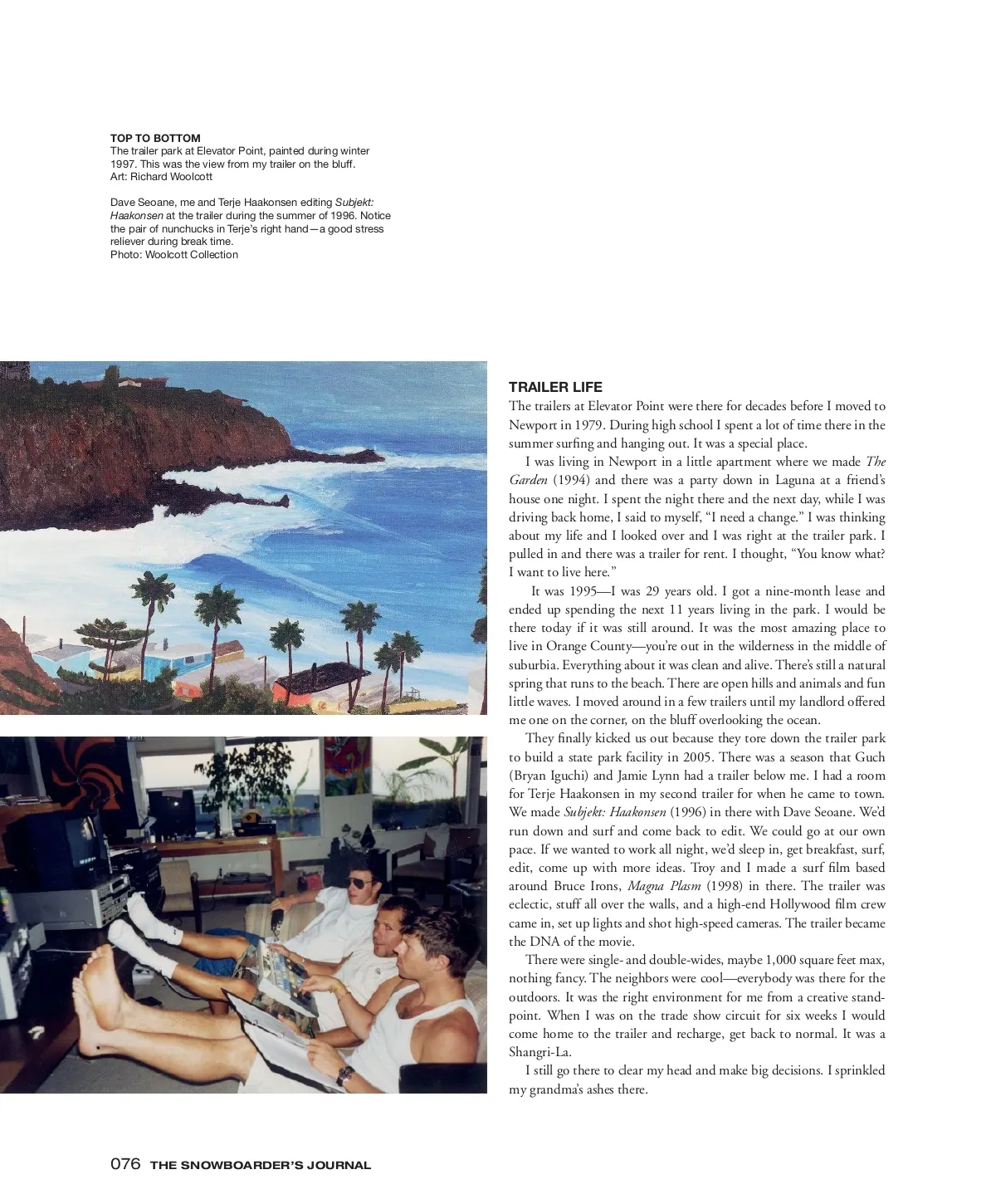
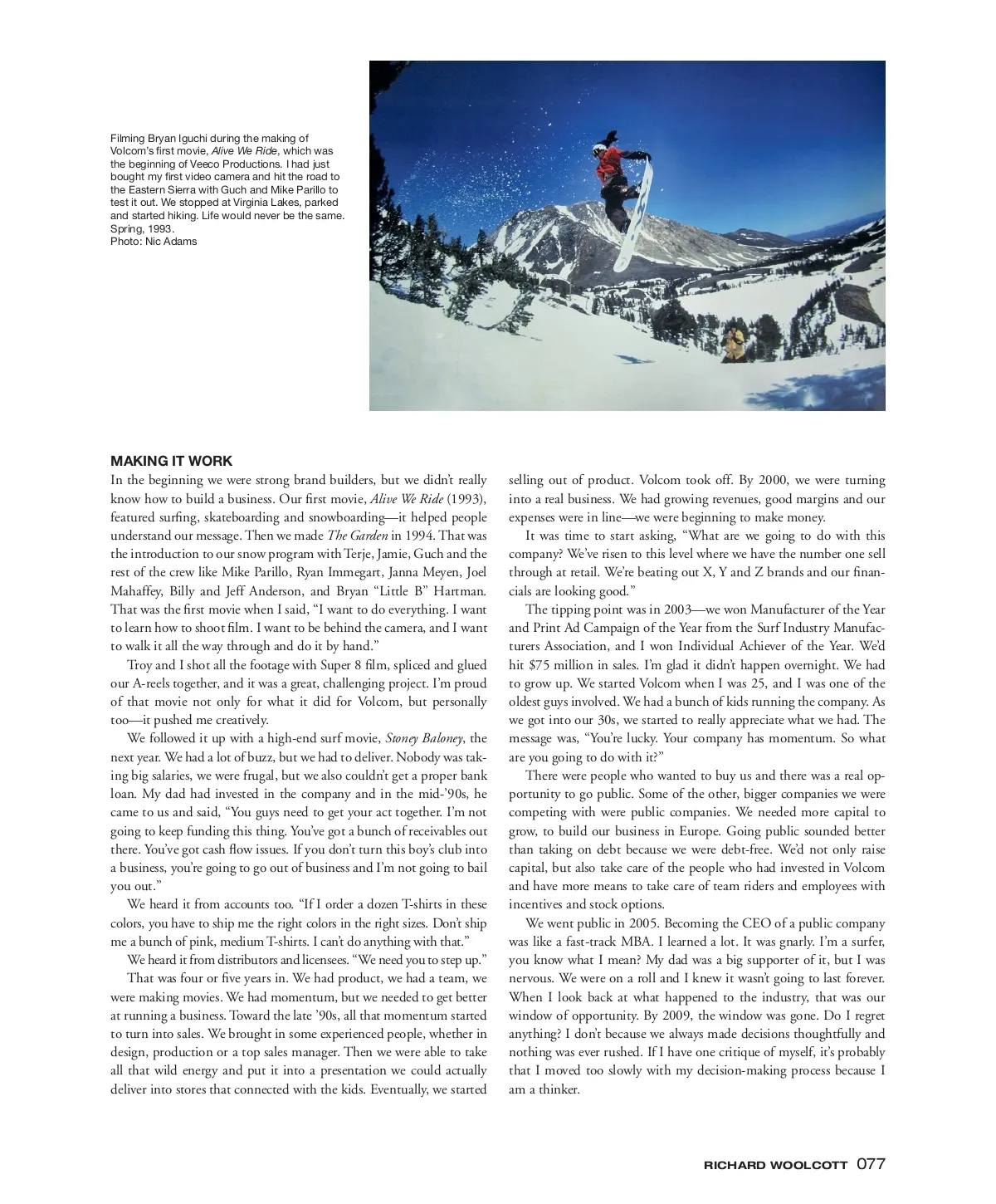
-PSTPUN)Y`HU0N\JOPK\YPUN[OLTHRPUNVM =VSJVT»ZÄYZ[TV]PL  Alive We Ride ^OPJO^HZ the beginning of Veeco Productions. I had just IV\NO[T`ÄYZ[]PKLVJHTLYHHUKOP[[OLYVHK[V [OL,HZ[LYU:PLYYH^P[O.\JOHUK4PRL7HYPSSV[V [LZ[P[V\[>LZ[VWWLKH[=PYNPUPH3HRLZ WHYRLK HUKZ[HY[LKOPRPUN3PML^V\SKUL]LYIL[OLZHTL :WYPUN  a; 7OV[V!5PJ(KHTZ MAKING IT WORK In the beginning we were strong brand builders, but we didn’t really know how to build a business. Our first movie, Alive We Ride (1993), featured surfing, skateboarding and snowboarding—it helped people understand our message. Then we made The Garden in 1994. That was the introduction to our snow program with Terje, Jamie, Guch and the rest of the crew like Mike Parillo, Ryan Immegart, Janna Meyen, Joel Mahaffey, Billy and Jeff Anderson, and Bryan “Little B” Hartman. That was the first movie when I said, “I want to do everything. I want to learn how to shoot film. I want to be behind the camera, and I want to walk it all the way through and do it by hand.” Troy and I shot all the footage with Super 8 film, spliced and glued our A-reels together, and it was a great, challenging project. I’m proud of that movie not only for what it did for Volcom, but personally too—it pushed me creatively. We followed it up with a high-end surf movie, Stoney Baloney , the next year. We had a lot of buzz, but we had to deliver. Nobody was tak-ing big salaries, we were frugal, but we also couldn’t get a proper bank loan. My dad had invested in the company and in the mid-’90s, he came to us and said, “You guys need to get your act together. I’m not going to keep funding this thing. You’ve got a bunch of receivables out there. You’ve got cash flow issues. If you don’t turn this boy’s club into a business, you’re going to go out of business and I’m not going to bail you out.” We heard it from accounts too. “If I order a dozen T-shirts in these colors, you have to ship me the right colors in the right sizes. Don’t ship me a bunch of pink, medium T-shirts. I can’t do anything with that.” We heard it from distributors and licensees. “We need you to step up.” That was four or five years in. We had product, we had a team, we were making movies. We had momentum, but we needed to get better at running a business. Toward the late ’90s, all that momentum started to turn into sales. We brought in some experienced people, whether in design, production or a top sales manager. Then we were able to take all that wild energy and put it into a presentation we could actually deliver into stores that connected with the kids. Eventually, we started selling out of product. Volcom took off. By 2000, we were turning into a real business. We had growing revenues, good margins and our expenses were in line—we were beginning to make money. It was time to start asking, “What are we going to do with this company? We’ve risen to this level where we have the number one sell through at retail. We’re beating out X, Y and Z brands and our finan-cials are looking good.” The tipping point was in 2003—we won Manufacturer of the Year and Print Ad Campaign of the Year from the Surf Industry Manufac-turers Association, and I won Individual Achiever of the Year. We’d hit $75 million in sales. I’m glad it didn’t happen overnight. We had to grow up. We started Volcom when I was 25, and I was one of the oldest guys involved. We had a bunch of kids running the company. As we got into our 30s, we started to really appreciate what we had. The message was, “You’re lucky. Your company has momentum. So what are you going to do with it?” There were people who wanted to buy us and there was a real op-portunity to go public. Some of the other, bigger companies we were competing with were public companies. We needed more capital to grow, to build our business in Europe. Going public sounded better than taking on debt because we were debt-free. We’d not only raise capital, but also take care of the people who had invested in Volcom and have more means to take care of team riders and employees with incentives and stock options. We went public in 2005. Becoming the CEO of a public company was like a fast-track MBA. I learned a lot. It was gnarly. I’m a surfer, you know what I mean? My dad was a big supporter of it, but I was nervous. We were on a roll and I knew it wasn’t going to last forever. When I look back at what happened to the industry, that was our window of opportunity. By 2009, the window was gone. Do I regret anything? I don’t because we always made decisions thoughtfully and nothing was ever rushed. If I have one critique of myself, it’s probably that I moved too slowly with my decision-making process because I am a thinker. RICHARD WOOLCOTT 077
The Snowboarder's Journal frequency 17.4: Page 79