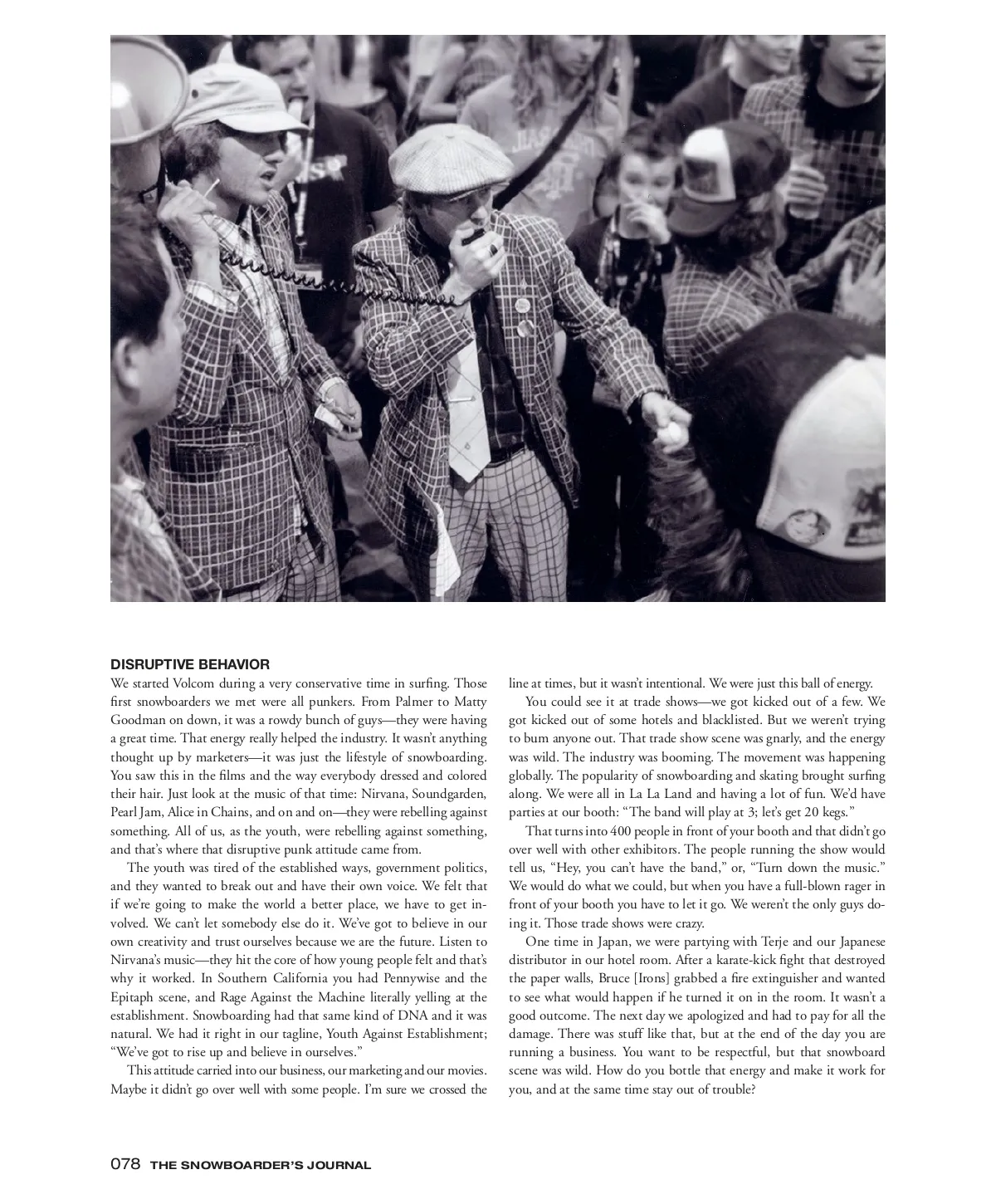
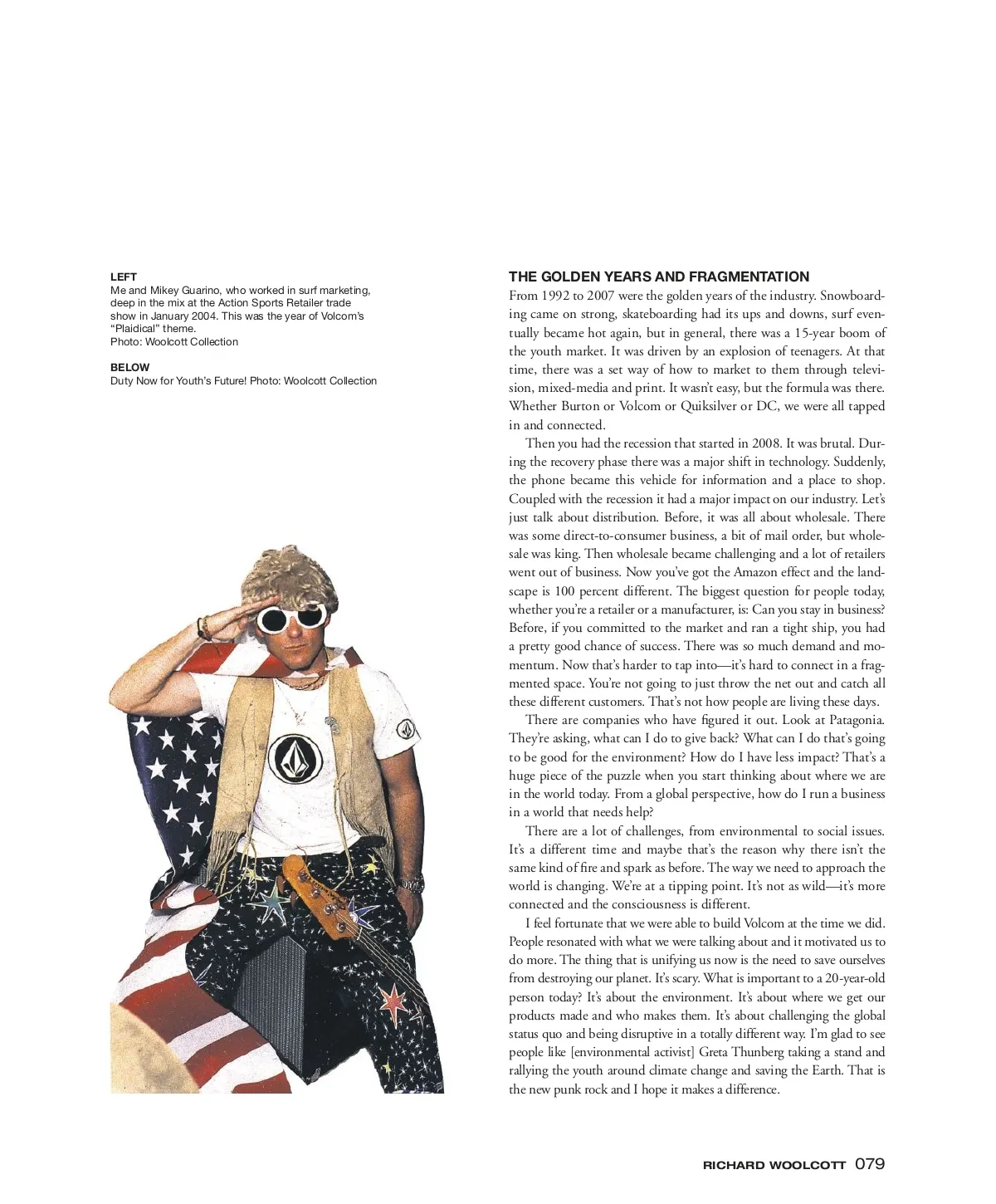
LEFT 4LHUK4PRL`.\HYPUV ^OV^VYRLKPUZ\YMTHYRL[PUN  KLLWPU[OLTP_H[[OL(J[PVU:WVY[Z9L[HPSLY[YHKL ZOV^PU1HU\HY`b;;OPZ^HZ[OL`LHYVM=VSJVT»Z ¸7SHPKPJHS¹[OLTL 7OV[V!>VVSJV[[*VSSLJ[PVU BELOW +\[`5V^MVY@V\[O»Z-\[\YL7OV[V!>VVSJV[[*VSSLJ[PVU THE GOLDEN YEARS AND FRAGMENTATION From 1992 to 2007 were the golden years of the industry. Snowboard-ing came on strong, skateboarding had its ups and downs, surf even-tually became hot again, but in general, there was a 15-year boom of the youth market. It was driven by an explosion of teenagers. At that time, there was a set way of how to market to them through televi-sion, mixed-media and print. It wasn’t easy, but the formula was there. Whether Burton or Volcom or Quiksilver or DC, we were all tapped in and connected. Then you had the recession that started in 2008. It was brutal. Dur-ing the recovery phase there was a major shift in technology. Suddenly, the phone became this vehicle for information and a place to shop. Coupled with the recession it had a major impact on our industry. Let’s just talk about distribution. Before, it was all about wholesale. There was some direct-to-consumer business, a bit of mail order, but whole-sale was king. Then wholesale became challenging and a lot of retailers went out of business. Now you’ve got the Amazon effect and the land-scape is 100 percent different. The biggest question for people today, whether you’re a retailer or a manufacturer, is: Can you stay in business? Before, if you committed to the market and ran a tight ship, you had a pretty good chance of success. There was so much demand and mo-mentum. Now that’s harder to tap into—it’s hard to connect in a frag-mented space. You’re not going to just throw the net out and catch all these different customers. That’s not how people are living these days. There are companies who have figured it out. Look at Patagonia. They’re asking, what can I do to give back? What can I do that’s going to be good for the environment? How do I have less impact? That’s a huge piece of the puzzle when you start thinking about where we are in the world today. From a global perspective, how do I run a business in a world that needs help? There are a lot of challenges, from environmental to social issues. It’s a different time and maybe that’s the reason why there isn’t the same kind of fire and spark as before. The way we need to approach the world is changing. We’re at a tipping point. It’s not as wild—it’s more connected and the consciousness is different. I feel fortunate that we were able to build Volcom at the time we did. People resonated with what we were talking about and it motivated us to do more. The thing that is unifying us now is the need to save ourselves from destroying our planet. It’s scary. What is important to a 20-year-old person today? It’s about the environment. It’s about where we get our products made and who makes them. It’s about challenging the global status quo and being disruptive in a totally different way. I’m glad to see people like [environmental activist] Greta Thunberg taking a stand and rallying the youth around climate change and saving the Earth. That is the new punk rock and I hope it makes a difference. RICHARD WOOLCOTT 079
The Snowboarder's Journal frequency 17.4: Page 81