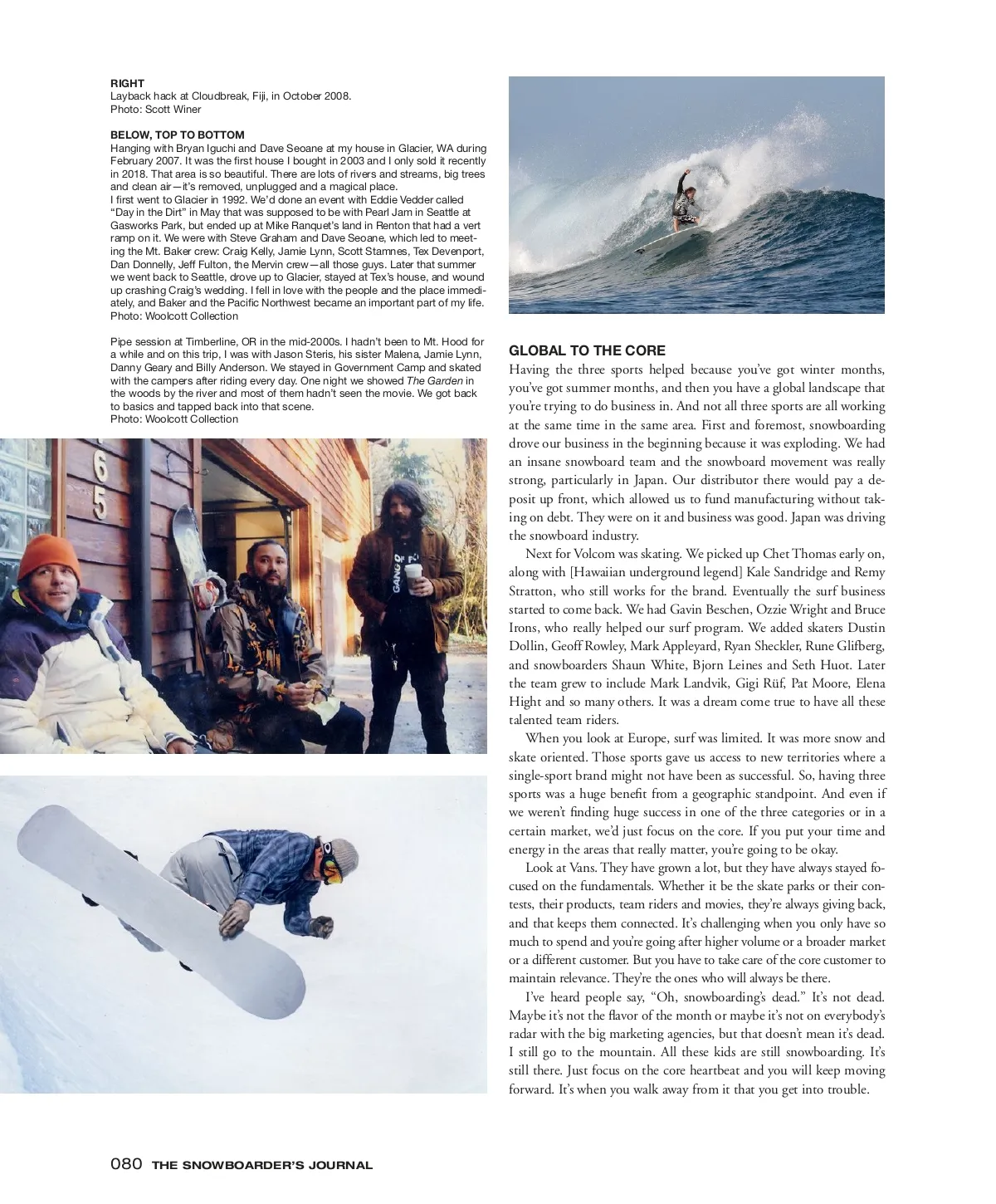
On the plane during Volcom’s road show to go public. It was a crazy two weeks of consistent travel and meetings with potential investors. I was so stoked when ^LÄUPZOLK0[MLS[SPRL0OHK^VU[OL^VYSK Z\YÄUN[P[SL VUS`[OPZ^HZPUI\ZPULZZ June 2005. Photo: Woolcott Collection A NEW REALITY Going public does change a culture. It puts a lot of pressure on the business to grow when you’re being reviewed quarterly, which is not al-ways the healthiest thing for a company. A lot of people will look back and go, “All these public companies probably weren’t the best thing for the industry because there was so much pressure to grow revenue.” Now it’s not about revenue growth, it’s about healthy sales. Some of the growth that companies were going after in the 2000s wasn’t realistic. Today, I don’t think being a public company in our industry is the right thing to do. You need to grow at the rate that the business allows. You can’t force sales. If you do, you end up in a situation that isn’t healthy for the business or the industry. I think we burned the industry out. As a group we wanted to be bigger, but there was a certain limit. It’s only going to get so big and our companies only got so big—that’s the lesson. There are a couple exceptions—look at Vans and Patagonia. Who would have thought they would be as big as they are? When we went public, I started spending my time on different stuff. I was focusing on conference calls every 90 days, dealing with corporate issues instead of brand building, hanging with the team or just being creative. The whole reason I started Volcom was to be cre-ative. I’d turned into the CEO of a public company. But I wanted to do a good job as CEO. The biggest challenge for us was figuring out how to maintain the Volcom culture while fulfilling the responsibili-ties of a public company, making the best decisions both short term and long term. It was another challenge, and I put all my effort into it, but it was a hard one. I think we did the best we could. In 2011 we were approached by several companies interested in buying us. We weren’t trying to sell the company, but our fiduciary duty to our shareholders required that we look at all serious offers. We were recovering from the recession and we thought, “It might be better for Volcom to have a big brother—somebody that can help us.” We were bought by Kering in June 2011 and gave it our all to make that next step a success. In the end, it didn’t work out and Kering sold Volcom in 2019 to focus more on the luxury side of their busi-ness. They were good partners and meant well. I’m thankful for how much effort they put into it. I stayed on for a year and a half as CEO after they bought Volcom because I wanted to help and be part of the transition. At the same time, I was getting burned out and starting to want change. At the end of 2012, I stepped down as CEO and took on the role of executive chairman. This allowed me to stay involved with helping figure out how to move the business forward without having to deal with all the daily pressures. As we regained some momentum, there was still the bigger issue of how to operate in this new market. We were still trying to sign team riders, make great product and create exciting marketing campaigns, but it was tough. Eventually, Kering started to make changes within the organization. Some of them I didn’t agree with and they were difficult to accept. I don’t have hard feelings about it now, but at the time, I was frustrated and felt lost. Budgets were get-ting cut and employees and team riders were being let go. I stayed on as long as I could, but I needed a break. In December of 2016, I left the company. It was all good and I’ve stayed friends with the Volcom crew—I hope only the best for Volcom. I’m still working through the change. It’s been tough trying to figure out who I am now, but it’s been a healthy process, too. My focus has been on my family—my wife, my son, my parents. I’ve been focused on surfing and snowboarding, and those two sports are my driving force—I need them to keep me energized, balanced and clearheaded. In terms of business, I’m not sure what I’m going to do next. I have an urge to be creative, but I don’t have an urge to build another Vol-com. I’m confident that at some point I’ll be working on something that’s fun, that’ll be fulfilling. And part of this process is not knowing what that is yet and I’m OK with that. I’m still relatively young, I’ve got a lot of experience and I still have creative drive, so we’ll see. RICHARD WOOLCOTT 081
The Snowboarder's Journal frequency 17.4: Page 83