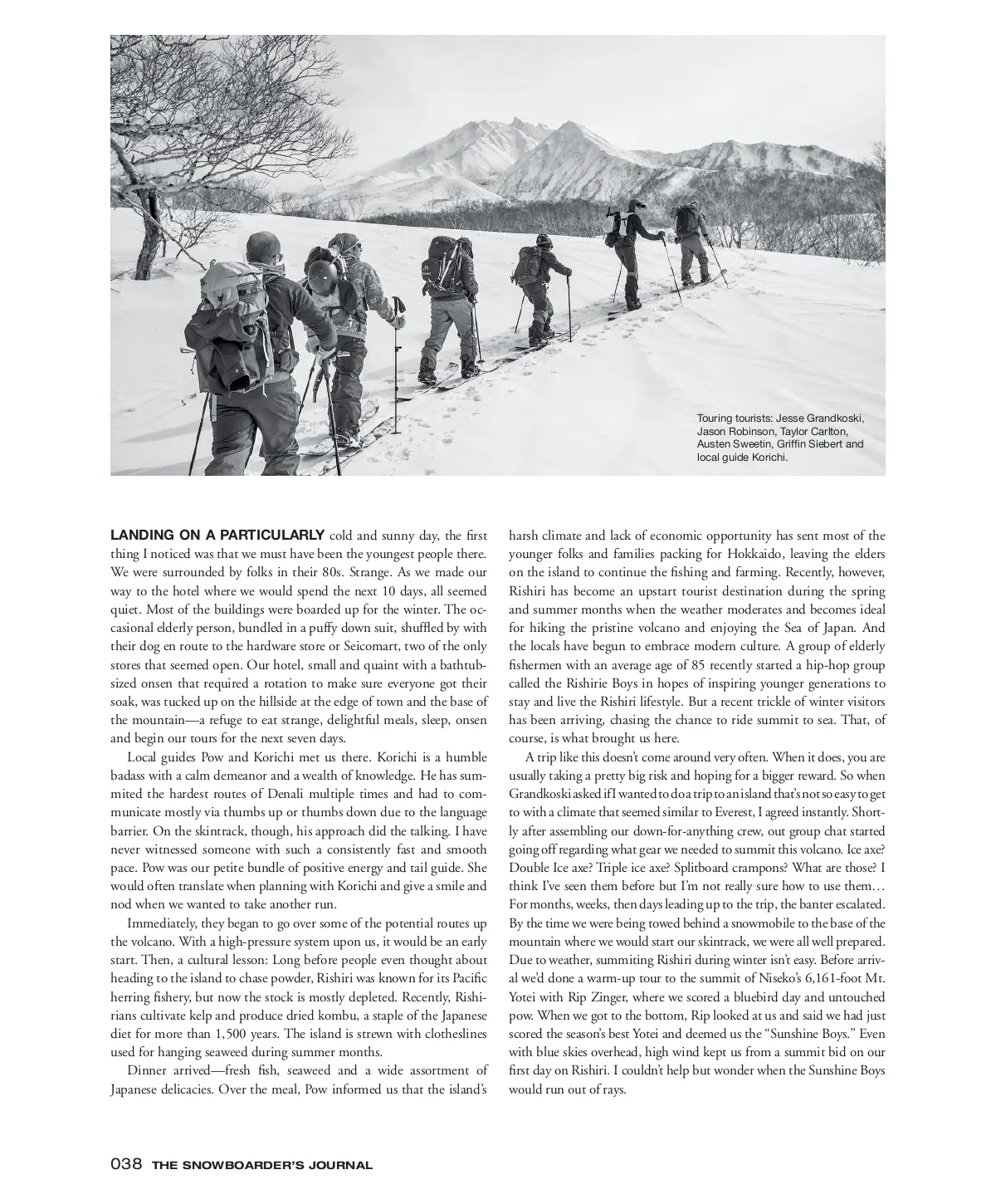
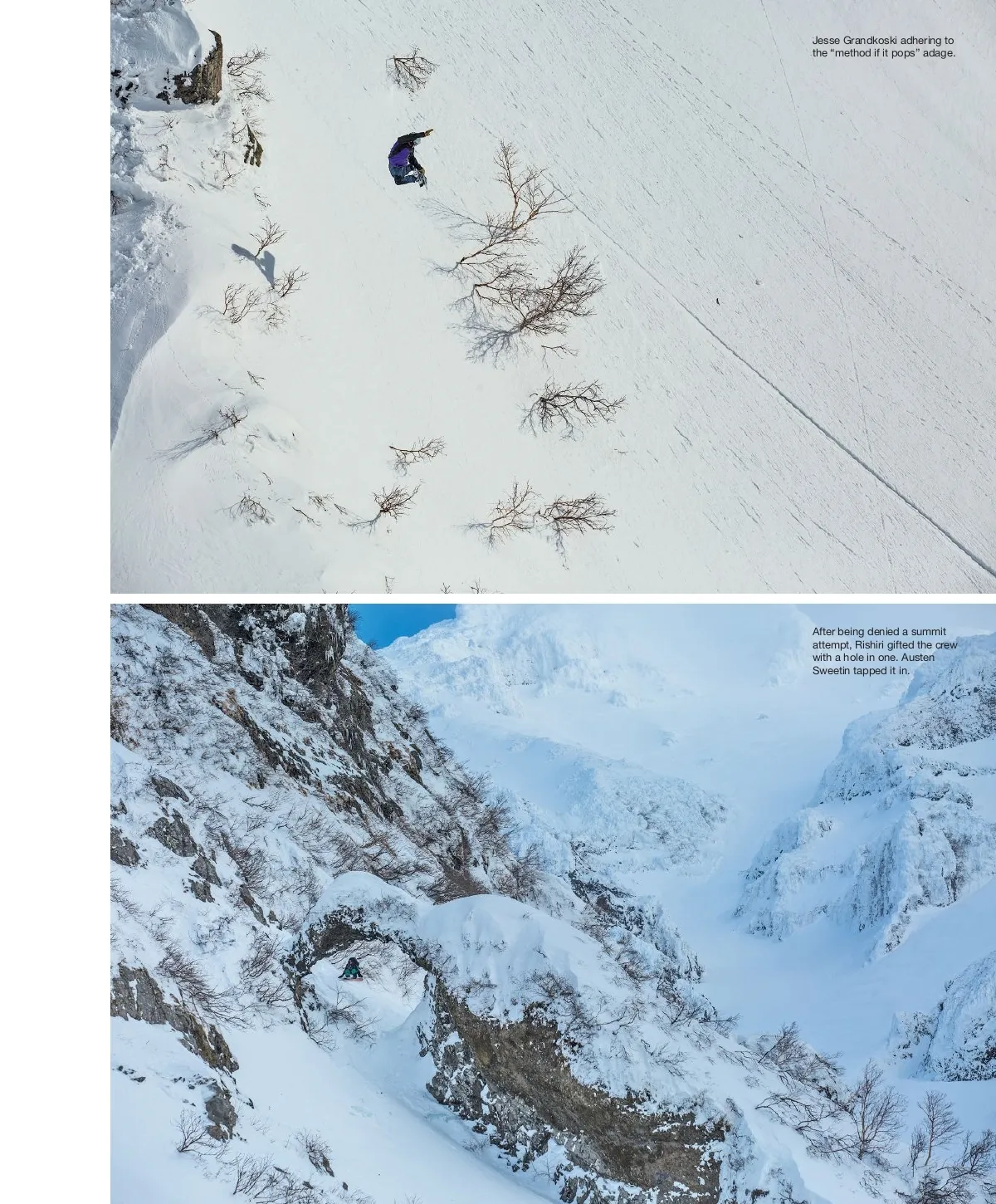
Touring tourists: Jesse Grandkoski, Jason Robinson, Taylor Carlton, Austen Sweetin, Griffin Siebert and local guide Korichi. LANDING ON A PARTICULARLY cold and sunny day, the first thing I noticed was that we must have been the youngest people there. We were surrounded by folks in their 80s. Strange. As we made our way to the hotel where we would spend the next 10 days, all seemed quiet. Most of the buildings were boarded up for the winter. The oc-casional elderly person, bundled in a puffy down suit, shuffled by with their dog en route to the hardware store or Seicomart, two of the only stores that seemed open. Our hotel, small and quaint with a bathtub-sized onsen that required a rotation to make sure everyone got their soak, was tucked up on the hillside at the edge of town and the base of the mountain—a refuge to eat strange, delightful meals, sleep, onsen and begin our tours for the next seven days. Local guides Pow and Korichi met us there. Korichi is a humble badass with a calm demeanor and a wealth of knowledge. He has sum-mited the hardest routes of Denali multiple times and had to com-municate mostly via thumbs up or thumbs down due to the language barrier. On the skintrack, though, his approach did the talking. I have never witnessed someone with such a consistently fast and smooth pace. Pow was our petite bundle of positive energy and tail guide. She would often translate when planning with Korichi and give a smile and nod when we wanted to take another run. Immediately, they began to go over some of the potential routes up the volcano. With a high-pressure system upon us, it would be an early start. Then, a cultural lesson: Long before people even thought about heading to the island to chase powder, Rishiri was known for its Pacific herring fishery, but now the stock is mostly depleted. Recently, Rishi-rians cultivate kelp and produce dried kombu, a staple of the Japanese diet for more than 1,500 years. The island is strewn with clotheslines used for hanging seaweed during summer months. Dinner arrived—fresh fish, seaweed and a wide assortment of Japanese delicacies. Over the meal, Pow informed us that the island’s harsh climate and lack of economic opportunity has sent most of the younger folks and families packing for Hokkaido, leaving the elders on the island to continue the fishing and farming. Recently, however, Rishiri has become an upstart tourist destination during the spring and summer months when the weather moderates and becomes ideal for hiking the pristine volcano and enjoying the Sea of Japan. And the locals have begun to embrace modern culture. A group of elderly fishermen with an average age of 85 recently started a hip-hop group called the Rishirie Boys in hopes of inspiring younger generations to stay and live the Rishiri lifestyle. But a recent trickle of winter visitors has been arriving, chasing the chance to ride summit to sea. That, of course, is what brought us here. A trip like this doesn’t come around very often. When it does, you are usually taking a pretty big risk and hoping for a bigger reward. So when Grandkoski asked if I wanted to do a trip to an island that’s not so easy to get to with a climate that seemed similar to Everest, I agreed instantly. Short-ly after assembling our down-for-anything crew, out group chat started going off regarding what gear we needed to summit this volcano. Ice axe? Double Ice axe? Triple ice axe? Splitboard crampons? What are those? I think I’ve seen them before but I’m not really sure how to use them… For months, weeks, then days leading up to the trip, the banter escalated. By the time we were being towed behind a snowmobile to the base of the mountain where we would start our skintrack, we were all well prepared. Due to weather, summiting Rishiri during winter isn’t easy. Before arriv-al we’d done a warm-up tour to the summit of Niseko’s 6,161-foot Mt. Yotei with Rip Zinger, where we scored a bluebird day and untouched pow. When we got to the bottom, Rip looked at us and said we had just scored the season’s best Yotei and deemed us the “Sunshine Boys.” Even with blue skies overhead, high wind kept us from a summit bid on our first day on Rishiri. I couldn’t help but wonder when the Sunshine Boys would run out of rays. 038 THE SNOWBOARDER’S JOURNAL
The Snowboarder's Journal The Snowboarder's Journal 18.4: Page 38