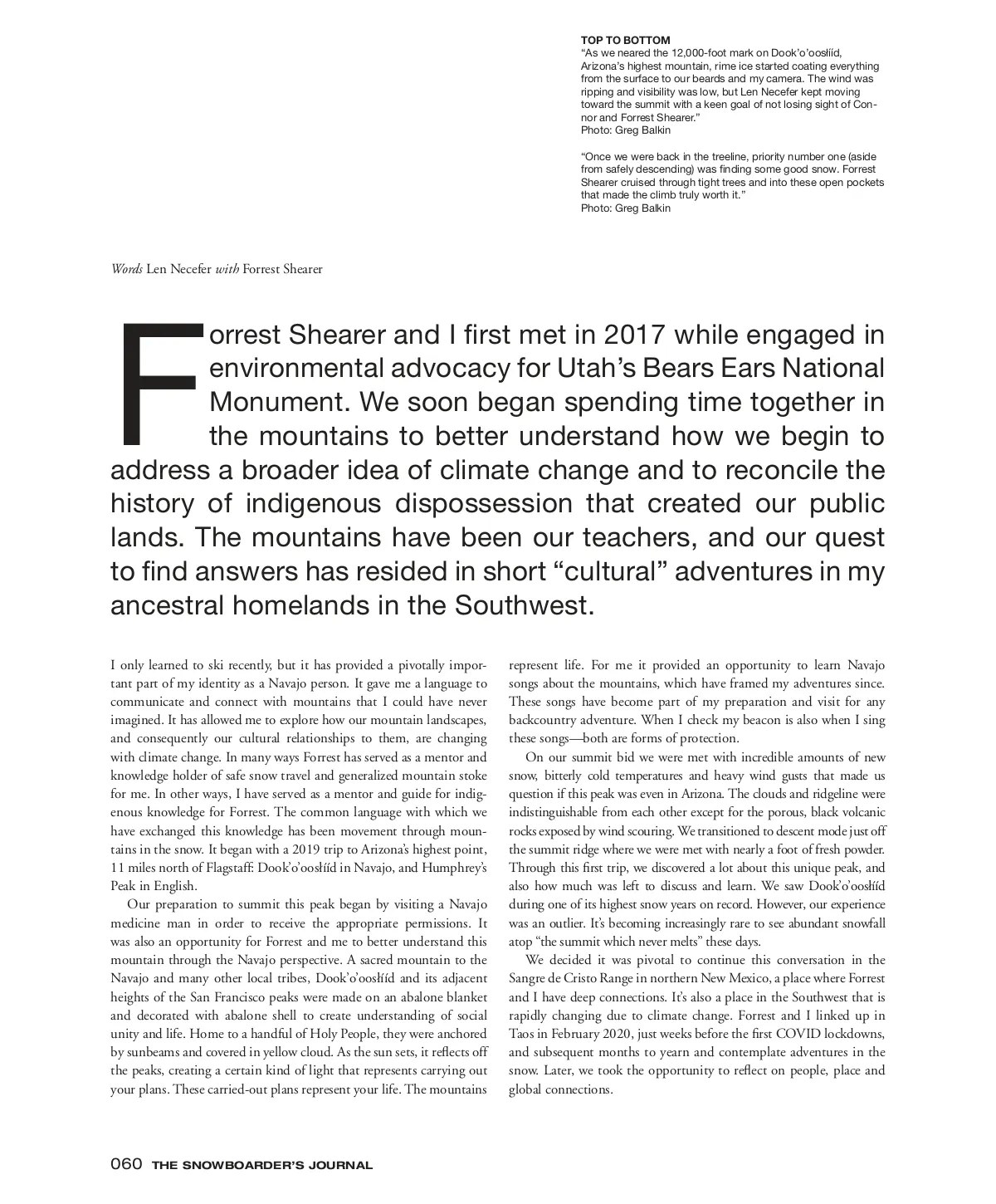
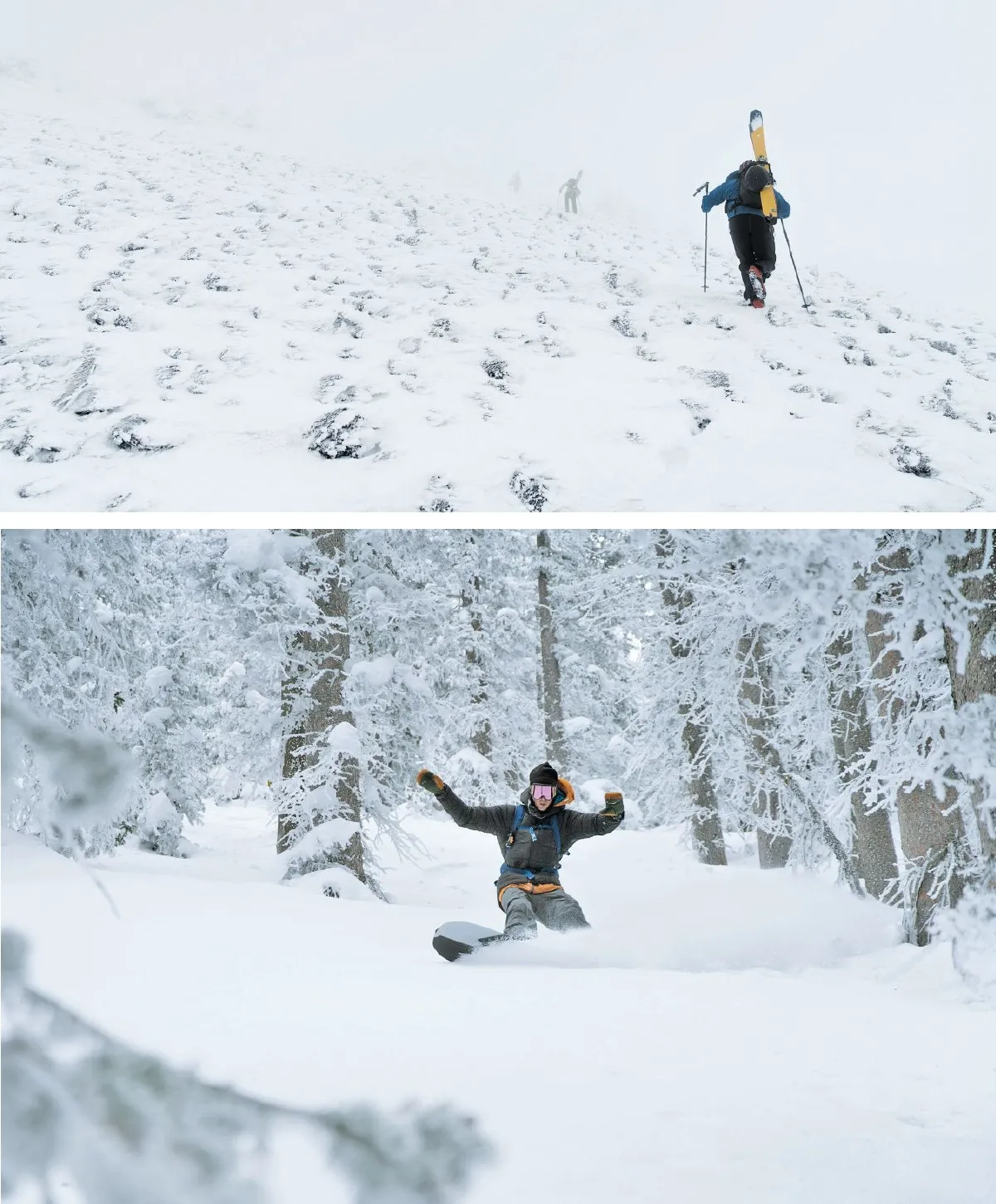
TOP TO BOTTOM “As we neared the 12,000-foot mark on Dook’o’oosłííd, Arizona’s highest mountain, rime ice started coating everything from the surface to our beards and my camera. The wind was ripping and visibility was low, but Len Necefer kept moving toward the summit with a keen goal of not losing sight of Con-nor and Forrest Shearer.” Photo: Greg Balkin “Once we were back in the treeline, priority number one (aside from safely descending) was finding some good snow. Forrest Shearer cruised through tight trees and into these open pockets that made the climb truly worth it.” Photo: Greg Balkin Words Len Necefer with Forrest Shearer orrest Shearer and I first met in 2017 while engaged in environmental advocacy for Utah’s Bears Ears National Monument. We soon began spending time together in the mountains to better understand how we begin to address a broader idea of climate change and to reconcile the history of indigenous dispossession that created our public lands. The mountains have been our teachers, and our quest to find answers has resided in short “cultural” adventures in my ancestral homelands in the Southwest. F I only learned to ski recently, but it has provided a pivotally impor-tant part of my identity as a Navajo person. It gave me a language to communicate and connect with mountains that I could have never imagined. It has allowed me to explore how our mountain landscapes, and consequently our cultural relationships to them, are changing with climate change. In many ways Forrest has served as a mentor and knowledge holder of safe snow travel and generalized mountain stoke for me. In other ways, I have served as a mentor and guide for indig-enous knowledge for Forrest. The common language with which we have exchanged this knowledge has been movement through moun-tains in the snow. It began with a 2019 trip to Arizona’s highest point, 11 miles north of Flagstaff: Dook’o’oosłííd in Navajo, and Humphrey’s Peak in English. Our preparation to summit this peak began by visiting a Navajo medicine man in order to receive the appropriate permissions. It was also an opportunity for Forrest and me to better understand this mountain through the Navajo perspective. A sacred mountain to the Navajo and many other local tribes, Dook’o’oosłííd and its adjacent heights of the San Francisco peaks were made on an abalone blanket and decorated with abalone shell to create understanding of social unity and life. Home to a handful of Holy People, they were anchored by sunbeams and covered in yellow cloud. As the sun sets, it reflects off the peaks, creating a certain kind of light that represents carrying out your plans. These carried-out plans represent your life. The mountains represent life. For me it provided an opportunity to learn Navajo songs about the mountains, which have framed my adventures since. These songs have become part of my preparation and visit for any backcountry adventure. When I check my beacon is also when I sing these songs—both are forms of protection. On our summit bid we were met with incredible amounts of new snow, bitterly cold temperatures and heavy wind gusts that made us question if this peak was even in Arizona. The clouds and ridgeline were indistinguishable from each other except for the porous, black volcanic rocks exposed by wind scouring. We transitioned to descent mode just off the summit ridge where we were met with nearly a foot of fresh powder. Through this first trip, we discovered a lot about this unique peak, and also how much was left to discuss and learn. We saw Dook’o’oosłííd during one of its highest snow years on record. However, our experience was an outlier. It’s becoming increasingly rare to see abundant snowfall atop “the summit which never melts” these days. We decided it was pivotal to continue this conversation in the Sangre de Cristo Range in northern New Mexico, a place where Forrest and I have deep connections. It’s also a place in the Southwest that is rapidly changing due to climate change. Forrest and I linked up in Taos in February 2020, just weeks before the first COVID lockdowns, and subsequent months to yearn and contemplate adventures in the snow. Later, we took the opportunity to reflect on people, place and global connections. 060 THE SNOWBOARDER’S JOURNAL
The Snowboarder's Journal The Snowboarder's Journal 18.4: Page 60