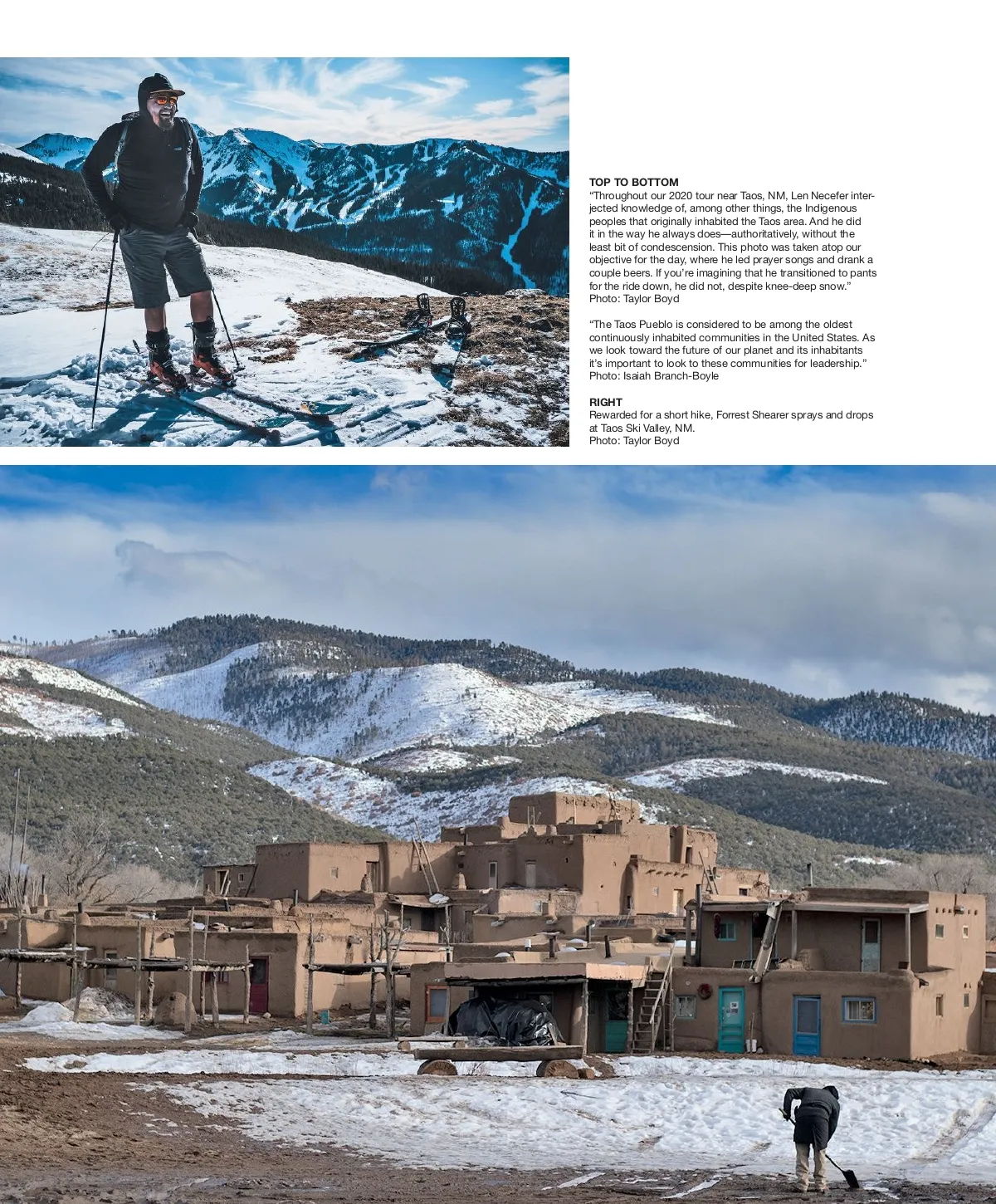
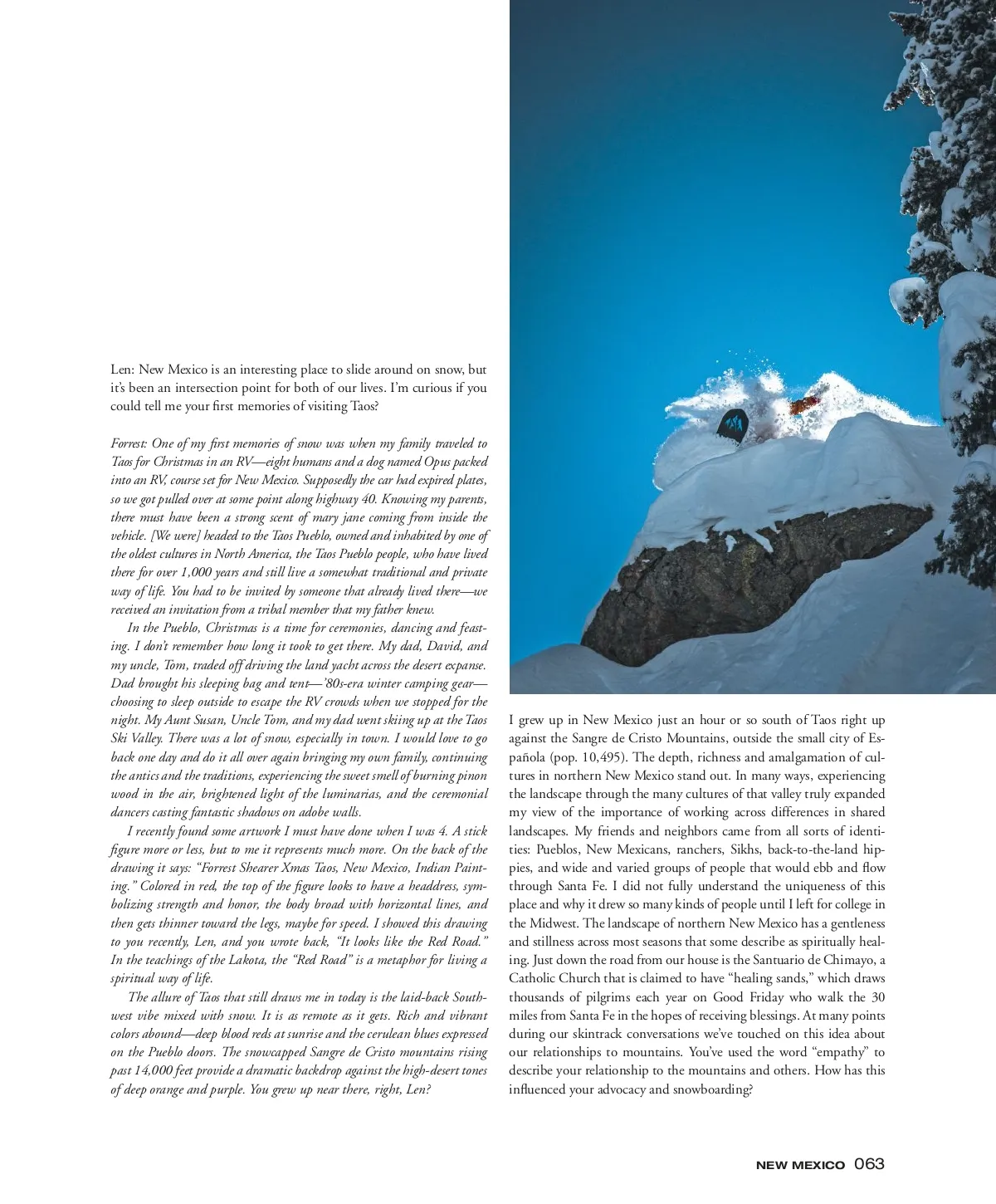
Len: New Mexico is an interesting place to slide around on snow, but it’s been an intersection point for both of our lives. I’m curious if you could tell me your first memories of visiting Taos? Forrest: One of my first memories of snow was when my family traveled to Taos for Christmas in an RV—eight humans and a dog named Opus packed into an RV, course set for New Mexico. Supposedly the car had expired plates, so we got pulled over at some point along highway 40. Knowing my parents, there must have been a strong scent of mary jane coming from inside the vehicle. [We were] headed to the Taos Pueblo, owned and inhabited by one of the oldest cultures in North America, the Taos Pueblo people, who have lived there for over 1,000 years and still live a somewhat traditional and private way of life. You had to be invited by someone that already lived there—we received an invitation from a tribal member that my father knew. In the Pueblo, Christmas is a time for ceremonies, dancing and feast-ing. I don’t remember how long it took to get there. My dad, David, and my uncle, Tom, traded off driving the land yacht across the desert expanse. Dad brought his sleeping bag and tent—’80s-era winter camping gear— choosing to sleep outside to escape the RV crowds when we stopped for the night. My Aunt Susan, Uncle Tom, and my dad went skiing up at the Taos Ski Valley. There was a lot of snow, especially in town. I would love to go back one day and do it all over again bringing my own family, continuing the antics and the traditions, experiencing the sweet smell of burning pinon wood in the air, brightened light of the luminarias, and the ceremonial dancers casting fantastic shadows on adobe walls. I recently found some artwork I must have done when I was 4. A stick figure more or less, but to me it represents much more. On the back of the drawing it says: “Forrest Shearer Xmas Taos, New Mexico, Indian Paint-ing.” Colored in red, the top of the figure looks to have a headdress, sym-bolizing strength and honor, the body broad with horizontal lines, and then gets thinner toward the legs, maybe for speed. I showed this drawing to you recently, Len, and you wrote back, “It looks like the Red Road.” In the teachings of the Lakota, the “Red Road” is a metaphor for living a spiritual way of life. The allure of Taos that still draws me in today is the laid-back South-west vibe mixed with snow. It is as remote as it gets. Rich and vibrant colors abound—deep blood reds at sunrise and the cerulean blues expressed on the Pueblo doors. The snowcapped Sangre de Cristo mountains rising past 14,000 feet provide a dramatic backdrop against the high-desert tones of deep orange and purple. You grew up near there, right, Len? I grew up in New Mexico just an hour or so south of Taos right up against the Sangre de Cristo Mountains, outside the small city of Es-pañola (pop. 10,495). The depth, richness and amalgamation of cul-tures in northern New Mexico stand out. In many ways, experiencing the landscape through the many cultures of that valley truly expanded my view of the importance of working across differences in shared landscapes. My friends and neighbors came from all sorts of identi-ties: Pueblos, New Mexicans, ranchers, Sikhs, back-to-the-land hip-pies, and wide and varied groups of people that would ebb and flow through Santa Fe. I did not fully understand the uniqueness of this place and why it drew so many kinds of people until I left for college in the Midwest. The landscape of northern New Mexico has a gentleness and stillness across most seasons that some describe as spiritually heal-ing. Just down the road from our house is the Santuario de Chimayo, a Catholic Church that is claimed to have “healing sands,” which draws thousands of pilgrims each year on Good Friday who walk the 30 miles from Santa Fe in the hopes of receiving blessings. At many points during our skintrack conversations we’ve touched on this idea about our relationships to mountains. You’ve used the word “empathy” to describe your relationship to the mountains and others. How has this influenced your advocacy and snowboarding? NEW MEXICO 063
The Snowboarder's Journal The Snowboarder's Journal 18.4: Page 63