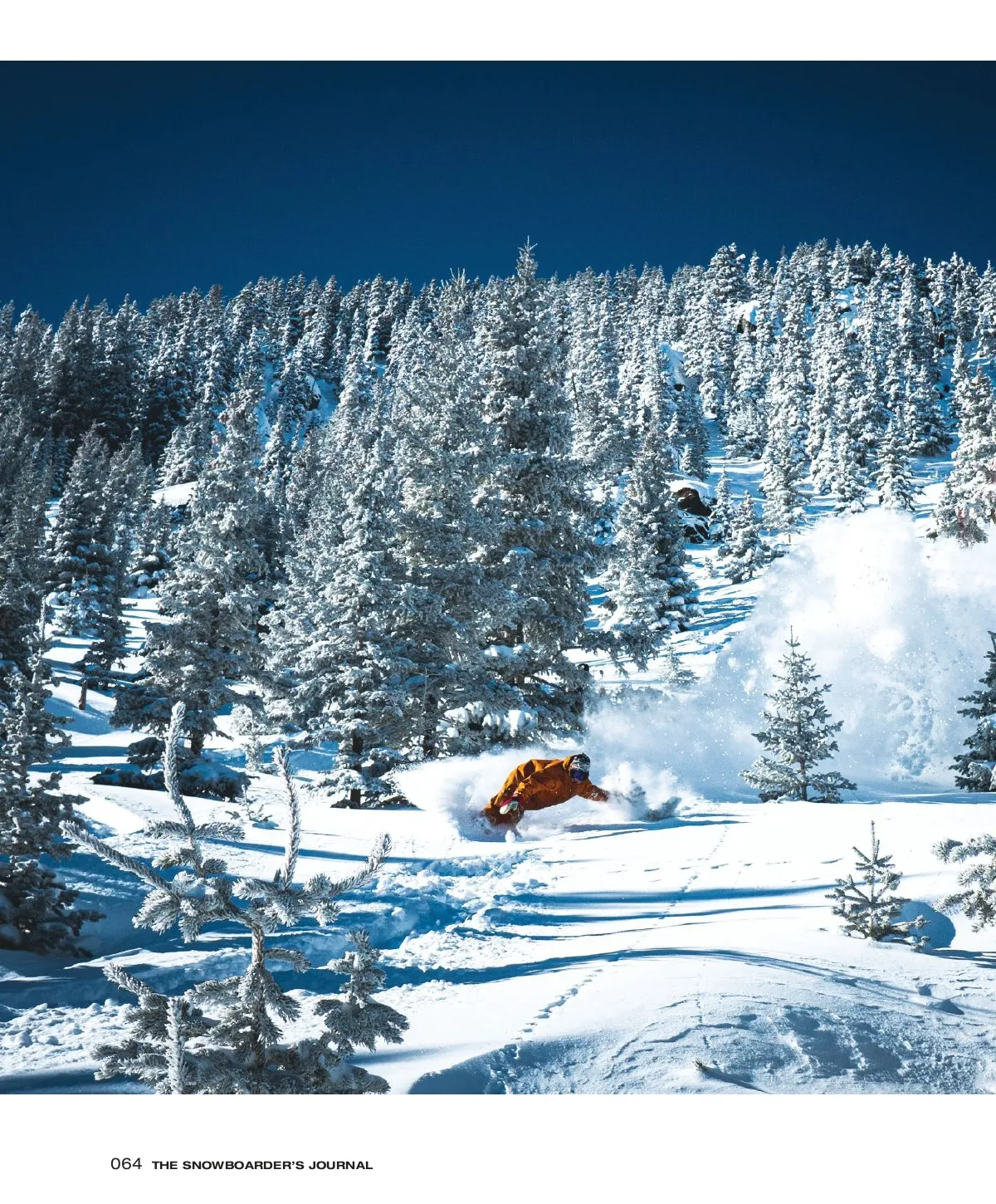
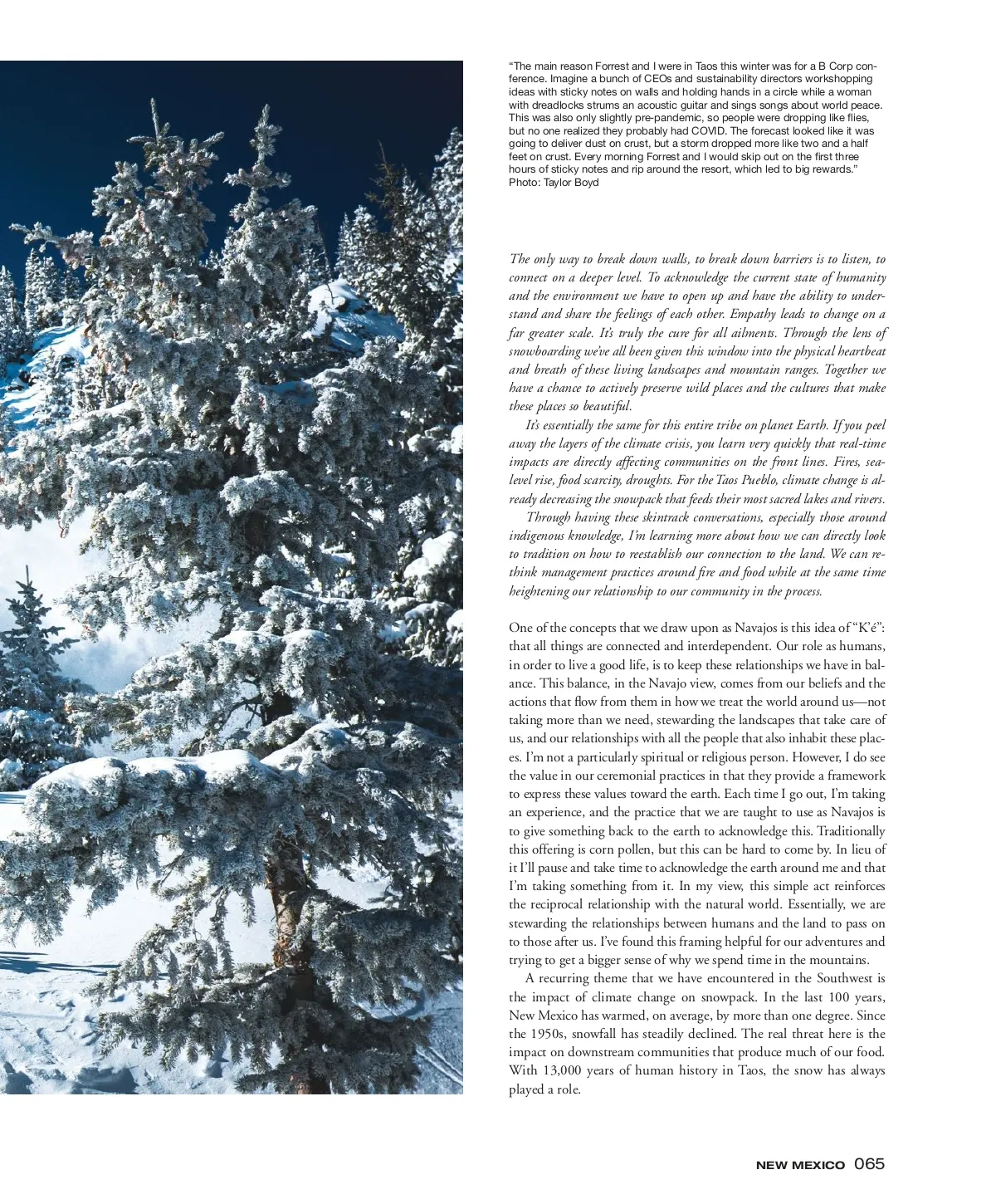
“The main reason Forrest and I were in Taos this winter was for a B Corp con-ference. Imagine a bunch of CEOs and sustainability directors workshopping ideas with sticky notes on walls and holding hands in a circle while a woman with dreadlocks strums an acoustic guitar and sings songs about world peace. This was also only slightly pre-pandemic, so people were dropping like flies, but no one realized they probably had COVID. The forecast looked like it was going to deliver dust on crust, but a storm dropped more like two and a half feet on crust. Every morning Forrest and I would skip out on the first three hours of sticky notes and rip around the resort, which led to big rewards.” Photo: Taylor Boyd The only way to break down walls, to break down barriers is to listen, to connect on a deeper level. To acknowledge the current state of humanity and the environment we have to open up and have the ability to under-stand and share the feelings of each other. Empathy leads to change on a far greater scale. It’s truly the cure for all ailments. Through the lens of snowboarding we’ve all been given this window into the physical heartbeat and breath of these living landscapes and mountain ranges. Together we have a chance to actively preserve wild places and the cultures that make these places so beautiful. It’s essentially the same for this entire tribe on planet Earth. If you peel away the layers of the climate crisis, you learn very quickly that real-time impacts are directly affecting communities on the front lines. Fires, sea-level rise, food scarcity, droughts. For the Taos Pueblo, climate change is al-ready decreasing the snowpack that feeds their most sacred lakes and rivers. Through having these skintrack conversations, especially those around indigenous knowledge, I’m learning more about how we can directly look to tradition on how to reestablish our connection to the land. We can re-think management practices around fire and food while at the same time heightening our relationship to our community in the process. One of the concepts that we draw upon as Navajos is this idea of “K’é”: that all things are connected and interdependent. Our role as humans, in order to live a good life, is to keep these relationships we have in bal-ance. This balance, in the Navajo view, comes from our beliefs and the actions that flow from them in how we treat the world around us—not taking more than we need, stewarding the landscapes that take care of us, and our relationships with all the people that also inhabit these plac-es. I’m not a particularly spiritual or religious person. However, I do see the value in our ceremonial practices in that they provide a framework to express these values toward the earth. Each time I go out, I’m taking an experience, and the practice that we are taught to use as Navajos is to give something back to the earth to acknowledge this. Traditionally this offering is corn pollen, but this can be hard to come by. In lieu of it I’ll pause and take time to acknowledge the earth around me and that I’m taking something from it. In my view, this simple act reinforces the reciprocal relationship with the natural world. Essentially, we are stewarding the relationships between humans and the land to pass on to those after us. I’ve found this framing helpful for our adventures and trying to get a bigger sense of why we spend time in the mountains. A recurring theme that we have encountered in the Southwest is the impact of climate change on snowpack. In the last 100 years, New Mexico has warmed, on average, by more than one degree. Since the 1950s, snowfall has steadily declined. The real threat here is the impact on downstream communities that produce much of our food. With 13,000 years of human history in Taos, the snow has always played a role. NEW MEXICO 065
The Snowboarder's Journal The Snowboarder's Journal 18.4: Page 65