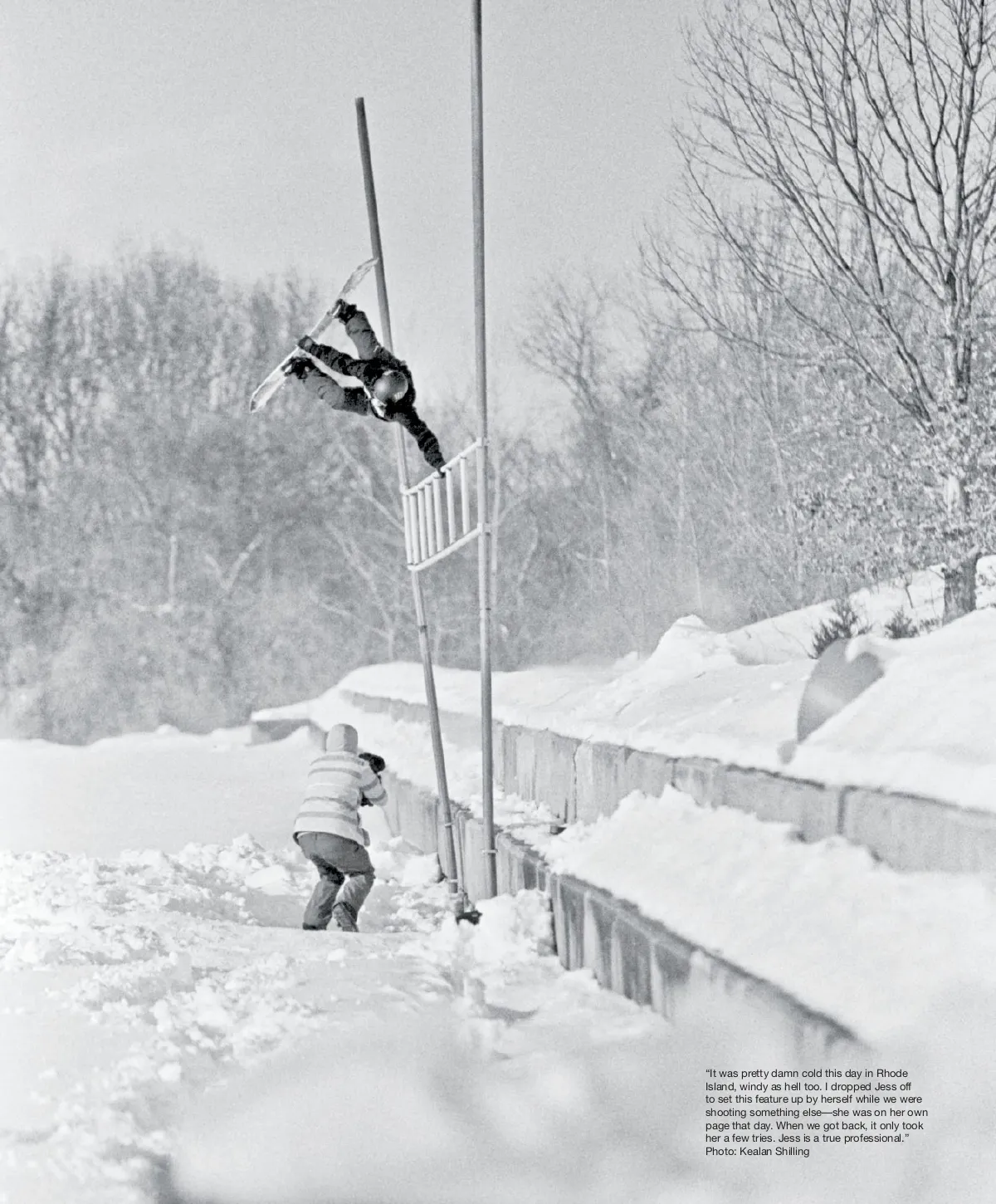
Words Colin Wiseman J ess Kimura has been through a lot. Despite all the accolades, the Video Part and Rider of the Year awards, the Nike and The North Face contracts, pro model snowboards and on and on, she had to struggle for a decade to get anyone’s attention as an athlete. She didn’t get her first real sponsorship until her mid-20s, an age by which most aspiring pro riders would have given up and moved on to other things. Jess was told she wouldn’t succeed, a lot. She got hurt, a lot. She’s been through some dark days—misdiagnosis of mental illness, institutionalization, addiction, withdrawal. The loss of the love of her life. Heavy stuff that would have broken some folks for good. and cartwheeled into the parking lot. Everyone was like, “Whoa! That was sick!” I thought, “I did something cool and it was really easy.” And all it took was being myself, trying something stupid. I was like, “I’m a fucking boarder.” The next year my mom got me a used demo board that actually fit me and the bindings stayed done up. I started landing on my feet. Gymnastics helped. How long were you in gymnastics? I started when I was pretty young, 6 or 7. I was really into it by the time I started liking snowboarding, around 14 or 15 years old. I’m guessing your parents got you started on that? What were your parents like? Yeah. My dad [Blake] worked for the city and my mom [Denise] worked with special needs kids. My dad was from a second-generation immigrant Japanese family. My mom was from a first-generation immigrant Belgian family. I always thought of my mom as someone who played it safe— not a risk taker or rebel. When I think about it now, her super Catholic European family wasn’t happy that she wanted to marry, as they would say, an “Oriental” guy. But she did it anyway, had me and my sister, and eventually her family grew to love my dad as much as she did. She took maybe the biggest risk she could have taken, in that sense? Yeah. My dad’s parents were living in Prince Rupert, BC. They were taken to Alberta during World War II and put in an internment camp. 1 Their fishing boats and property were all taken away. He was born shortly afterward. My mom’s family were sugar beet farmers in Alberta. That’s where they met. 1 The Canadian government put 22,000 Japanese Canadians—90 percent of the Japanese population in Canada at the time—in internment camps during World War II. Many were forced into physical labor, including working at sugar beet farms in Alberta. Yet Jess has hung on. Even thrived. She second-guessed herself plenty, but she kept her foot on the gas, sometimes without respect for her long-term health. And, eventually, she succeeded. Still, her demons chased her through life. The slams, the anxiety, they took their toll. Still, she’s here. And she’s as influential as ever. Recently, we caught up with Jess at her home in Squamish, BC. She’d been buried in learning to edit a video on the go, pushing to give more ladies the chance to succeed as snowboarders, to finish The Uninvited II . The sequel to an all-female, street-oriented action flick funded by her personal savings account, it’s as grassroots as it gets. It’s evidence that Jess is embracing her role as mentor. It’s evidence of her willingness to lay it all on the line for what she believes. And it’s evidence of her own healing process. Despite the mounting pressure of a self-produced project launch-ing in a week’s time, Jess gave us her full, undivided attention. For two hours she laughed and cried and swore. She opened up as few would, as real as it gets. And at the end of it all, it felt like Jess is finally finding some peace through giving back. The Snowboarder’s Journal: You were born and raised in Vernon, BC. What was it like growing up there? Jess Kimura: We had SilverStar [Mountain Resort] 15 minutes from town, so everyone skied. Around grade eight, all my friends switched to snowboarding. I got a cheap board at the ski swap, which was way too big for me—a Sims Salasnek 158 with the skate trucks on the bottom. It was so heavy. The bindings would pop off halfway down the run. I couldn’t turn toeside. I hated the feeling of my friends all waiting for me. Then, one day, these guys were building a jump on “the Knoll” above the parking lot, and they said it was a backflip-only jump, and I was like, “Bitch, I can do a backflip,” because I was in gymnastics. I straight-lined it toward the jump, hucked a backflip onto my head, JESS KIMURA 071
The Snowboarder's Journal The Snowboarder's Journal 18.4: Page 71