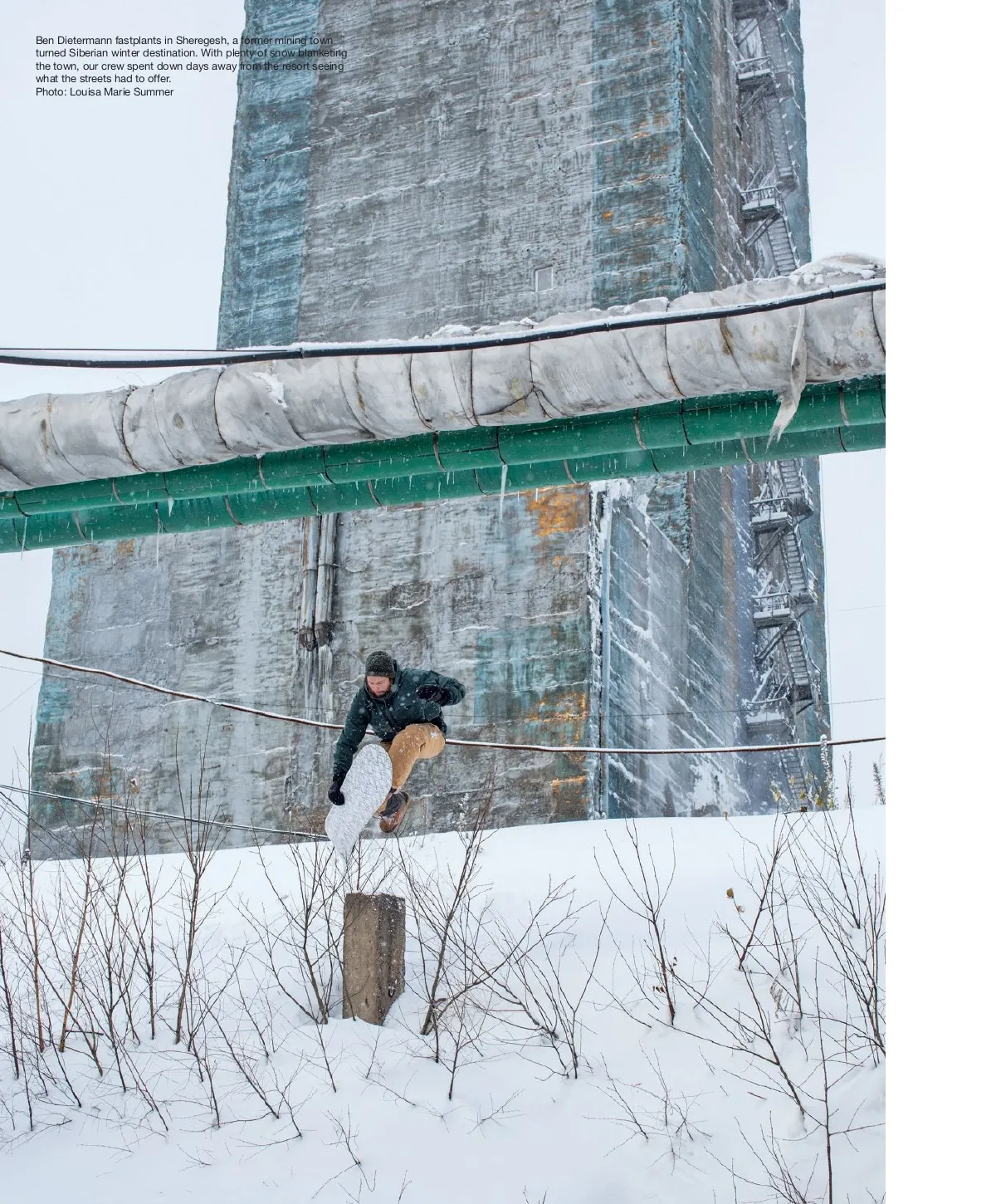
Words Ben Dietermann iberia encompasses five million square miles of freezing tundra span-ning most of northern Asia. And what else? A nascent snowboard culture, per-haps? Friendly locals and untracked lines? Where there is snow and mountains there are usually folks enjoying the alpine. But Siberia remains an unknown entity—a vast, mysterious chunk on the map with little beta. A land waiting to be explored. S It’s November. Reports of heavy snowfall blanketing quaint towns along the Trans-Siberian Railway suggest a brighter picture than the region’s nickname of the “Sleeping Land” implies. It’s time to see what it holds and paint memories between the lines. After long flights from Munich and Zurich, respectively, our crew assembles at the buzzing Moscow Domodedovo Airport before taking another six-hour soar to the city of Irkutsk, some 3,000 miles east of the Russian metropolis. Yeah, Siberia is a long way from home. The group consists of Daniel Schneider, the unofficial cook, Andreas Weiss and his positive vibes, photographer Louisa Marie Summer and me, the shaper of the powdersurfers we’re riding on this trip. With a bit of luck, we arrange a last-minute ride in an all-terrain vehicle that will take us toward Mamay, the first destination on our itinerary. While the driver loads our gear and makes his final prepara-tions, we sip a cup of chai tea with his mother. With a bit of body language and scattered French, we manage to strike up something that resembles a conversation about her life in Irkutsk, what brought us here and our daily lives back home. Although we are communicating across language barriers, we feel welcomed. Soon we’re off to Mamay, a small valley in the nearly 220-mile-long Khamar-Daban mountain range next to Lake Baikal. At just under 400 miles long, Lake Baikal is the world’s oldest and deepest freshwater lake— a body of water so massive it’s easily identifiable from outer space. As we turn off the road that runs along its southeastern shore, the route becomes too muddy for motorized transport. We unload and hike the final few miles to the primitive log cabin that will serve as our home base for the next five days. In the beginning of winter, be-fore it has a chance to freeze over, Lake Baikal’s moisture brings abundant snow to the region, and the valley protects powder from the wind. As a result, Mamay Valley is becoming an increasingly popular touring destination and guided op-erations have appeared here during the past several years. It’s easy pick-ings, full of cold, untouched lines, some of which lead right to our cabin’s front door. Along with the fun tree runs around the huts, there are open bowls higher up, as well as pillows if you know where to look. The sun is out from about 8 in the morning to 5 p.m. and so are we, riding multiple runs per day for as long as the light allows. We aren’t the only ones out here. About 70 cabins spread across the valley. But they’re mostly used for hunting during warmer months, so few are occupied now. Our cabin is only 9 feet by 13 feet and is without running water. Electricity lasts for a few fleeting moments each evening. We have a small gas stove to cook with, and another fed by wet wood to generate some warmth. Plain wooden boards make up the beds. It’s simple but boisterous throughout our stay. The evenings are full of unexpected visits and merry gatherings. Impromptu guests include local legends such as big mountain skier Sergey “Avalanche Man” Klimov, backcountry guides from the Elbrus region, beginner snowboarders from Moscow, a cook from the neighbouring hut, as well as other enthusiasts enjoying winter in the valley. We share sto-ries and drinks late into most nights. A баня (banya ) —the Russian-Eastern Slavic version of an onsen or sauna—is situated only a few feet from the cabin that is closest to the river. Its steam soothes our bodies and souls after long days of powdersurfing. After five days, everyone is inclined to stay longer, if only it weren’t for the train tickets we’d booked in advance. TRANS-SIBERIAN RAILWAY 055
The Snowboarder's Journal The Snowboarder's Journal 19.1: Page 55