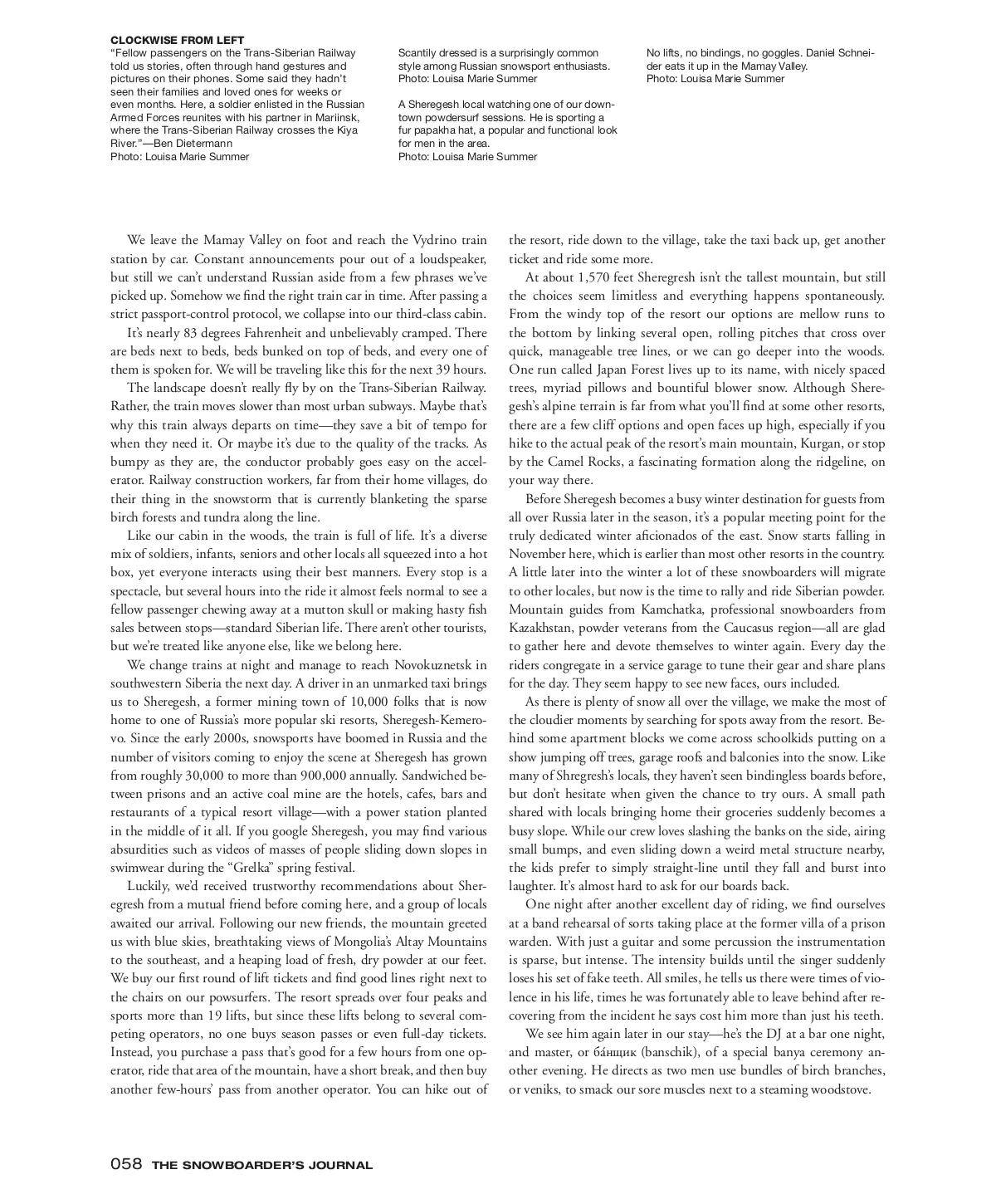
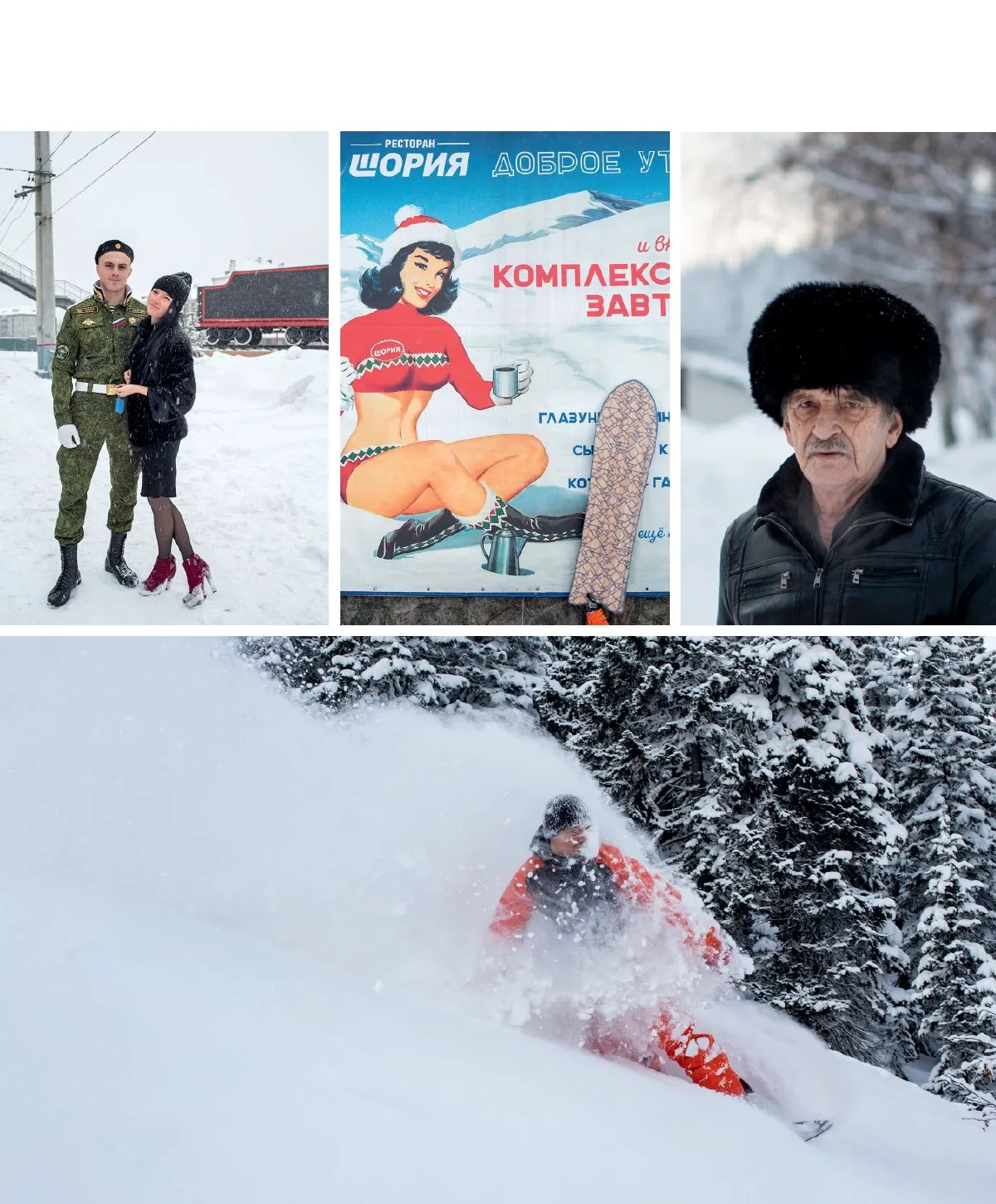
CLOCKWISE FROM LEFT “Fellow passengers on the Trans-Siberian Railway told us stories, often through hand gestures and pictures on their phones. Some said they hadn’t seen their families and loved ones for weeks or even months. Here, a soldier enlisted in the Russian Armed Forces reunites with his partner in Mariinsk, where the Trans-Siberian Railway crosses the Kiya River.”—Ben Dietermann Photo: Louisa Marie Summer Scantily dressed is a surprisingly common style among Russian snowsport enthusiasts. Photo: Louisa Marie Summer A Sheregesh local watching one of our down-town powdersurf sessions. He is sporting a fur papakha hat, a popular and functional look for men in the area. Photo: Louisa Marie Summer No lifts, no bindings, no goggles. Daniel Schnei-der eats it up in the Mamay Valley. Photo: Louisa Marie Summer We leave the Mamay Valley on foot and reach the Vydrino train station by car. Constant announcements pour out of a loudspeaker, but still we can’t understand Russian aside from a few phrases we’ve picked up. Somehow we find the right train car in time. After passing a strict passport-control protocol, we collapse into our third-class cabin. It’s nearly 83 degrees Fahrenheit and unbelievably cramped. There are beds next to beds, beds bunked on top of beds, and every one of them is spoken for. We will be traveling like this for the next 39 hours. The landscape doesn’t really fly by on the Trans-Siberian Railway. Rather, the train moves slower than most urban subways. Maybe that’s why this train always departs on time—they save a bit of tempo for when they need it. Or maybe it’s due to the quality of the tracks. As bumpy as they are, the conductor probably goes easy on the accel-erator. Railway construction workers, far from their home villages, do their thing in the snowstorm that is currently blanketing the sparse birch forests and tundra along the line. Like our cabin in the woods, the train is full of life. It’s a diverse mix of soldiers, infants, seniors and other locals all squeezed into a hot box, yet everyone interacts using their best manners. Every stop is a spectacle, but several hours into the ride it almost feels normal to see a fellow passenger chewing away at a mutton skull or making hasty fish sales between stops—standard Siberian life. There aren’t other tourists, but we’re treated like anyone else, like we belong here. We change trains at night and manage to reach Novokuznetsk in southwestern Siberia the next day. A driver in an unmarked taxi brings us to Sheregesh, a former mining town of 10,000 folks that is now home to one of Russia’s more popular ski resorts, Sheregesh-Kemero-vo. Since the early 2000s, snowsports have boomed in Russia and the number of visitors coming to enjoy the scene at Sheregesh has grown from roughly 30,000 to more than 900,000 annually. Sandwiched be-tween prisons and an active coal mine are the hotels, cafes, bars and restaurants of a typical resort village—with a power station planted in the middle of it all. If you google Sheregesh, you may find various absurdities such as videos of masses of people sliding down slopes in swimwear during the “Grelka” spring festival. Luckily, we’d received trustworthy recommendations about Sher-egresh from a mutual friend before coming here, and a group of locals awaited our arrival. Following our new friends, the mountain greeted us with blue skies, breathtaking views of Mongolia’s Altay Mountains to the southeast, and a heaping load of fresh, dry powder at our feet. We buy our first round of lift tickets and find good lines right next to the chairs on our powsurfers. The resort spreads over four peaks and sports more than 19 lifts, but since these lifts belong to several com-peting operators, no one buys season passes or even full-day tickets. Instead, you purchase a pass that’s good for a few hours from one op-erator, ride that area of the mountain, have a short break, and then buy another few-hours’ pass from another operator. You can hike out of the resort, ride down to the village, take the taxi back up, get another ticket and ride some more. At about 1,570 feet Sheregresh isn’t the tallest mountain, but still the choices seem limitless and everything happens spontaneously. From the windy top of the resort our options are mellow runs to the bottom by linking several open, rolling pitches that cross over quick, manageable tree lines, or we can go deeper into the woods. One run called Japan Forest lives up to its name, with nicely spaced trees, myriad pillows and bountiful blower snow. Although Shere-gesh’s alpine terrain is far from what you’ll find at some other resorts, there are a few cliff options and open faces up high, especially if you hike to the actual peak of the resort’s main mountain, Kurgan, or stop by the Camel Rocks, a fascinating formation along the ridgeline, on your way there. Before Sheregesh becomes a busy winter destination for guests from all over Russia later in the season, it’s a popular meeting point for the truly dedicated winter aficionados of the east. Snow starts falling in November here, which is earlier than most other resorts in the country. A little later into the winter a lot of these snowboarders will migrate to other locales, but now is the time to rally and ride Siberian powder. Mountain guides from Kamchatka, professional snowboarders from Kazakhstan, powder veterans from the Caucasus region—all are glad to gather here and devote themselves to winter again. Every day the riders congregate in a service garage to tune their gear and share plans for the day. They seem happy to see new faces, ours included. As there is plenty of snow all over the village, we make the most of the cloudier moments by searching for spots away from the resort. Be-hind some apartment blocks we come across schoolkids putting on a show jumping off trees, garage roofs and balconies into the snow. Like many of Shregresh’s locals, they haven’t seen bindingless boards before, but don’t hesitate when given the chance to try ours. A small path shared with locals bringing home their groceries suddenly becomes a busy slope. While our crew loves slashing the banks on the side, airing small bumps, and even sliding down a weird metal structure nearby, the kids prefer to simply straight-line until they fall and burst into laughter. It’s almost hard to ask for our boards back. One night after another excellent day of riding, we find ourselves at a band rehearsal of sorts taking place at the former villa of a prison warden. With just a guitar and some percussion the instrumentation is sparse, but intense. The intensity builds until the singer suddenly loses his set of fake teeth. All smiles, he tells us there were times of vio-lence in his life, times he was fortunately able to leave behind after re-covering from the incident he says cost him more than just his teeth. We see him again later in our stay—he’s the DJ at a bar one night, and master, or б á нщик (banschik), of a special banya ceremony an-other evening. He directs as two men use bundles of birch branches, or veniks, to smack our sore muscles next to a steaming woodstove. 058 THE SNOWBOARDER’S JOURNAL
The Snowboarder's Journal The Snowboarder's Journal 19.1: Page 58