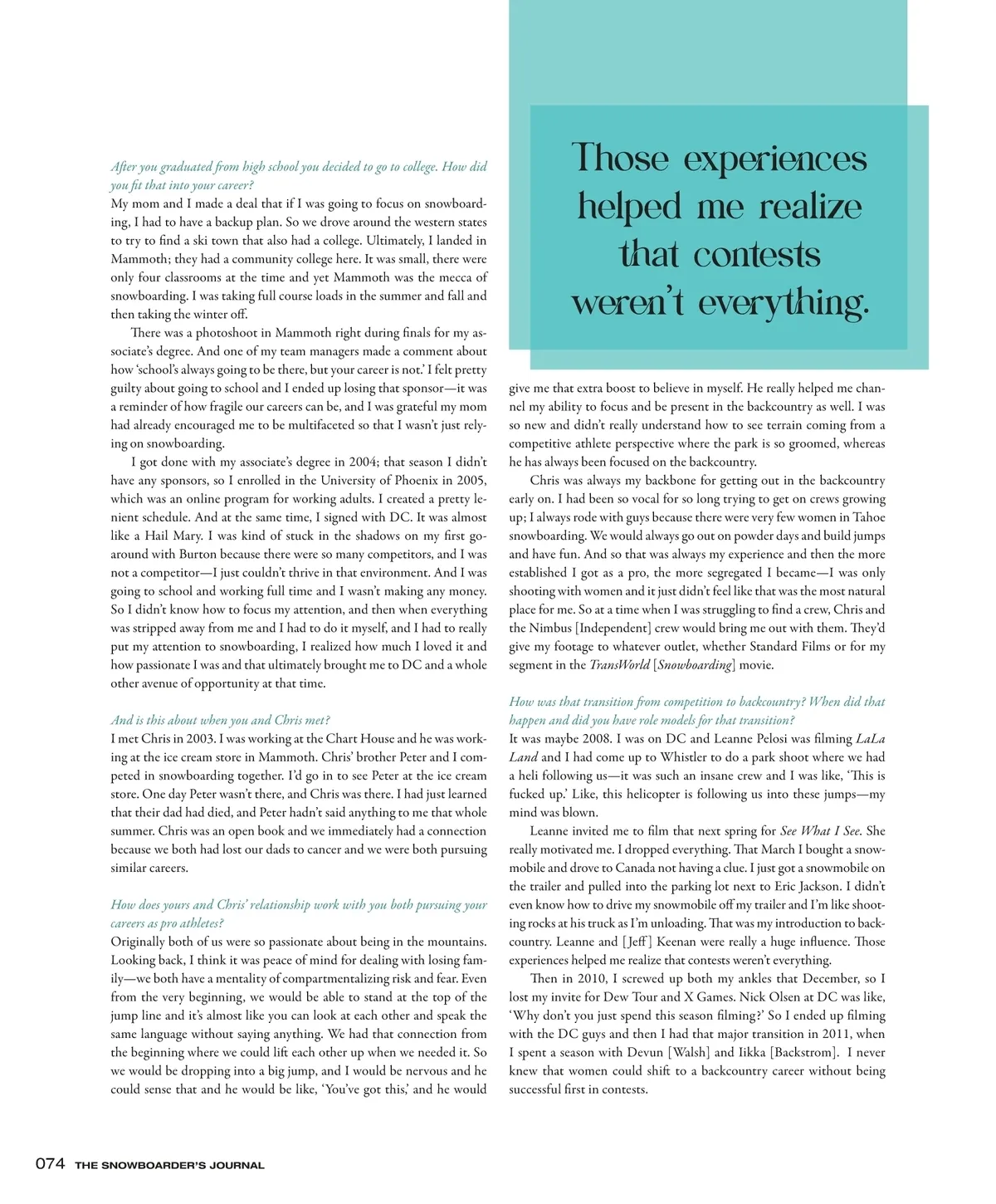
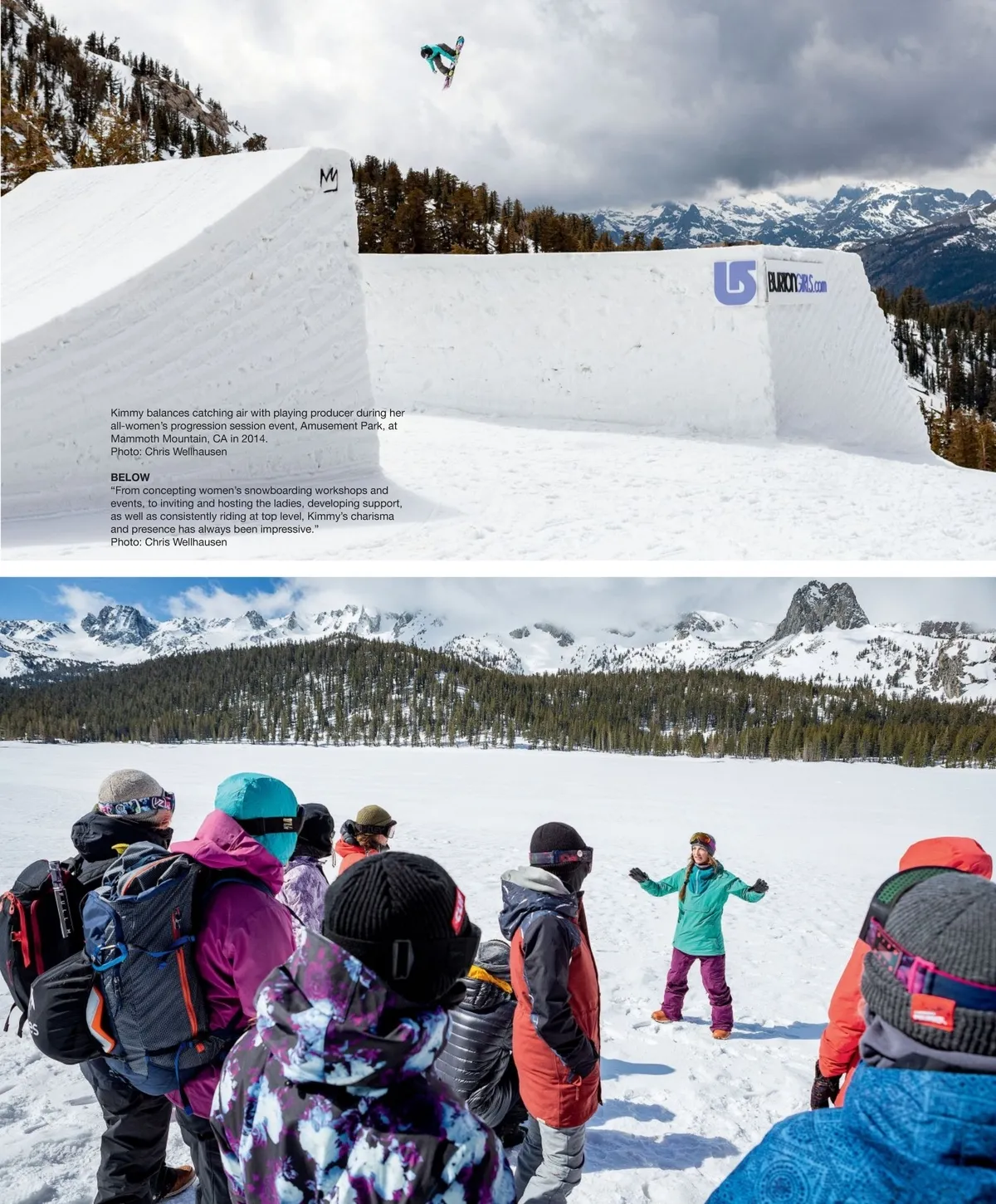
After you graduated from high school you decided to go to college. How did you fit that into your career? My mom and I made a deal that if I was going to focus on snowboard-ing, I had to have a backup plan. So we drove around the western states to try to find a ski town that also had a college. Ultimately, I landed in Mammoth; they had a community college here. It was small, there were only four classrooms at the time and yet Mammoth was the mecca of snowboarding. I was taking full course loads in the summer and fall and then taking the winter off. There was a photoshoot in Mammoth right during finals for my as-sociate’s degree. And one of my team managers made a comment about how ‘school’s always going to be there, but your career is not.’ I felt pretty guilty about going to school and I ended up losing that sponsor—it was a reminder of how fragile our careers can be, and I was grateful my mom had already encouraged me to be multifaceted so that I wasn’t just rely-ing on snowboarding. I got done with my associate’s degree in 2004; that season I didn’t have any sponsors, so I enrolled in the University of Phoenix in 2005, which was an online program for working adults. I created a pretty le-nient schedule. And at the same time, I signed with DC. It was almost like a Hail Mary. I was kind of stuck in the shadows on my first go-around with Burton because there were so many competitors, and I was not a competitor—I just couldn’t thrive in that environment. And I was going to school and working full time and I wasn’t making any money. So I didn’t know how to focus my attention, and then when everything was stripped away from me and I had to do it myself, and I had to really put my attention to snowboarding, I realized how much I loved it and how passionate I was and that ultimately brought me to DC and a whole other avenue of opportunity at that time. And is this about when you and Chris met? I met Chris in 2003. I was working at the Chart House and he was work-ing at the ice cream store in Mammoth. Chris’ brother Peter and I com-peted in snowboarding together. I’d go in to see Peter at the ice cream store. One day Peter wasn’t there, and Chris was there. I had just learned that their dad had died, and Peter hadn’t said anything to me that whole summer. Chris was an open book and we immediately had a connection because we both had lost our dads to cancer and we were both pursuing similar careers. How does yours and Chris’ relationship work with you both pursuing your careers as pro athletes? Originally both of us were so passionate about being in the mountains. Looking back, I think it was peace of mind for dealing with losing fam-ily—we both have a mentality of compartmentalizing risk and fear. Even from the very beginning, we would be able to stand at the top of the jump line and it’s almost like you can look at each other and speak the same language without saying anything. We had that connection from the beginning where we could lift each other up when we needed it. So we would be dropping into a big jump, and I would be nervous and he could sense that and he would be like, ‘You’ve got this,’ and he would Those expi ces helped me realize at contests w ’t evying. give me that extra boost to believe in myself. He really helped me chan-nel my ability to focus and be present in the backcountry as well. I was so new and didn’t really understand how to see terrain coming from a competitive athlete perspective where the park is so groomed, whereas he has always been focused on the backcountry. Chris was always my backbone for getting out in the backcountry early on. I had been so vocal for so long trying to get on crews growing up; I always rode with guys because there were very few women in Tahoe snowboarding. We would always go out on powder days and build jumps and have fun. And so that was always my experience and then the more established I got as a pro, the more segregated I became—I was only shooting with women and it just didn’t feel like that was the most natural place for me. So at a time when I was struggling to find a crew, Chris and the Nimbus [Independent] crew would bring me out with them. They’d give my footage to whatever outlet, whether Standard Films or for my segment in the TransWorld [ Snowboarding ] movie. How was that transition from competition to backcountry? When did that happen and did you have role models for that transition? It was maybe 2008. I was on DC and Leanne Pelosi was filming LaLa Land and I had come up to Whistler to do a park shoot where we had a heli following us—it was such an insane crew and I was like, ‘This is fucked up.’ Like, this helicopter is following us into these jumps—my mind was blown. Leanne invited me to film that next spring for See What I See . She really motivated me. I dropped everything. That March I bought a snow-mobile and drove to Canada not having a clue. I just got a snowmobile on the trailer and pulled into the parking lot next to Eric Jackson. I didn’t even know how to drive my snowmobile off my trailer and I’m like shoot-ing rocks at his truck as I’m unloading. That was my introduction to back-country. Leanne and [ Jeff ] Keenan were really a huge influence. Those experiences helped me realize that contests weren’t everything. Then in 2010, I screwed up both my ankles that December, so I lost my invite for Dew Tour and X Games. Nick Olsen at DC was like, ‘Why don’t you just spend this season filming?’ So I ended up filming with the DC guys and then I had that major transition in 2011, when I spent a season with Devun [Walsh] and Iikka [Backstrom]. I never knew that women could shift to a backcountry career without being successful first in contests. 074 THE SNOWBOARDER’S JOURNAL
The Snowboarder's Journal The Snowboarder's Journal 20.3: Page 74