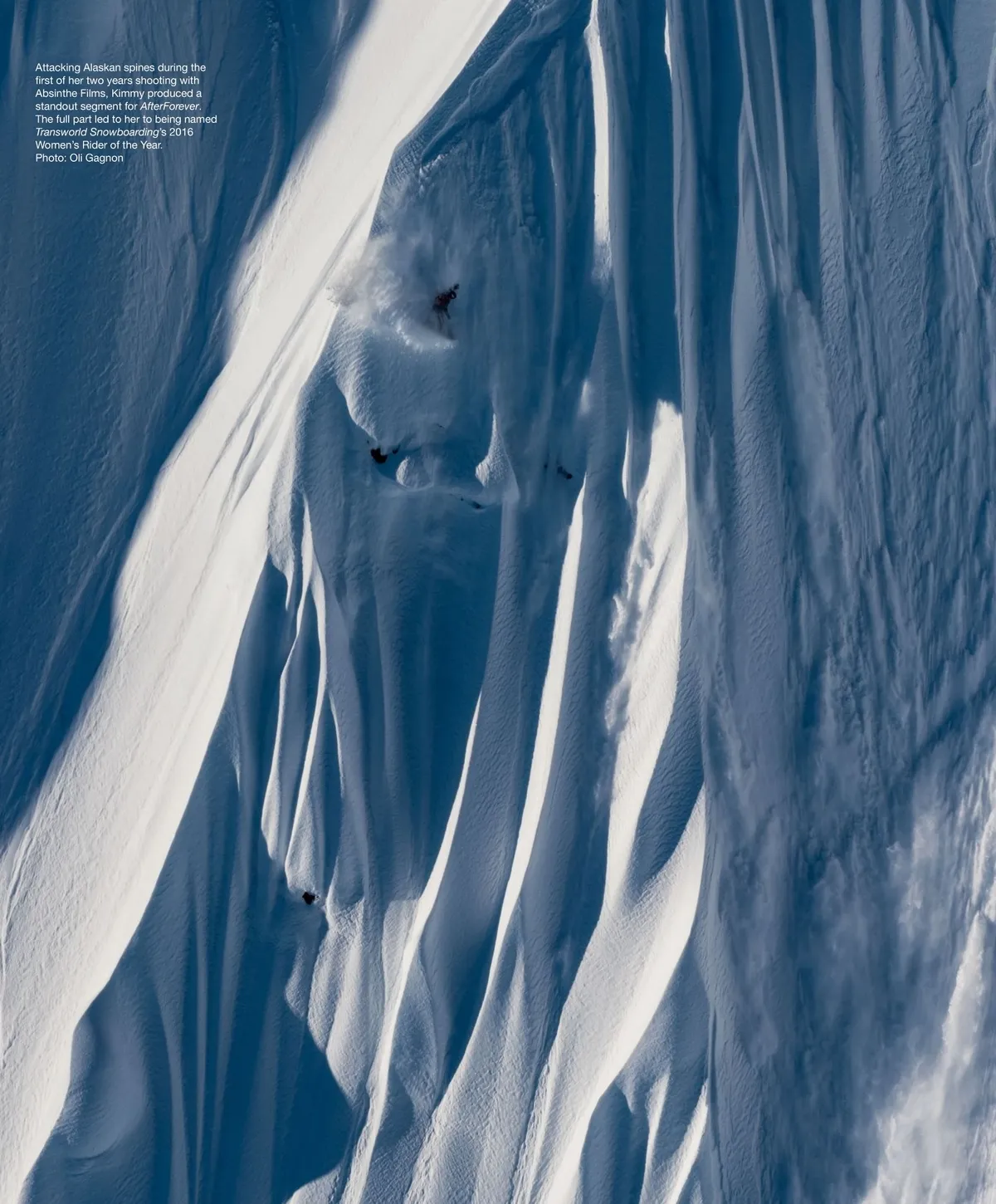
You had success at contests early on, but you don’t see yourself as having been a successful competitor? I feel like as soon as I started on the pro circuit, I choked. I couldn’t handle the pressure of somebody telling me to drop in, and I would make finals and then get last. I was such a scatterbrain. But once I got into the backcountry and I realized that I could land tricks right away, I understood that maybe there was a niche that I could fill, and that contests didn’t have to define my career even though that’s what I saw all my peers doing. But you took one more stab at contests? So basically, I come off that 2011 season; I have like mega-confidence because I just filmed with Devun and Iikka. I had been nominated for like four things—Stand Out Performance for doing the double backflip, Video Part of the Year… It was also a time of crazy transition because I left DC and went to Burton. So, with all that momentum, going into that 2012 season were the Olympic qualifiers. I hired a coach, Cody Rosen-thal, who’s an amazing friend of mine, to help me get back into park rid-ing and see if I could actually pull it together. And in early December, I drifted off a jump and did my ACL, MCL, PCL and broke my pelvis. That was the ultimate reminder that I was not meant to do contests. I was only doing it because that’s what I felt like I should do. In 1999, there was a newspaper article that came out in Truckee that was like ‘USASA national gold medalist is eyeing up the Olympics.’ I just always thought the Olympics was my career. So this major injury happened around the same time as you started Amusement Park at Mammoth? How did that come to be? It was in 2011 and I was really excited to do the double backflip in the park—I’d done it in the backcountry and there were a lot of naysayers, which was fine. I wanted to build a jump so that I could do that trick in the park; I was still filming for Standard at the time and Mammoth was really supportive. I invited a handful of girls: Jamie Anderson, Erin Comstock, Raewyn Reid, Kristi Leskinen. And that was the kickoff con-cept; it was more of a fun shred that had no pressure. We were filming it, but it wasn’t designed to be competitive. It was so fun and really pushed me to progress my riding and I realized that it’d be amazing to provide this kind of platform for the rest of the industry because at the time all we had was Superpark. That was a great step for women’s snowboarding to find progression outside of contests. I wanted there to be no pressure on this event, but I wanted to pro-vide editorial and I wanted women to be able to come session together. In 2011, I had that event in Mammoth and then I had that injury and de-cided OK well now’s the time I’m a year off snow. So I built out Amuse-ment Park as an actual event and Mammoth helped build a massive jump and an amazing roster of women showed up. I also had a Burton Girls ride day and a hundred women showed up for yoga. From that point I just was like, ‘I’m going to do whatever it takes to make this a year-after-year event.’ It ran for five years and it was awesome. Then I got to a point where I wasn’t riding park anymore. It just wasn’t where I felt inspired. That’s why I decided to transition it into Amusement MTN, a backcountry event, because I felt like there was also a huge lack there. I’ve always be le to make a pl d execute e pl — wh you’re diagnosed wi c c, you’re stripped of all of at. I had been fighting so hard to get on crews and the biggest thing when joining a crew is your knowledge. It had taken me eight years to gain all this knowledge; I thought maybe I could expedite a handful of women’s learning curve to give them an edge to get out in the backcoun-try and be a reliable partner. And I wanted to get more young women educated in backcountry awareness. That way we could all really move this needle and be an asset. And you can’t always trust the crew that you’re with—you need to have your own knowledge. Everybody that joined had to take an AIARE 1 avalanche course and then in the spring we would regroup and apply all the skills and pick out a face and then choose lines and we would have photographers and filmers. It’s a safe place for women to learn without feeling like they’re being judged. You were busy planning Amusement MTN ahead of last winter. What else was going on in your life before you unexpectedly received your cancer diagnosis? Chris’ brother and his family were in town because it was just about Thanksgiving. And I was just coming off being pregnant, so I hadn’t had a winter on my board. I had some complications with placenta previa, so they were adamant that I be mindful with activity. Zep was nine-and-a-half months. I was regaining my strength but really excited to get back on snow. I had all these ideas of what we were going to do and getting ready. Being that the world was still shut down, we had just bought this cabin in Mammoth. We had been talking to Warren Miller [Entertainment] about doing a segment about life at the cabin, showcasing how we could be in Mammoth with both kids instead of traveling the world like we had with Koa. We decided to try to plant some roots and stay home—we were just hoping that it would snow. We had a lot of objectives around Mammoth that we wanted to tackle. KIMMY FASANI 077
The Snowboarder's Journal The Snowboarder's Journal 20.3: Page 77