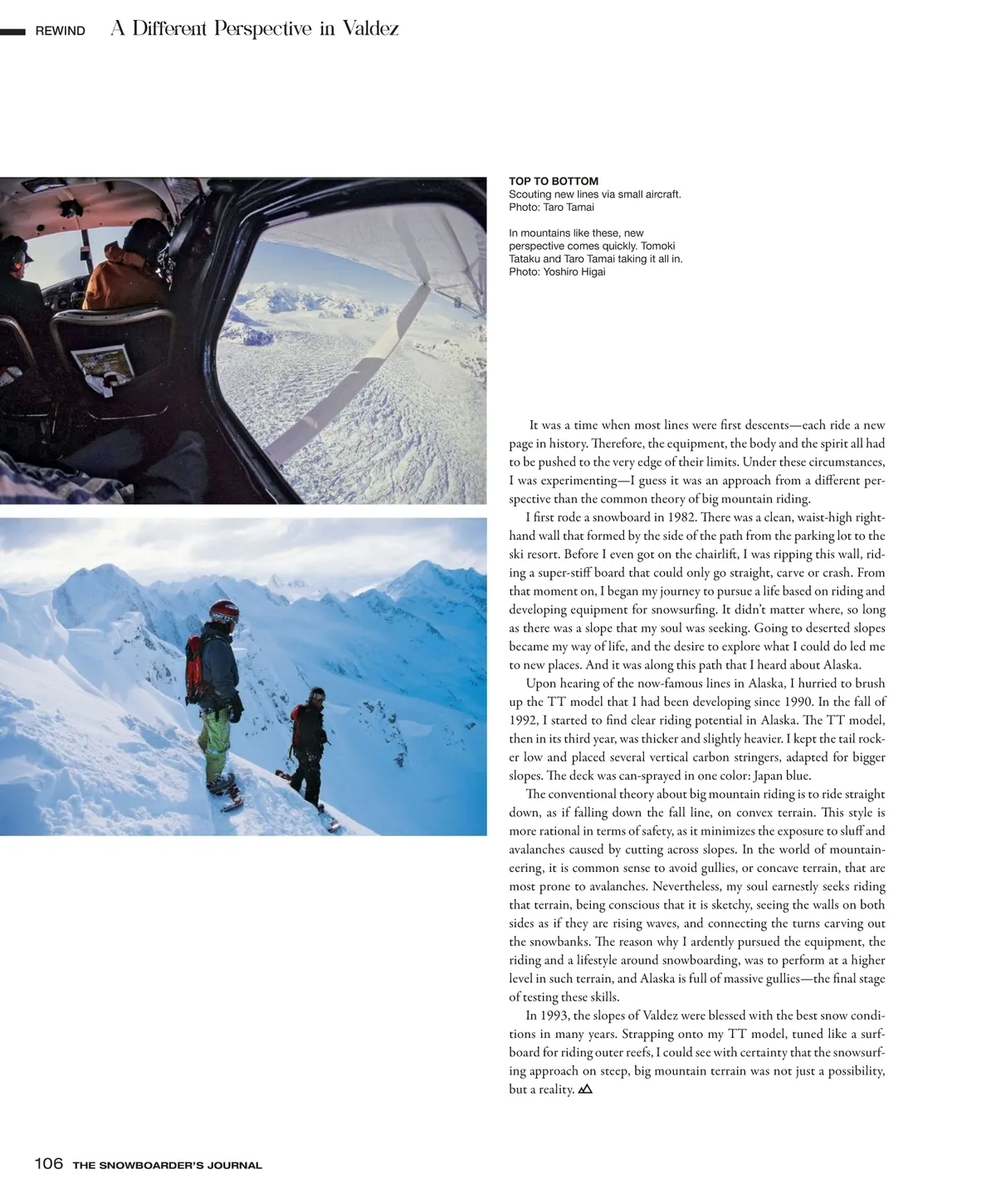
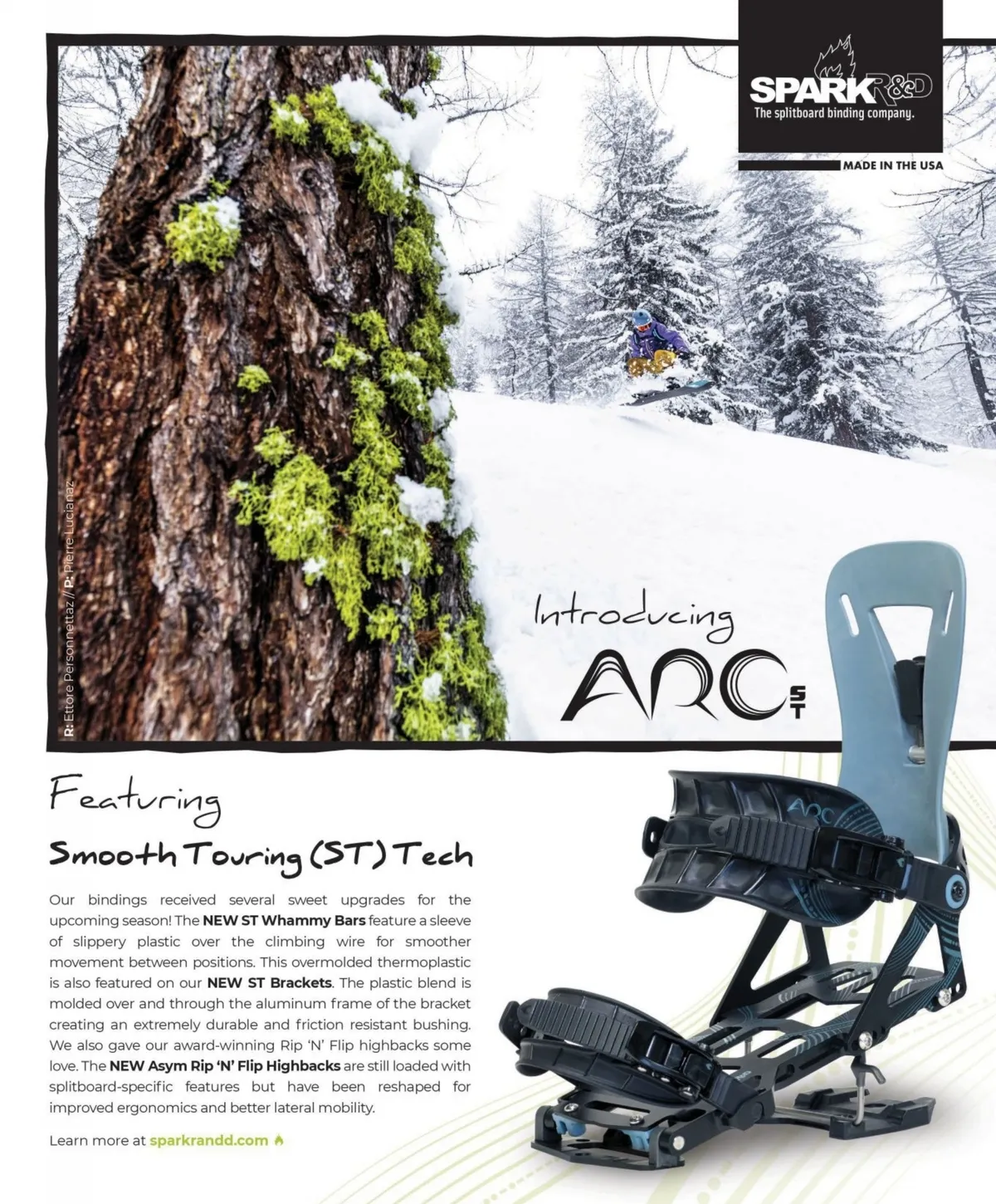
REWIND A Diff t P spective in Valdez TOP TO BOTTOM Scouting new lines via small aircraft. Photo: Taro Tamai In mountains like these, new perspective comes quickly. Tomoki Tataku and Taro Tamai taking it all in. Photo: Yoshiro Higai It was a time when most lines were first descents—each ride a new page in history. Therefore, the equipment, the body and the spirit all had to be pushed to the very edge of their limits. Under these circumstances, I was experimenting—I guess it was an approach from a different per-spective than the common theory of big mountain riding. I first rode a snowboard in 1982. There was a clean, waist-high right-hand wall that formed by the side of the path from the parking lot to the ski resort. Before I even got on the chairlift, I was ripping this wall, rid-ing a super-stiff board that could only go straight, carve or crash. From that moment on, I began my journey to pursue a life based on riding and developing equipment for snowsurfing. It didn’t matter where, so long as there was a slope that my soul was seeking. Going to deserted slopes became my way of life, and the desire to explore what I could do led me to new places. And it was along this path that I heard about Alaska. Upon hearing of the now-famous lines in Alaska, I hurried to brush up the TT model that I had been developing since 1990. In the fall of 1992, I started to find clear riding potential in Alaska. The TT model, then in its third year, was thicker and slightly heavier. I kept the tail rock-er low and placed several vertical carbon stringers, adapted for bigger slopes. The deck was can-sprayed in one color: Japan blue. The conventional theory about big mountain riding is to ride straight down, as if falling down the fall line, on convex terrain. This style is more rational in terms of safety, as it minimizes the exposure to sluff and avalanches caused by cutting across slopes. In the world of mountain-eering, it is common sense to avoid gullies, or concave terrain, that are most prone to avalanches. Nevertheless, my soul earnestly seeks riding that terrain, being conscious that it is sketchy, seeing the walls on both sides as if they are rising waves, and connecting the turns carving out the snowbanks. The reason why I ardently pursued the equipment, the riding and a lifestyle around snowboarding, was to perform at a higher level in such terrain, and Alaska is full of massive gullies—the final stage of testing these skills. In 1993, the slopes of Valdez were blessed with the best snow condi-tions in many years. Strapping onto my TT model, tuned like a surf-board for riding outer reefs, I could see with certainty that the snowsurf-ing approach on steep, big mountain terrain was not just a possibility, but a reality. 106 THE SNOWBOARDER’S JOURNAL
The Snowboarder's Journal The Snowboarder's Journal 20.4: Page 106