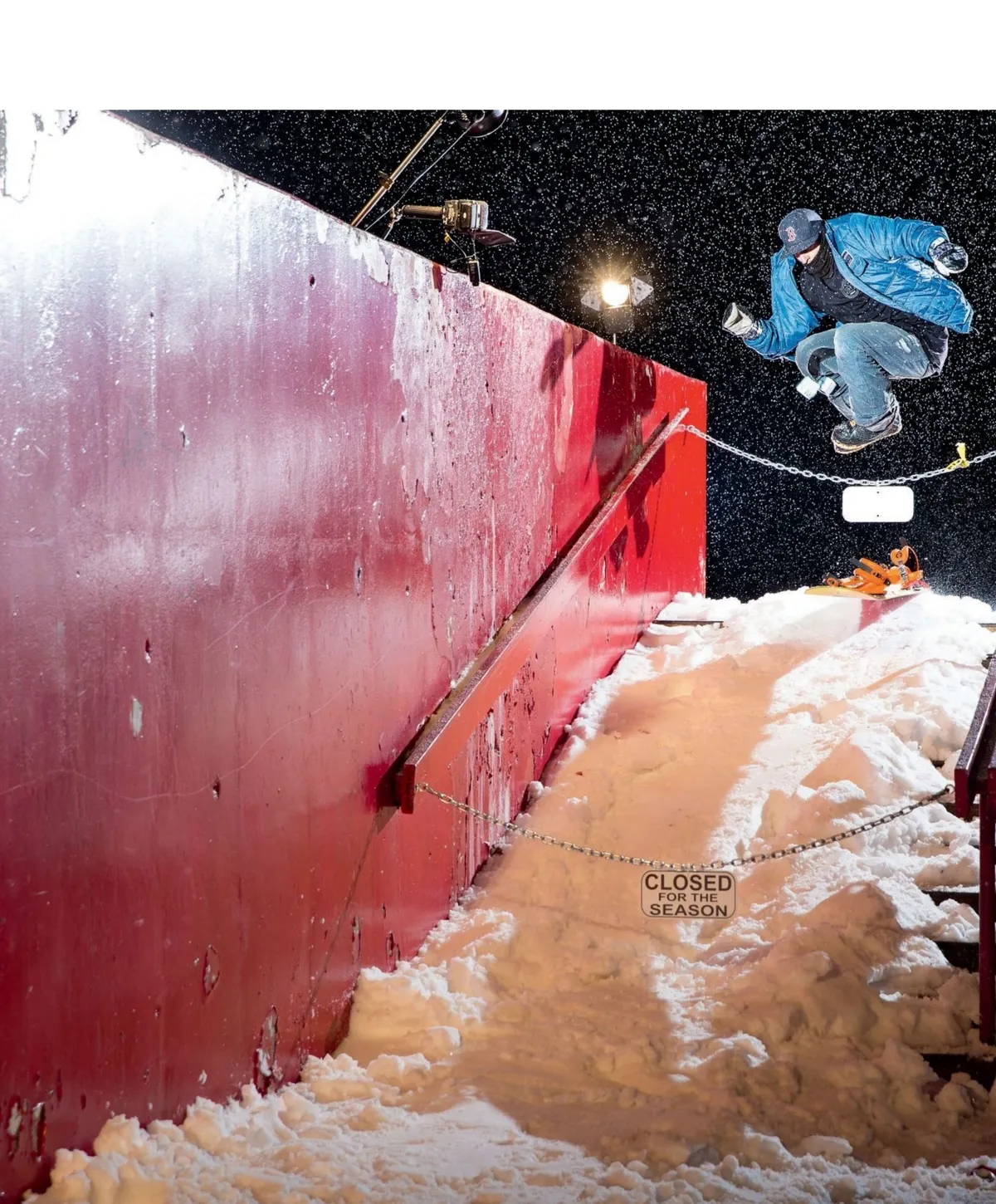
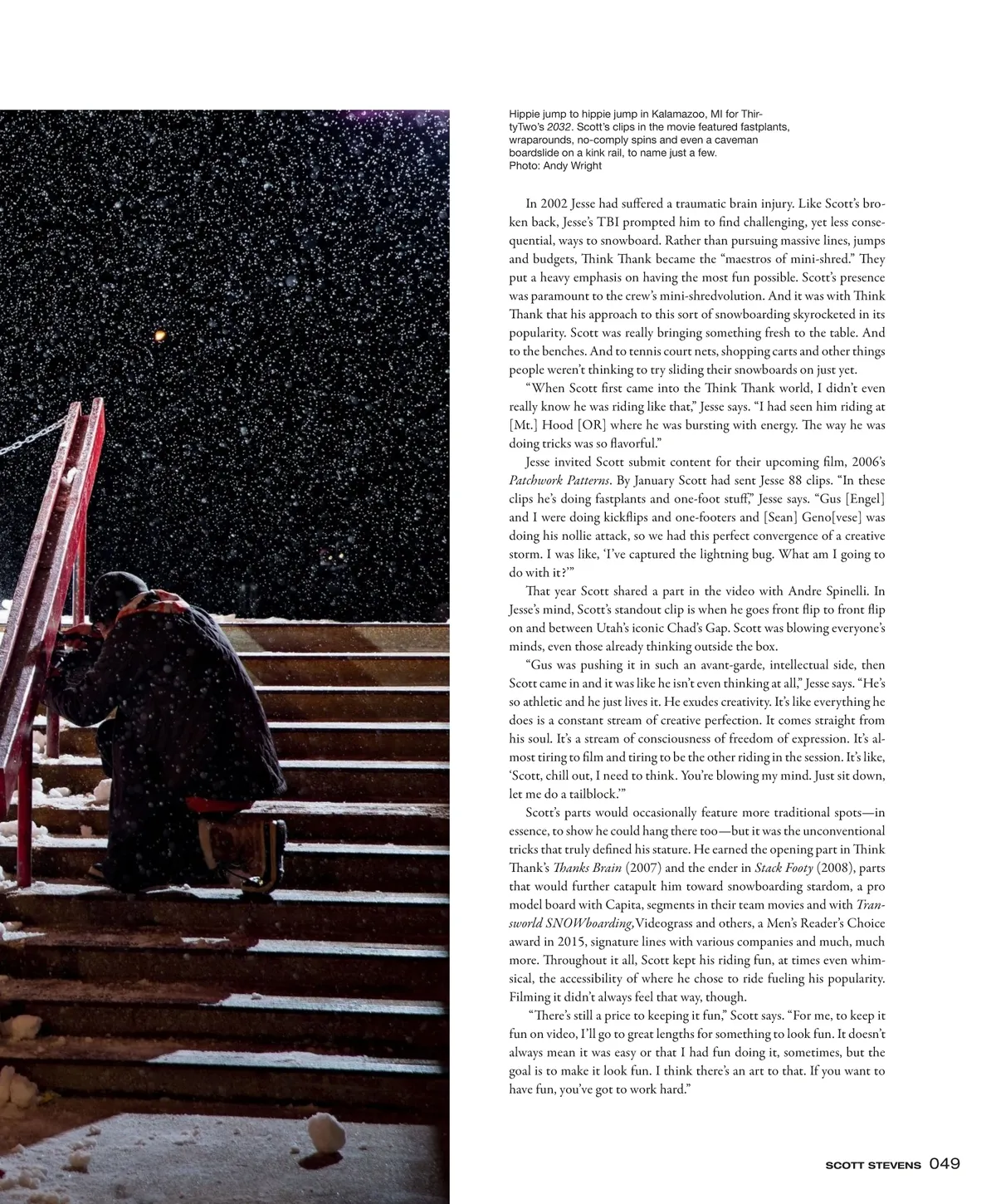
Hippie jump to hippie jump in Kalamazoo, MI for Thir-tyTwo’s 2032 . Scott’s clips in the movie featured fastplants, wraparounds, no-comply spins and even a caveman boardslide on a kink rail, to name just a few. Photo: Andy Wright In 2002 Jesse had suffered a traumatic brain injury. Like Scott’s bro-ken back, Jesse’s TBI prompted him to find challenging, yet less conse-quential, ways to snowboard. Rather than pursuing massive lines, jumps and budgets, Think Thank became the “maestros of mini-shred.” They put a heavy emphasis on having the most fun possible. Scott’s presence was paramount to the crew’s mini-shredvolution. And it was with Think Thank that his approach to this sort of snowboarding skyrocketed in its popularity. Scott was really bringing something fresh to the table. And to the benches. And to tennis court nets, shopping carts and other things people weren’t thinking to try sliding their snowboards on just yet. “When Scott first came into the Think Thank world, I didn’t even really know he was riding like that,” Jesse says. “I had seen him riding at [Mt.] Hood [OR] where he was bursting with energy. The way he was doing tricks was so flavorful.” Jesse invited Scott submit content for their upcoming film, 2006’s Patchwork Patterns . By January Scott had sent Jesse 88 clips. “In these clips he’s doing fastplants and one-foot stuff,” Jesse says. “Gus [Engel] and I were doing kickflips and one-footers and [Sean] Geno[vese] was doing his nollie attack, so we had this perfect convergence of a creative storm. I was like, ‘I’ve captured the lightning bug. What am I going to do with it?’” That year Scott shared a part in the video with Andre Spinelli. In Jesse’s mind, Scott’s standout clip is when he goes front flip to front flip on and between Utah’s iconic Chad’s Gap. Scott was blowing everyone’s minds, even those already thinking outside the box. “Gus was pushing it in such an avant-garde, intellectual side, then Scott came in and it was like he isn’t even thinking at all,” Jesse says. “He’s so athletic and he just lives it. He exudes creativity. It’s like everything he does is a constant stream of creative perfection. It comes straight from his soul. It’s a stream of consciousness of freedom of expression. It’s al-most tiring to film and tiring to be the other riding in the session. It’s like, ‘Scott, chill out, I need to think. You’re blowing my mind. Just sit down, let me do a tailblock.’” Scott’s parts would occasionally feature more traditional spots—in essence, to show he could hang there too—but it was the unconventional tricks that truly defined his stature. He earned the opening part in Think Thank’s Thanks Brain (2007) and the ender in Stack Footy (2008), parts that would further catapult him toward snowboarding stardom, a pro model board with Capita, segments in their team movies and with Tran-sworld SNOWboarding, Videograss and others, a Men’s Reader’s Choice award in 2015, signature lines with various companies and much, much more. Throughout it all, Scott kept his riding fun, at times even whim-sical, the accessibility of where he chose to ride fueling his popularity. Filming it didn’t always feel that way, though. “There’s still a price to keeping it fun,” Scott says. “For me, to keep it fun on video, I’ll go to great lengths for something to look fun. It doesn’t always mean it was easy or that I had fun doing it, sometimes, but the goal is to make it look fun. I think there’s an art to that. If you want to have fun, you’ve got to work hard.” SCOTT STEVENS 049
The Snowboarder's Journal The Snowboarder's Journal 20.4: Page 49