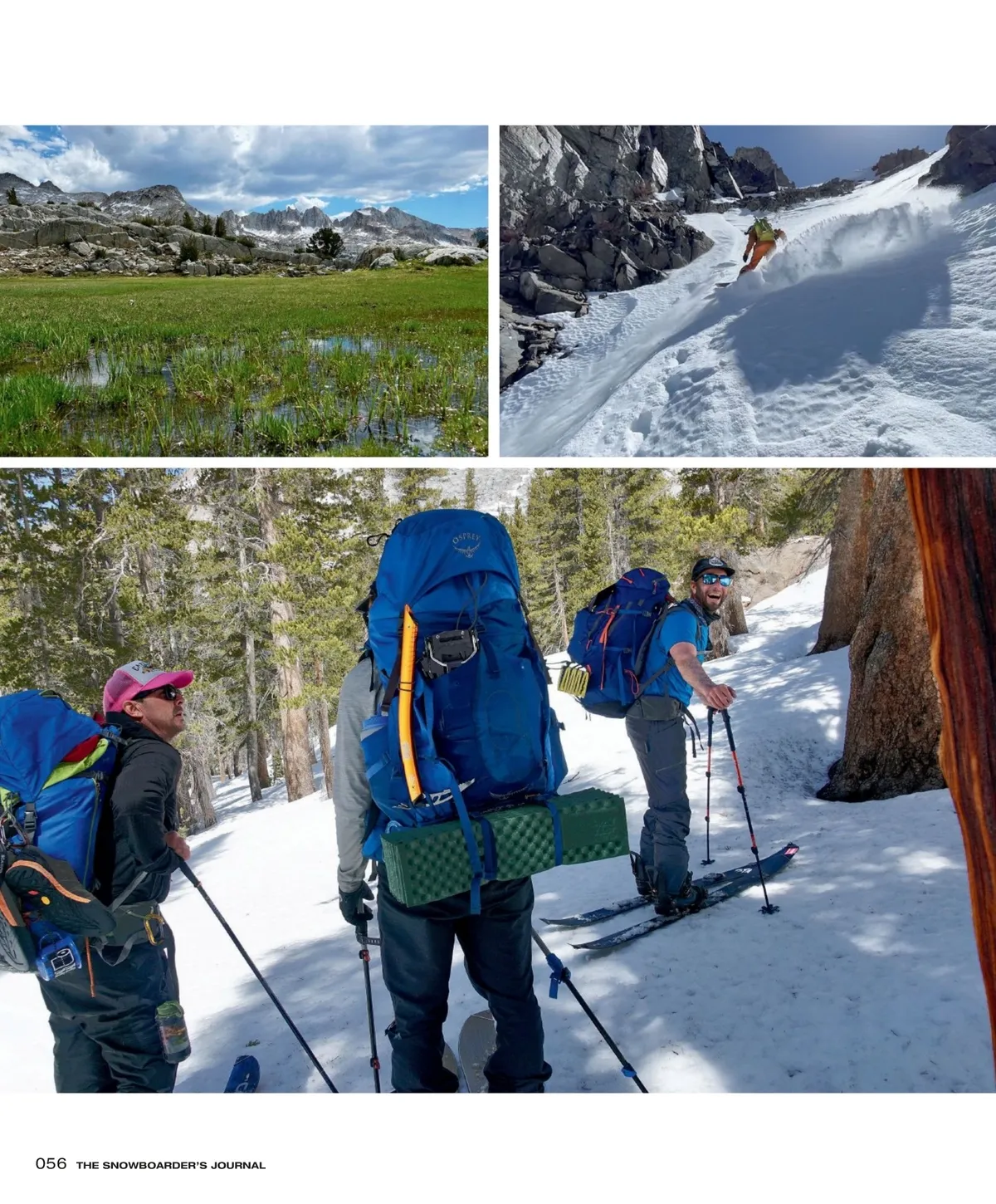
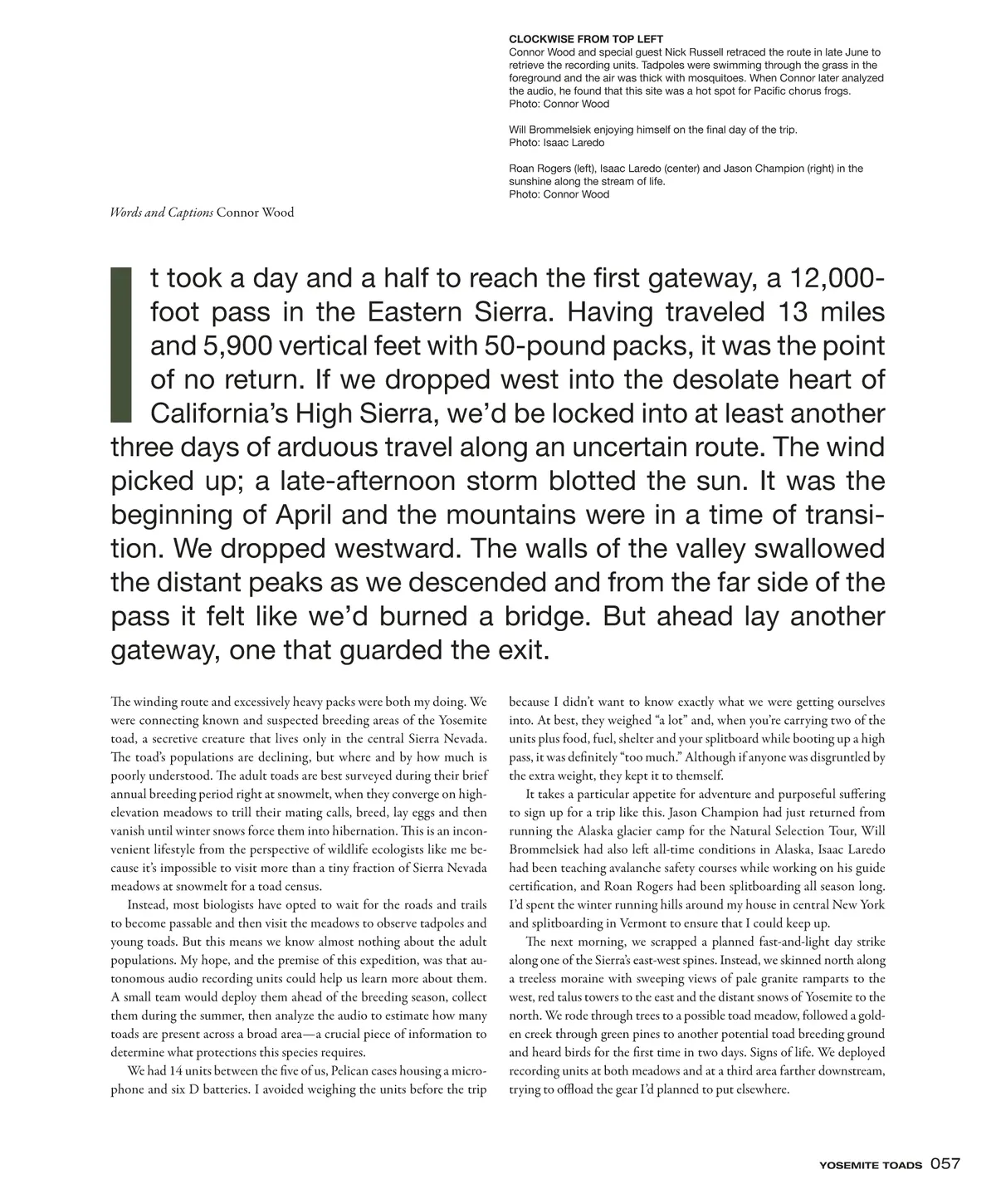
CLOCKWISE FROM TOP LEFT Connor Wood and special guest Nick Russell retraced the route in late June to retrieve the recording units. Tadpoles were swimming through the grass in the foreground and the air was thick with mosquitoes. When Connor later analyzed the audio, he found that this site was a hot spot for Pacific chorus frogs. Photo: Connor Wood Will Brommelsiek enjoying himself on the final day of the trip. Photo: Isaac Laredo Roan Rogers (left), Isaac Laredo (center) and Jason Champion (right) in the sunshine along the stream of life. Photo: Connor Wood Words and Captions Connor Wood I t took a day and a half to reach the first gateway, a 12,000-foot pass in the Eastern Sierra. Having traveled 13 miles and 5,900 vertical feet with 50-pound packs, it was the point of no return. If we dropped west into the desolate heart of California’s High Sierra, we’d be locked into at least another three days of arduous travel along an uncertain route. The wind picked up; a late-afternoon storm blotted the sun. It was the beginning of April and the mountains were in a time of transi-tion. We dropped westward. The walls of the valley swallowed the distant peaks as we descended and from the far side of the pass it felt like we’d burned a bridge. But ahead lay another gateway, one that guarded the exit. The winding route and excessively heavy packs were both my doing. We were connecting known and suspected breeding areas of the Yosemite toad, a secretive creature that lives only in the central Sierra Nevada. The toad’s populations are declining, but where and by how much is poorly understood. The adult toads are best surveyed during their brief annual breeding period right at snowmelt, when they converge on high-elevation meadows to trill their mating calls, breed, lay eggs and then vanish until winter snows force them into hibernation. This is an incon-venient lifestyle from the perspective of wildlife ecologists like me be-cause it’s impossible to visit more than a tiny fraction of Sierra Nevada meadows at snowmelt for a toad census. Instead, most biologists have opted to wait for the roads and trails to become passable and then visit the meadows to observe tadpoles and young toads. But this means we know almost nothing about the adult populations. My hope, and the premise of this expedition, was that au-tonomous audio recording units could help us learn more about them. A small team would deploy them ahead of the breeding season, collect them during the summer, then analyze the audio to estimate how many toads are present across a broad area—a crucial piece of information to determine what protections this species requires. We had 14 units between the five of us, Pelican cases housing a micro-phone and six D batteries. I avoided weighing the units before the trip because I didn’t want to know exactly what we were getting ourselves into. At best, they weighed “a lot” and, when you’re carrying two of the units plus food, fuel, shelter and your splitboard while booting up a high pass, it was definitely “too much.” Although if anyone was disgruntled by the extra weight, they kept it to themself. It takes a particular appetite for adventure and purposeful suffering to sign up for a trip like this. Jason Champion had just returned from running the Alaska glacier camp for the Natural Selection Tour, Will Brommelsiek had also left all-time conditions in Alaska, Isaac Laredo had been teaching avalanche safety courses while working on his guide certification, and Roan Rogers had been splitboarding all season long. I’d spent the winter running hills around my house in central New York and splitboarding in Vermont to ensure that I could keep up. The next morning, we scrapped a planned fast-and-light day strike along one of the Sierra’s east-west spines. Instead, we skinned north along a treeless moraine with sweeping views of pale granite ramparts to the west, red talus towers to the east and the distant snows of Yosemite to the north. We rode through trees to a possible toad meadow, followed a gold-en creek through green pines to another potential toad breeding ground and heard birds for the first time in two days. Signs of life. We deployed recording units at both meadows and at a third area farther downstream, trying to offload the gear I’d planned to put elsewhere. YOSEMITE TOADS 057
The Snowboarder's Journal The Snowboarder's Journal 20.4: Page 57