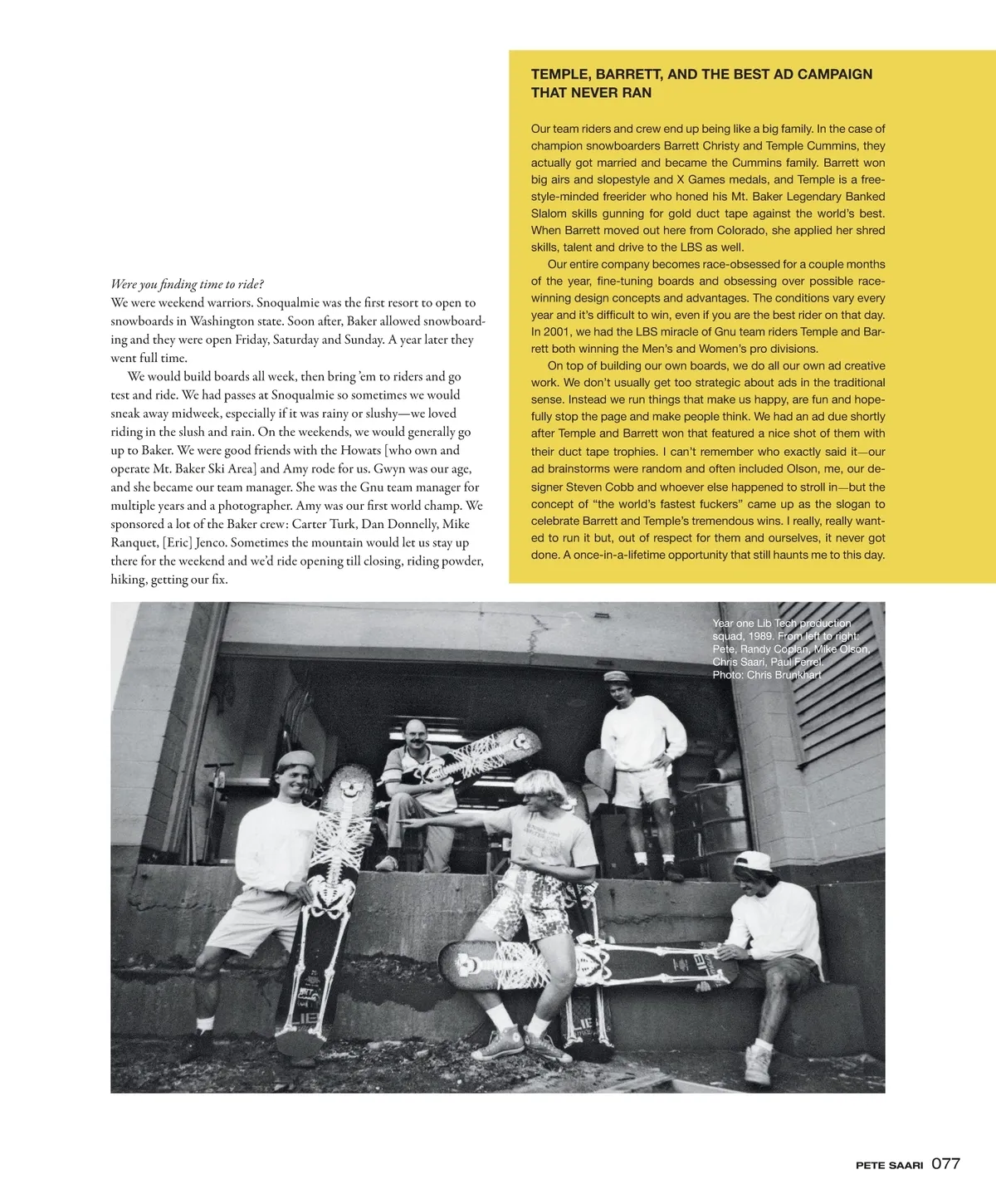
When did Mervin Manufacturing become a thing? Mervin started when we lost Gnu, in ’88 or ’89. In the mid-’80s, we were building as fast as we could, but that meant one or two boards per day—vacuum-bag one-offs. We got our first shop in Cloverdale, which was a rough part of Seattle. It got to the point where our business partner, Fred Lomax, was very into making money, and Mike and I were very into making boards. It wasn’t that we weren’t into making money, it just wasn’t our priority—we were into building boards to ride ’em. Fred was a windsurfer and he lined us up with a distributor called Wind Line and, all of a sudden, the snowboarding market blew up. We couldn’t build enough. Mike met Walter Knauder, who ran a factory called Pale Ski in Austria. We built prototypes then went over there and taught them what snowboards were and how we wanted them built and brought them inserts and a few other components they didn’t have, and the concepts, the geometries. They started building us the green Anti-Gravitys and the green Hyper-Carves, the 166 and the 156. We were still building all the prototypes for the team guys like Dan Donnelly, Amy Howat and Carter Turk—I was building all those. We had one year where Pale only built our boards. Then we went to a trade show and Jamie Salter from Kemper followed Mike in and realized where we were getting our boards built. He met with Pale and Walter and started doing more boards and eventually just bought out the whole production. We realized, anyways, that the Austrian boards weren’t the quality we wanted. The flexes were varying radically. A lot of people loved them, and people did great things on them, but they weren’t as good as what we were making ourselves. That experience is a big part of what made Mike and I bring all our manufacturing back to the U.S. and do it ourselves—we wanted control over flex, we wanted control over quality. We wanted to be able to experiment, we wanted to be board builders. MCA WON’T RAP Mike and I were into punk rock and obscure thrift shop tapes, but Matt Cummins had introduced us to the Beastie Boys Licensed to ILL (1986) when it first came out. We used to listen to them on road trips to the mountains all the time. One day I was working alone in our factory on North Pacific by Gasworks Park in Seattle getting ready to layup some boards, and the phone rang. Mike and I never used to answer the phone because if we got on the phone that meant we were gonna get stuck on the phone and not get any work done. But for some reason I picked it up this time, and the guy on the other end introduced himself as Adam from the Beastie Boys. I was feeling a bit sassy and thought for sure this guy was bullshitting. He was saying he wanted to buy a snowboard, so I told him he could if he busted some rhymes right now. He wouldn’t do it and I kept hassling him— he said I wasn’t “cutting him no slack,” but he held his line. Eventu-ally, I figured it out it was actually MCA, and we started sending him boards for quite a few years after that. He passed way too soon. Looking back at what those guys did, it is amazing seeing how they navigated learning, change and growth. I felt like there were some similarities between their approach and the energy Mike and I brought to our snowboards and life. We worked at a different scale of course, but their work and their projects are still inspiring today. How were you making it work financially? We were barely making it. Mike had a bank loan that got spent by someone who might have been more focused on themselves than the business, but we were eventually able to pay that off. We had an inves-tor, Randy Copeland, who believed in snowboarding—he mortgaged his house and ran another business called Printing Control. He gave us business advice. Another friend of Randy’s mortgaged their house. These two older families believed in us and took risks, and we were building boards and selling them. We made money in the Pale years— snowboarding blew up and we sold a lot of boards—but eventually our distributor one year didn’t want to build tools for a new board we had made, the Vertigo, that was a twin with a rolled bottom. Wind Line had taken over the relationship with Pale. They owed us royalties on boards and they didn’t pay us. In the late ’80s, we lost Gnu. Wind Line took that 400 grand they owed us and used it to buy wind-surf gear and later start Nitro. They asked us to work for Nitro and we did—we built all the first Nitro prototypes for them. We did the Pyro with the asymmetric sidecut. We did a bunch of their race boards. But we couldn’t continue to work for them because they didn’t pay us. They had screwed us. We didn’t have a plan B, but we needed a new name and Mike had built a skateboard as a side project using a lace pattern as a backing and called it a Liberace Technology, ’cause it looked shimmery like a sparkly Liberace suit. So we regrouped and started Mervin Manufacturing and Lib Technologies with Randy, Mike and I owning the business. Randy helped finance it. Wind Line had told us we couldn’t do this skeleton graphic that our friend Mark Gale had made—they said it would never sell. When we started Lib Tech, we put that graphic on. We were pissed off when we started Lib Tech. When Gnu was built, it was young and fun and friendly. When we started Lib, we had gone through hard knocks. We did skeletons on every board. The first year [1989] we sold about 1,500 Lib Techs—everything we could make, direct to dealers. We were our own distributor and shipped ourselves and built all the boards our-selves. From then on, we were making money, we were able to pay back all our vendors and run a legit business. We were able to buy the Gnu name back a year later for not much money. From then on, we’ve been piecing it together by making smart material decisions, working hard, and pricing the boards in a place that allows us to be profitable. We were working 12, 14 hours a day, seven days a week. All our friends were partying. One time we stayed up three days straight with no drugs and built boards nonstop. We built our own tooling. We studied materials and figured out that in some cases the least expensive, most environmentally friendly material solution was also the best solution for snowboards. Like wood cores—fast-growing woods that most people didn’t want to use that were light and lively worked great for snowboards. They happened to be some of the less-expensive materials. We didn’t have money, but we had a lot of heart, a lot of passion, some brains, enough athletic talent to ride ourselves—and the whole combina-tion worked for us. 076 THE SNOWBOARDER’S JOURNAL
The Snowboarder's Journal The Snowboarder's Journal 20.4: Page 76