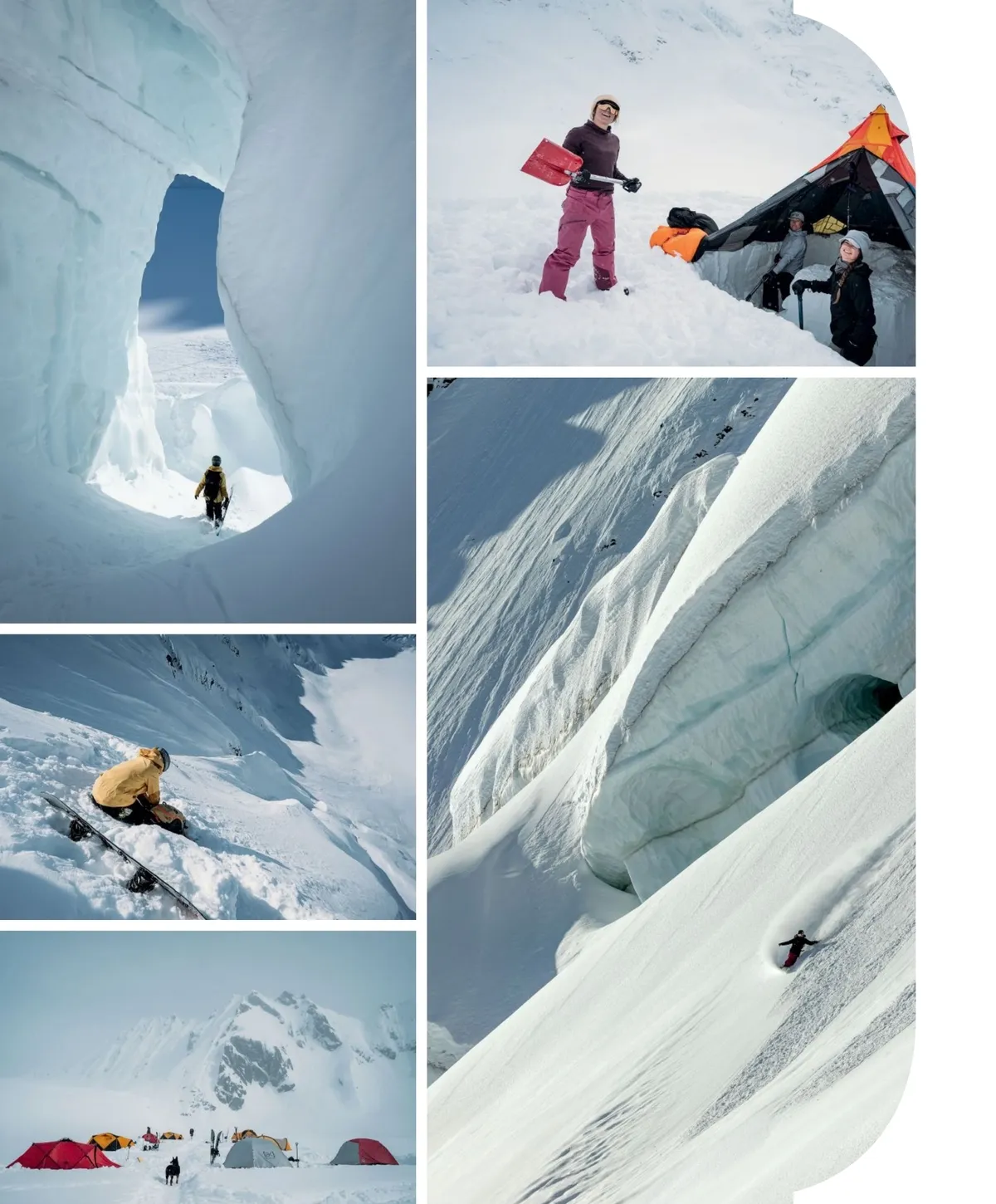
CLOCKWISE FROM TOP LEFT Robin humbled by the sheer vastness of Alaska. Photo: Michelle Parker Robin Van Gyn, Elena Hight and Michelle Parker tend to some down day chores. Photo: Leslie Hittmeier “The Abominable Snowman finally getting his Dwell -worthy front entrance in print. Elena Hight with a foreground appearance.” – Robin Van Gyn Photo: Aaron Blatt Home on the glacier. Photo: Leslie Hittmeier Robin transitions from sharp edging to smooth sliding. No way out but down. Photo: Leslie Hittmeier I n the process of building camp, the snow seemed better than we had previously thought. With tons of sun in the forecast and one little reset on the way, we optimistically took our time building the perfect little village. One of my favorite things about glacier camping is the setup process—seeing how efficient you can make your tent scene, how dry you can keep your gear, how organized your socks and hats can be, creating a hygiene cor-ner, seeing how much power you can get from your solar rig—it’s a game and we all compete. Nothing lights me up more than feel-ing like I could stay for months on end in the wild. Everyone’s snow yard was sculpted differently, and it was a fun neighborhood stroll checking out the landscaping. Our tents were neatly spaced on either side of the main street, slightly offset from our neigh-bors across the way. The road led to the cook tent and up toward our jacket tent, which provided a functional hang and scope zone. Justin and Elena constructed wind walls, while Jeff, Shane and I had gear storage and drying areas. Blatt and Michelle, alongside Leslie and Ben, had main house and ADU (accessory dwelling unit) style lots. Then there was Rafe with a bench specifically made for our resident squirrel Chippy (a literal lawn ornament) and our volleyball, Wilson. We started slow, knowing there was time, scoping ascents and descents to give ourselves extensive possibilities. When the sun is out it’s hard not to jump on the first thing you see, but easing into it is always a good progression so you are ready for action when conditions fall into place. It was time to get closer to Nautilus— to check the dipstick before starting the real journey. In creating a mental terrain map, we learn a lot about differ-ent perspectives and past experiences. Sometimes we see the same things, but sometimes you pretend to know what “hump” your riding partner is talking about when describing a line. We all note the light, and the lines we think we see—it takes creative collabo-ration to reach an overall plan. When you don’t have technol-ogy to rely upon for access and avalanche reports, you learn to take bits of strength from each person to create a cohesive and powerful whole; you communicate like your life depends on it, because it does. It’s fun. When everyone’s voice is accounted for it becomes a true collaboration of cumulative time in the moun-tains, each person drawing upon their own knowledge base. Find-ing out who is best at what and leaning into that creates a perfect landscape to acquire more of the skills we individually bring to the table. Yet our first line brought us down from our sunny outlook. We climbed for an hour and a half in firm and variable snow. Some-times the ascent can give you a good idea what it will be like on the way down. On the other hand, we usually hike up protected runnels of frozen sluff that are adjacent to the spines themselves, so there is always hope that the differing aspect and terrain fea-tures will hold better snow. This time, it didn’t. What looked creamy was more of a stay-on-your-edge-and-ride-with-your-ice-axe-in-hand scenario. A learning moment: if the hike straight up the line seems sus, think about what the ride down might be like before going too far. We laughed it off and relived the hairball moments, then pivoted focus to the main objective right above camp: the longest and best-looking lines in the zone. As the days started to stack, we found a rhythm of breakfast meetings, nighttime games, and a hell of a lot of laughing. Rafe’s antics with Chippy and constant ridiculousness kept the mood light. We learned who would be ready first (Elena), who always has a lighter (Rafe), and who not to speak to before coffee (me)— it was fast-track familiarization. On top of learning each other’s personal nuances, the inherent down time and off-grid nature of glacier camping leads to hearing the best stories from everyone’s lives on the road—an unfolding of life that is only shared when you have the nothingness of time for idle chit-chat. It’s real time with real people, and I loved listening to everyone’s best and most exhilarating mountain experiences, alongside the “almost died” stories that teach good lessons. It is in these in-between moments that you build trust and become tighter as a crew. But as nice as the downtime may be, we go to the mountains to ride. ALASKA RANGE 043
The Snowboarder's Journal The Snowboarder's Journal 21.2: Page 43