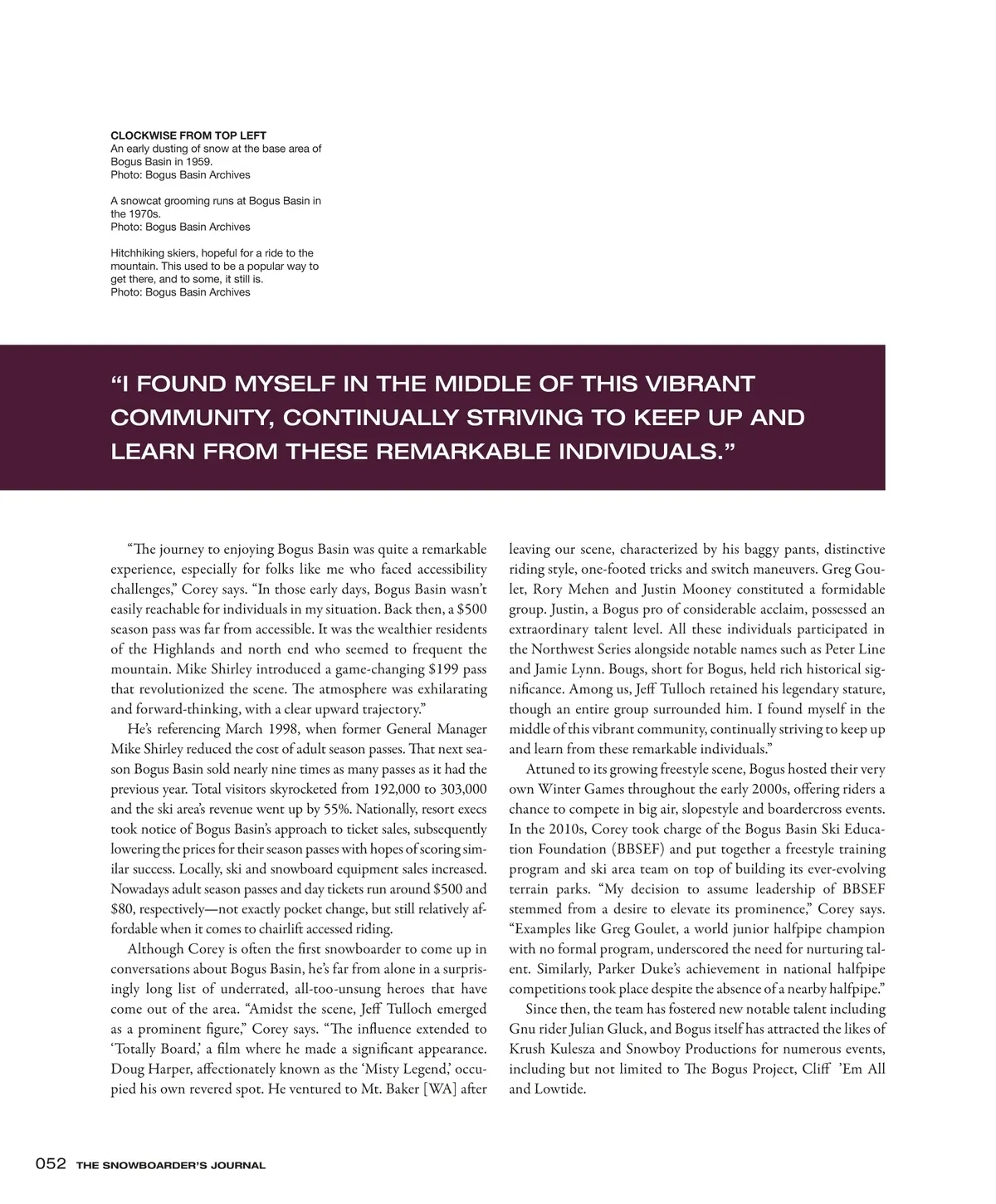
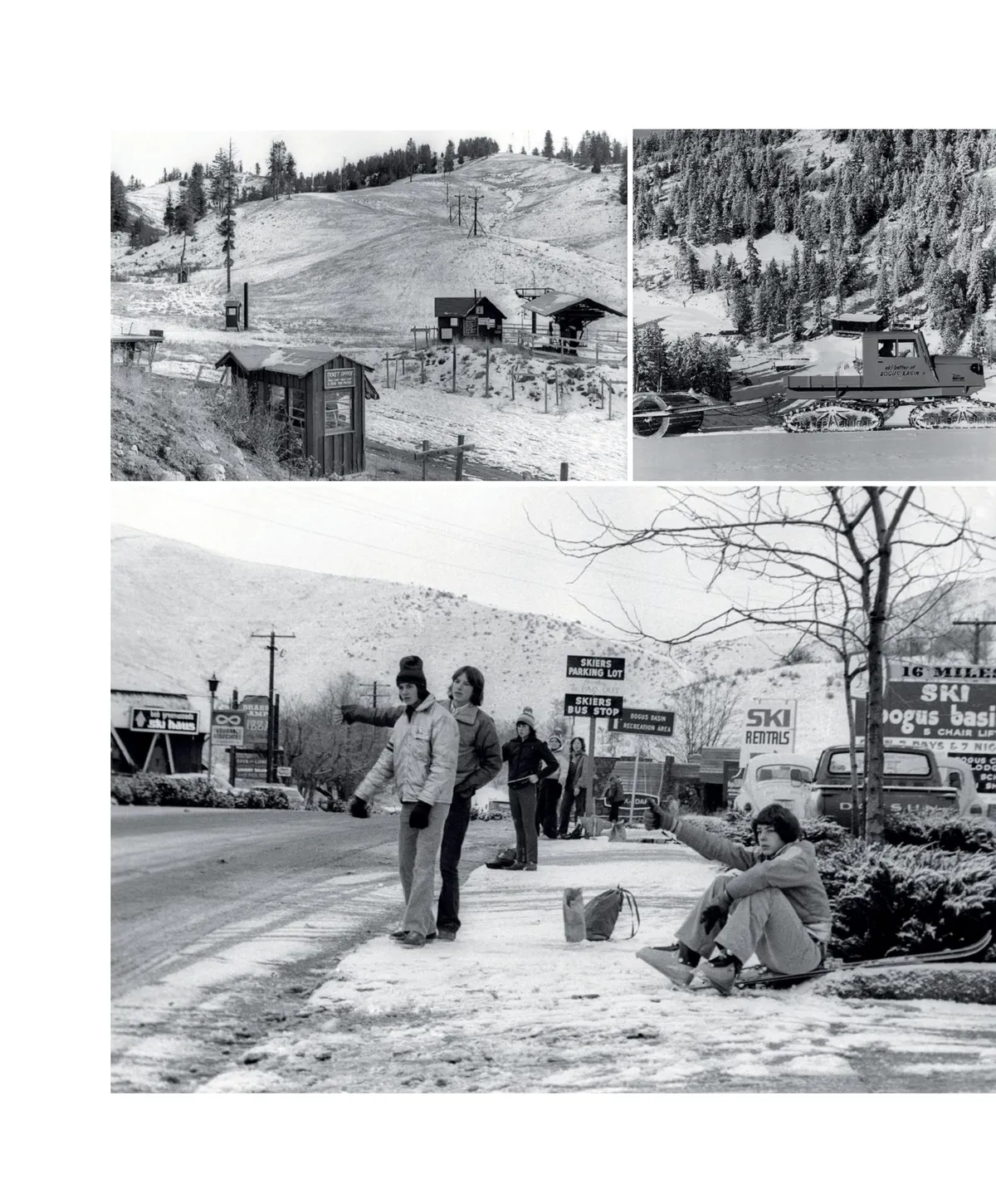
CLOCKWISE FROM TOP LEFT An early dusting of snow at the base area of Bogus Basin in 1959. Photo: Bogus Basin Archives A snowcat grooming runs at Bogus Basin in the 1970s. Photo: Bogus Basin Archives Hitchhiking skiers, hopeful for a ride to the mountain. This used to be a popular way to get there, and to some, it still is. Photo: Bogus Basin Archives “I FOUND MYSELF IN THE MIDDLE OF THIS VIBRANT COMMUNITY, CONTINUALLY STRIVING TO KEEP UP AND LEARN FROM THESE REMARKABLE INDIVIDUALS.” “The journey to enjoying Bogus Basin was quite a remarkable experience, especially for folks like me who faced accessibility challenges,” Corey says. “In those early days, Bogus Basin wasn’t easily reachable for individuals in my situation. Back then, a $500 season pass was far from accessible. It was the wealthier residents of the Highlands and north end who seemed to frequent the mountain. Mike Shirley introduced a game-changing $199 pass that revolutionized the scene. The atmosphere was exhilarating and forward-thinking, with a clear upward trajectory.” He’s referencing March 1998, when former General Manager Mike Shirley reduced the cost of adult season passes. That next sea-son Bogus Basin sold nearly nine times as many passes as it had the previous year. Total visitors skyrocketed from 192,000 to 303,000 and the ski area’s revenue went up by 55%. Nationally, resort execs took notice of Bogus Basin’s approach to ticket sales, subsequently lowering the prices for their season passes with hopes of scoring sim-ilar success. Locally, ski and snowboard equipment sales increased. Nowadays adult season passes and day tickets run around $500 and $80, respectively—not exactly pocket change, but still relatively af-fordable when it comes to chairlift accessed riding. Although Corey is often the first snowboarder to come up in conversations about Bogus Basin, he’s far from alone in a surpris-ingly long list of underrated, all-too-unsung heroes that have come out of the area. “Amidst the scene, Jeff Tulloch emerged as a prominent figure,” Corey says. “The influence extended to ‘Totally Board,’ a film where he made a significant appearance. Doug Harper, affectionately known as the ‘Misty Legend,’ occu-pied his own revered spot. He ventured to Mt. Baker [WA] after leaving our scene, characterized by his baggy pants, distinctive riding style, one-footed tricks and switch maneuvers. Greg Gou-let, Rory Mehen and Justin Mooney constituted a formidable group. Justin, a Bogus pro of considerable acclaim, possessed an extraordinary talent level. All these individuals participated in the Northwest Series alongside notable names such as Peter Line and Jamie Lynn. Bougs, short for Bogus, held rich historical sig-nificance. Among us, Jeff Tulloch retained his legendary stature, though an entire group surrounded him. I found myself in the middle of this vibrant community, continually striving to keep up and learn from these remarkable individuals.” Attuned to its growing freestyle scene, Bogus hosted their very own Winter Games throughout the early 2000s, offering riders a chance to compete in big air, slopestyle and boardercross events. In the 2010s, Corey took charge of the Bogus Basin Ski Educa-tion Foundation (BBSEF) and put together a freestyle training program and ski area team on top of building its ever-evolving terrain parks. “My decision to assume leadership of BBSEF stemmed from a desire to elevate its prominence,” Corey says. “Examples like Greg Goulet, a world junior halfpipe champion with no formal program, underscored the need for nurturing tal-ent. Similarly, Parker Duke’s achievement in national halfpipe competitions took place despite the absence of a nearby halfpipe.” Since then, the team has fostered new notable talent including Gnu rider Julian Gluck, and Bogus itself has attracted the likes of Krush Kulesza and Snowboy Productions for numerous events, including but not limited to The Bogus Project, Cliff ’Em All and Lowtide. 052 THE SNOWBOARDER’S JOURNAL
The Snowboarder's Journal The Snowboarder's Journal 21.2: Page 52