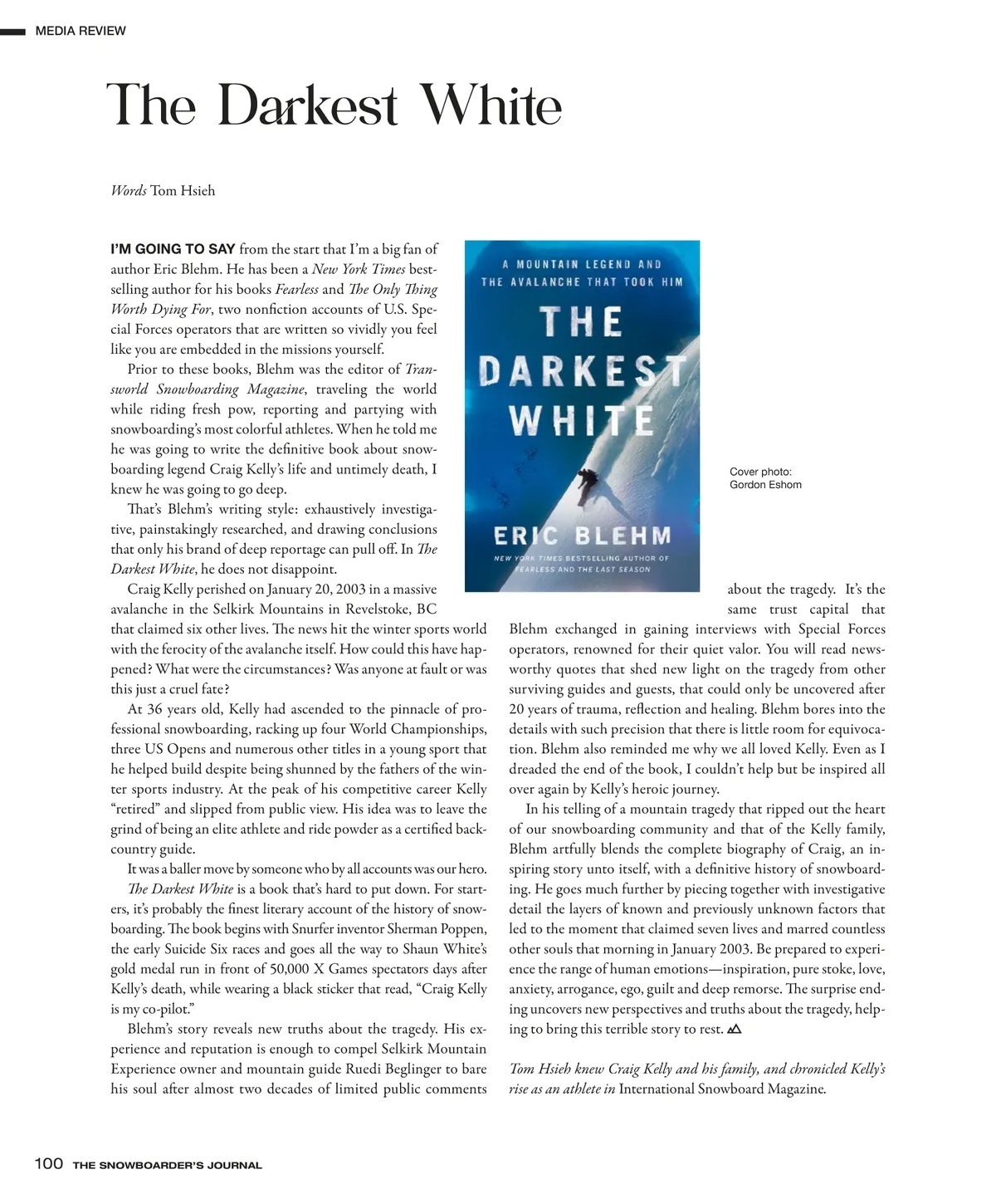
MEDIA REVIEW The D kest White Words Tom Hsieh I’M GOING TO SAY from the start that I’m a big fan of author Eric Blehm. He has been a New York Times best-selling author for his books Fearless and The Only Thing Worth Dying For , two nonfiction accounts of U.S. Spe-cial Forces operators that are written so vividly you feel like you are embedded in the missions yourself. Prior to these books, Blehm was the editor of Tran-sworld Snowboarding Magazine , traveling the world while riding fresh pow, reporting and partying with snowboarding’s most colorful athletes. When he told me he was going to write the definitive book about snow-boarding legend Craig Kelly’s life and untimely death, I knew he was going to go deep. That’s Blehm’s writing style: exhaustively investiga-tive, painstakingly researched, and drawing conclusions that only his brand of deep reportage can pull off. In The Darkest White , he does not disappoint. Craig Kelly perished on January 20, 2003 in a massive avalanche in the Selkirk Mountains in Revelstoke, BC that claimed six other lives. The news hit the winter sports world with the ferocity of the avalanche itself. How could this have hap-pened? What were the circumstances? Was anyone at fault or was this just a cruel fate? At 36 years old, Kelly had ascended to the pinnacle of pro-fessional snowboarding, racking up four World Championships, three US Opens and numerous other titles in a young sport that he helped build despite being shunned by the fathers of the win-ter sports industry. At the peak of his competitive career Kelly “retired” and slipped from public view. His idea was to leave the grind of being an elite athlete and ride powder as a certified back-country guide. It was a baller move by someone who by all accounts was our hero. The Darkest White is a book that’s hard to put down. For start-ers, it’s probably the finest literary account of the history of snow-boarding. The book begins with Snurfer inventor Sherman Poppen, the early Suicide Six races and goes all the way to Shaun White’s gold medal run in front of 50,000 X Games spectators days after Kelly’s death, while wearing a black sticker that read, “Craig Kelly is my co-pilot.” Blehm’s story reveals new truths about the tragedy. His ex-perience and reputation is enough to compel Selkirk Mountain Experience owner and mountain guide Ruedi Beglinger to bare his soul after almost two decades of limited public comments Cover photo: Gordon Eshom about the tragedy. It’s the same trust capital that Blehm exchanged in gaining interviews with Special Forces operators, renowned for their quiet valor. You will read news-worthy quotes that shed new light on the tragedy from other surviving guides and guests, that could only be uncovered after 20 years of trauma, reflection and healing. Blehm bores into the details with such precision that there is little room for equivoca-tion. Blehm also reminded me why we all loved Kelly. Even as I dreaded the end of the book, I couldn’t help but be inspired all over again by Kelly’s heroic journey. In his telling of a mountain tragedy that ripped out the heart of our snowboarding community and that of the Kelly family, Blehm artfully blends the complete biography of Craig, an in-spiring story unto itself, with a definitive history of snowboard-ing. He goes much further by piecing together with investigative detail the layers of known and previously unknown factors that led to the moment that claimed seven lives and marred countless other souls that morning in January 2003. Be prepared to experi-ence the range of human emotions—inspiration, pure stoke, love, anxiety, arrogance, ego, guilt and deep remorse. The surprise end-ing uncovers new perspectives and truths about the tragedy, help-ing to bring this terrible story to rest. Tom Hsieh knew Craig Kelly and his family, and chronicled Kelly’s rise as an athlete in International Snowboard Magazine . 100 THE SNOWBOARDER’S JOURNAL
The Snowboarder's Journal The Snowboarder's Journal 21.4: Page 100