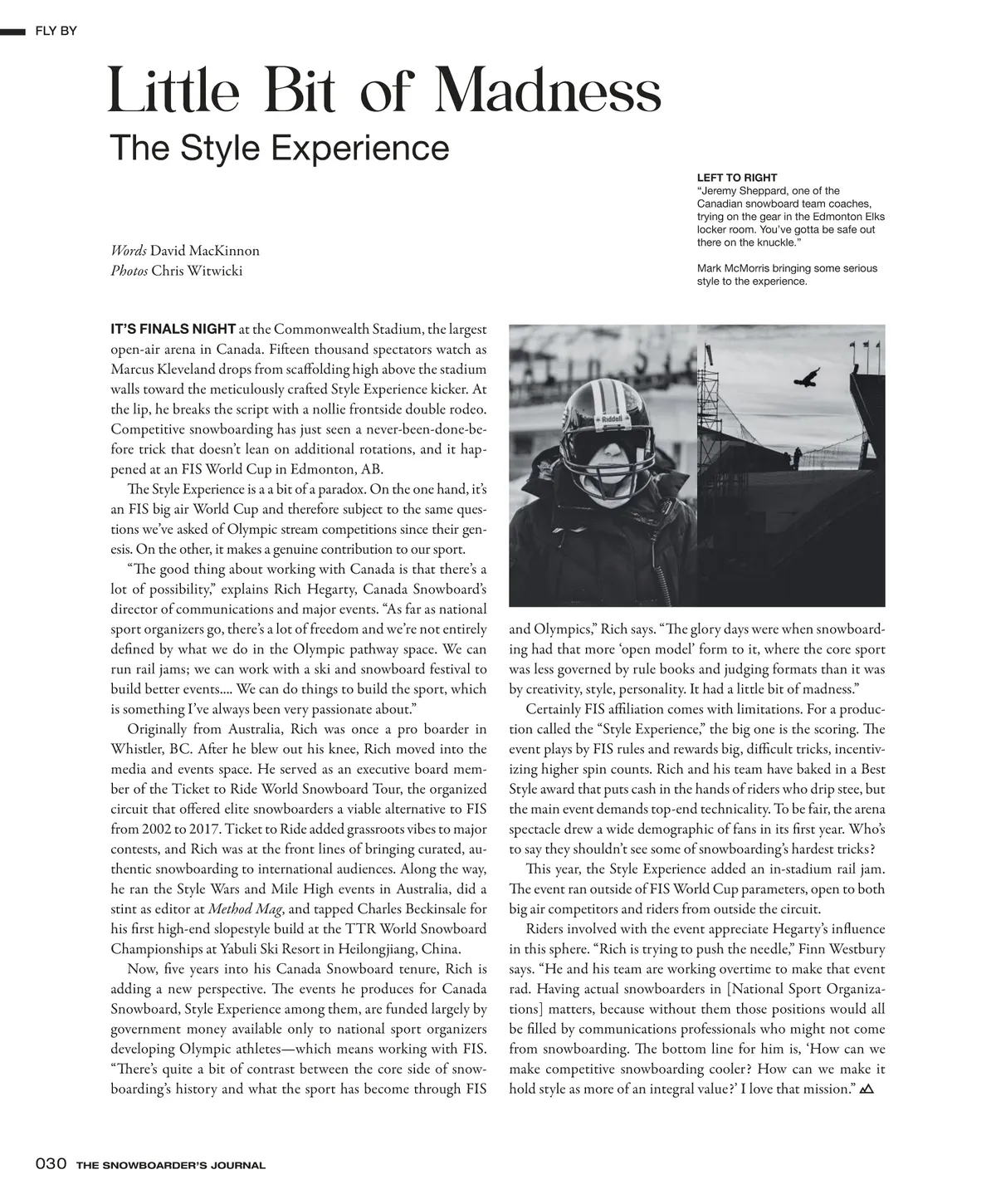
FLY BY Little Bit of Madness The Style Experience Words David MacKinnon Photos Chris Witwicki LEFT TO RIGHT “Jeremy Sheppard, one of the Canadian snowboard team coaches, trying on the gear in the Edmonton Elks locker room. You’ve gotta be safe out there on the knuckle.” Mark McMorris bringing some serious style to the experience. IT’S FINALS NIGHT at the Commonwealth Stadium, the largest open-air arena in Canada. Fifteen thousand spectators watch as Marcus Kleveland drops from scaffolding high above the stadium walls toward the meticulously crafted Style Experience kicker. At the lip, he breaks the script with a nollie frontside double rodeo. Competitive snowboarding has just seen a never-been-done-be-fore trick that doesn’t lean on additional rotations, and it hap-pened at an FIS World Cup in Edmonton, AB. The Style Experience is a a bit of a paradox. On the one hand, it’s an FIS big air World Cup and therefore subject to the same ques-tions we’ve asked of Olympic stream competitions since their gen-esis. On the other, it makes a genuine contribution to our sport. “The good thing about working with Canada is that there’s a lot of possibility,” explains Rich Hegarty, Canada Snowboard’s director of communications and major events. “As far as national sport organizers go, there’s a lot of freedom and we’re not entirely defined by what we do in the Olympic pathway space. We can run rail jams; we can work with a ski and snowboard festival to build better events.... We can do things to build the sport, which is something I’ve always been very passionate about.” Originally from Australia, Rich was once a pro boarder in Whistler, BC. After he blew out his knee, Rich moved into the media and events space. He served as an executive board mem-ber of the Ticket to Ride World Snowboard Tour, the organized circuit that offered elite snowboarders a viable alternative to FIS from 2002 to 2017. Ticket to Ride added grassroots vibes to major contests, and Rich was at the front lines of bringing curated, au-thentic snowboarding to international audiences. Along the way, he ran the Style Wars and Mile High events in Australia, did a stint as editor at Method Mag , and tapped Charles Beckinsale for his first high-end slopestyle build at the TTR World Snowboard Championships at Yabuli Ski Resort in Heilongjiang, China. Now, five years into his Canada Snowboard tenure, Rich is adding a new perspective. The events he produces for Canada Snowboard, Style Experience among them, are funded largely by government money available only to national sport organizers developing Olympic athletes—which means working with FIS. “There’s quite a bit of contrast between the core side of snow-boarding’s history and what the sport has become through FIS and Olympics,” Rich says. “The glory days were when snowboard-ing had that more ‘open model’ form to it, where the core sport was less governed by rule books and judging formats than it was by creativity, style, personality. It had a little bit of madness.” Certainly FIS affiliation comes with limitations. For a produc-tion called the “Style Experience,” the big one is the scoring. The event plays by FIS rules and rewards big, difficult tricks, incentiv-izing higher spin counts. Rich and his team have baked in a Best Style award that puts cash in the hands of riders who drip stee, but the main event demands top-end technicality. To be fair, the arena spectacle drew a wide demographic of fans in its first year. Who’s to say they shouldn’t see some of snowboarding’s hardest tricks? This year, the Style Experience added an in-stadium rail jam. The event ran outside of FIS World Cup parameters, open to both big air competitors and riders from outside the circuit. Riders involved with the event appreciate Hegarty’s influence in this sphere. “Rich is trying to push the needle,” Finn Westbury says. “He and his team are working overtime to make that event rad. Having actual snowboarders in [National Sport Organiza-tions] matters, because without them those positions would all be filled by communications professionals who might not come from snowboarding. The bottom line for him is, ‘How can we make competitive snowboarding cooler? How can we make it hold style as more of an integral value?’ I love that mission.” 030 THE SNOWBOARDER’S JOURNAL
The Snowboarder's Journal The Snowboarder's Journal 21.4: Page 30