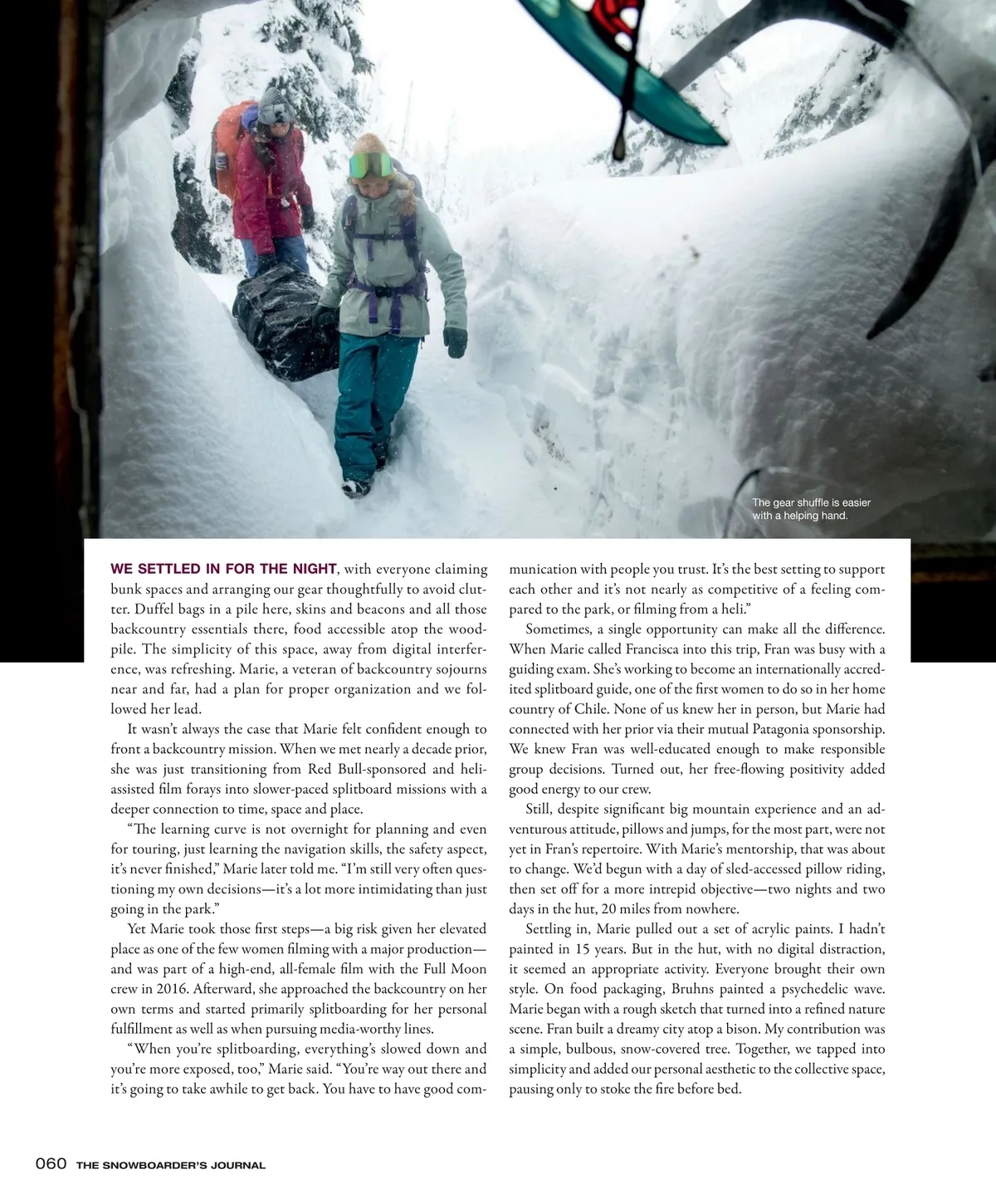
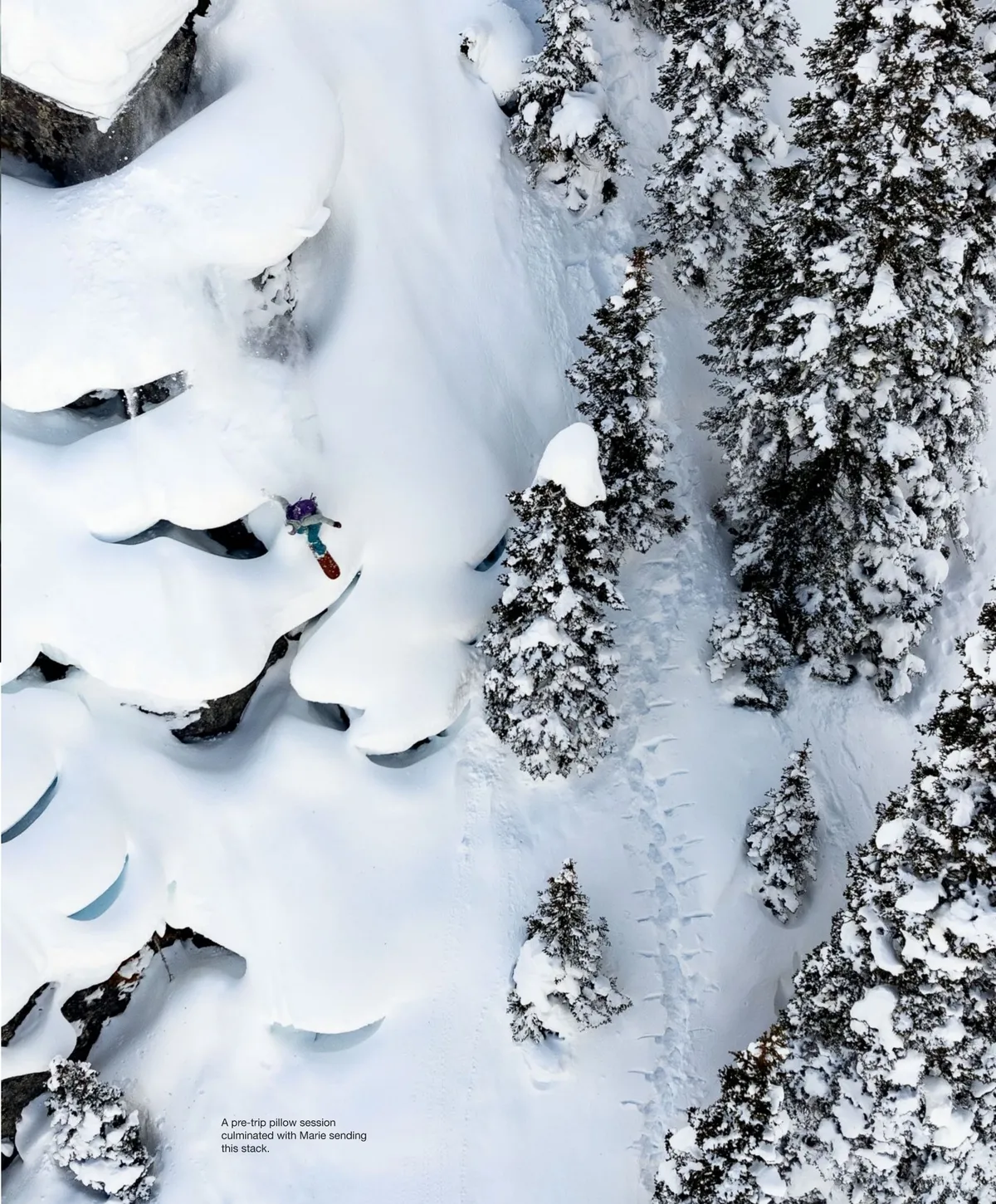
The gear shuffle is easier with a helping hand. WE SETTLED IN FOR THE NIGHT , with everyone claiming bunk spaces and arranging our gear thoughtfully to avoid clut-ter. Duffel bags in a pile here, skins and beacons and all those backcountry essentials there, food accessible atop the wood-pile. The simplicity of this space, away from digital interfer-ence, was refreshing. Marie, a veteran of backcountry sojourns near and far, had a plan for proper organization and we fol-lowed her lead. It wasn’t always the case that Marie felt confident enough to front a backcountry mission. When we met nearly a decade prior, she was just transitioning from Red Bull-sponsored and heli-assisted film forays into slower-paced splitboard missions with a deeper connection to time, space and place. “The learning curve is not overnight for planning and even for touring, just learning the navigation skills, the safety aspect, it’s never finished,” Marie later told me. “I’m still very often ques-tioning my own decisions—it’s a lot more intimidating than just going in the park.” Yet Marie took those first steps—a big risk given her elevated place as one of the few women filming with a major production— and was part of a high-end, all-female film with the Full Moon crew in 2016. Afterward, she approached the backcountry on her own terms and started primarily splitboarding for her personal fulfillment as well as when pursuing media-worthy lines. “When you’re splitboarding, everything’s slowed down and you’re more exposed, too,” Marie said. “You’re way out there and it’s going to take awhile to get back. You have to have good com-munication with people you trust. It’s the best setting to support each other and it’s not nearly as competitive of a feeling com-pared to the park, or filming from a heli.” Sometimes, a single opportunity can make all the difference. When Marie called Francisca into this trip, Fran was busy with a guiding exam. She’s working to become an internationally accred-ited splitboard guide, one of the first women to do so in her home country of Chile. None of us knew her in person, but Marie had connected with her prior via their mutual Patagonia sponsorship. We knew Fran was well-educated enough to make responsible group decisions. Turned out, her free-flowing positivity added good energy to our crew. Still, despite significant big mountain experience and an ad-venturous attitude, pillows and jumps, for the most part, were not yet in Fran’s repertoire. With Marie’s mentorship, that was about to change. We’d begun with a day of sled-accessed pillow riding, then set off for a more intrepid objective—two nights and two days in the hut, 20 miles from nowhere. Settling in, Marie pulled out a set of acrylic paints. I hadn’t painted in 15 years. But in the hut, with no digital distraction, it seemed an appropriate activity. Everyone brought their own style. On food packaging, Bruhns painted a psychedelic wave. Marie began with a rough sketch that turned into a refined nature scene. Fran built a dreamy city atop a bison. My contribution was a simple, bulbous, snow-covered tree. Together, we tapped into simplicity and added our personal aesthetic to the collective space, pausing only to stoke the fire before bed. 060 THE SNOWBOARDER’S JOURNAL
The Snowboarder's Journal The Snowboarder's Journal 21.4: Page 60