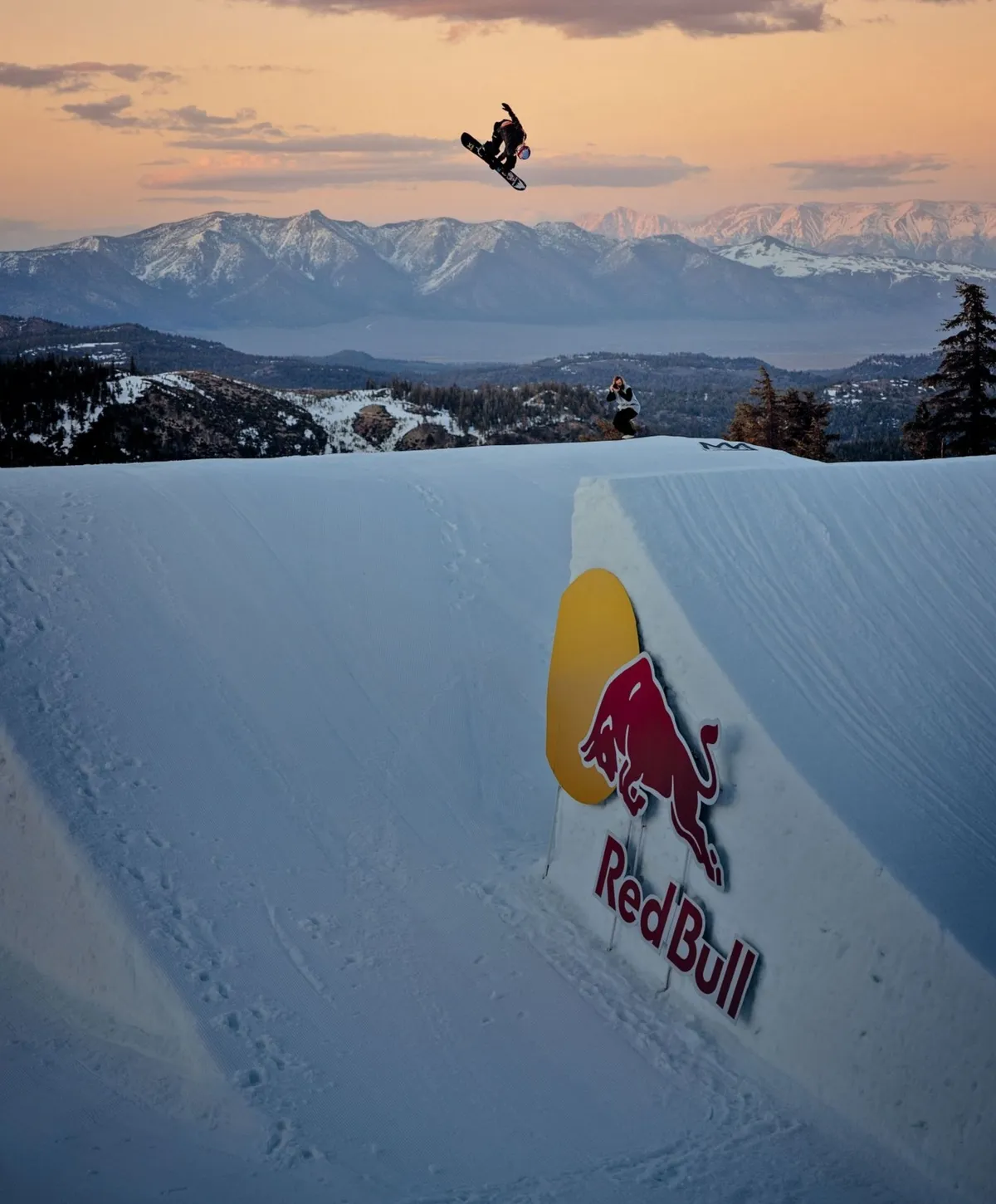
“Anna is driven—whether it’s a contest, a back-country trip, or figuring out how to snowmobile, she just goes for it. She was the driving force on this sunset shoot with the Red Bull team at Mammoth Mountain, CA. She started and ended the session with these switch backside 180s in the wind.” Photo: Aaron Blatt I met you at O’Neill Evolution in 2012 and you did a super-nice back five and got third. That was my first international podium and the start of ev-erything. Even when I did the cab double for the first time, I wanted to learn the cab 9 flat to just have it. I didn’t use the cab double [in a contest] for probably three or four years after I did it. I wanted to go step by step. In a sense, you were a contest winner before you were a snow-boarder. How important has it been for you to be accepted by the core community? It was very important to become better at snowboarding. I wanted to look good riding; I didn’t want to just be good in the air. I committed every bad weather day to going up to the mountain and just snowboarding, or riding switch. I was crazy obsessed, and it took a long time, but now I think I’m a strong snowboarder, not just in the air. My first years snowboarding I was a rail rider. I only rode rails because it was easier. Rails and maybe baby jumps where I would just go backflip… Sketchy girl [laughing]. Miss Sketchy. I can’t believe people called you that. Miss Sketchy has come a long way. What element of competition took the longest for you to learn if it wasn’t the actual tricks? The consistency and adapting to different jumps, different speeds, different features. My first year competing in local comps, I would never land, but I knew I could do those tricks on perfect days. I started questioning myself. I was like, “Maybe I thought it was too easy.” Starting a sport so late, my parents were supporting me, but they wanted me to go to school and get a good education. I told them, “I think I can be a snowboarder. I think I can do this,” but I had nothing to prove it to them. The O’Neill Evolution gave me the motivation to keep trying. It made me believe in myself. The following year you landed a cab double nine at Stubai. That was such a massive moment for snowboarding and no one even knew who you were yet. How quickly did your world change? Suddenly, I got my first contracts. It was good timing because it was just before the Olympics in Sochi. Then you got invited to Dew Tour in Breckenridge. You had just been signed onto Nike. The first day I saw you riding in practice, and I was like, “Oh, she’s riding really good.” Later that night when you got to the Nike house you couldn’t walk. I asked if you got hurt in practice and you said, “No, it was a few weeks ago. It’s not so bad—I just have to land switch.” I thought you were a little crazy as you hobbled around, but you’re just so stubborn and strong-willed. Can you talk a bit about that mindset and how that changed as your career has gone on? I’m a little smarter now. Two days after doing the cab double 9, I injured my ankle. There was no way in the world I would miss my first big opportunity to compete in the U.S. So I taped it up and pushed through the pain. It wasn’t very smart and I didn’t ride very well, but just to be there with all of my heroes, to compete against all the best girls in the world, it was a dream. I had to base every run around my ankle that season, even the Olympics, so the whole year I would land switch. I would do back five to cab seven, all the landings that I knew my ankle was good at. Your ankles have probably been your biggest injuries throughout your career… I’ve had my fair share of injuries, but over the years I’ve learned that it’s important to give your body rest and chill. Because I started so late and I wanted to prove myself so bad, I would just keep going. When the season was over in North America, I would go to Dachstein Glacier in Austria and I would never stop or take a break; I would not give my body the rest it needed. So the annoying little injuries, they just kept on coming. Every year there would be something. Now I’ve gotten better at taking care of my body and eating better than I did in the beginning. Your biggest injury was your neck [a herniated disc and hairline fracture of the C6] in 2015… My ankle sucked because I lost so much time on snow, but my biggest injury was probably the neck because it’s such a scary place to be injured. The doctors were like, “Maybe it’s not smart that you snowboard anymore.” When you hear that, the whole world breaks down. I was in shock even though other doctors said, “No, you’re fine.” I’m so happy I could work around it and I didn’t need surgery. It was the first time I took a long break from snowboarding, about five months. That break changed my perspective on snowboarding because I had to find other things to do, and that took a lot of pressure off. When I came back, and I wasn’t scared and hadn’t gotten worse, that was probably the best year I have ever snowboarded. I wasn’t as stubborn. I was more chill and then suddenly all the tricks worked, and I landed in every contest. 072 THE SNOWBOARDER’S JOURNAL
The Snowboarder's Journal The Snowboarder's Journal 21.4: Page 72