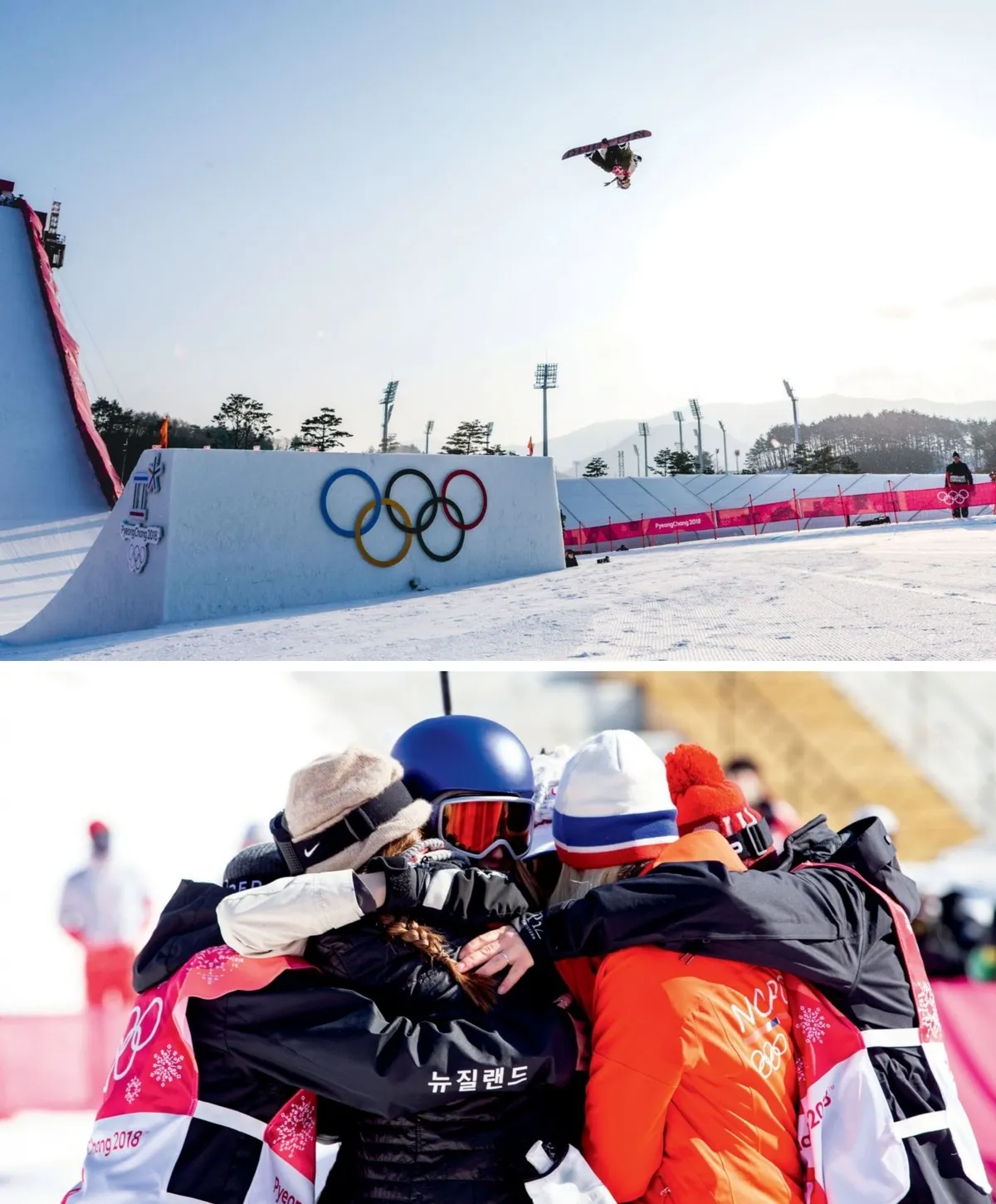
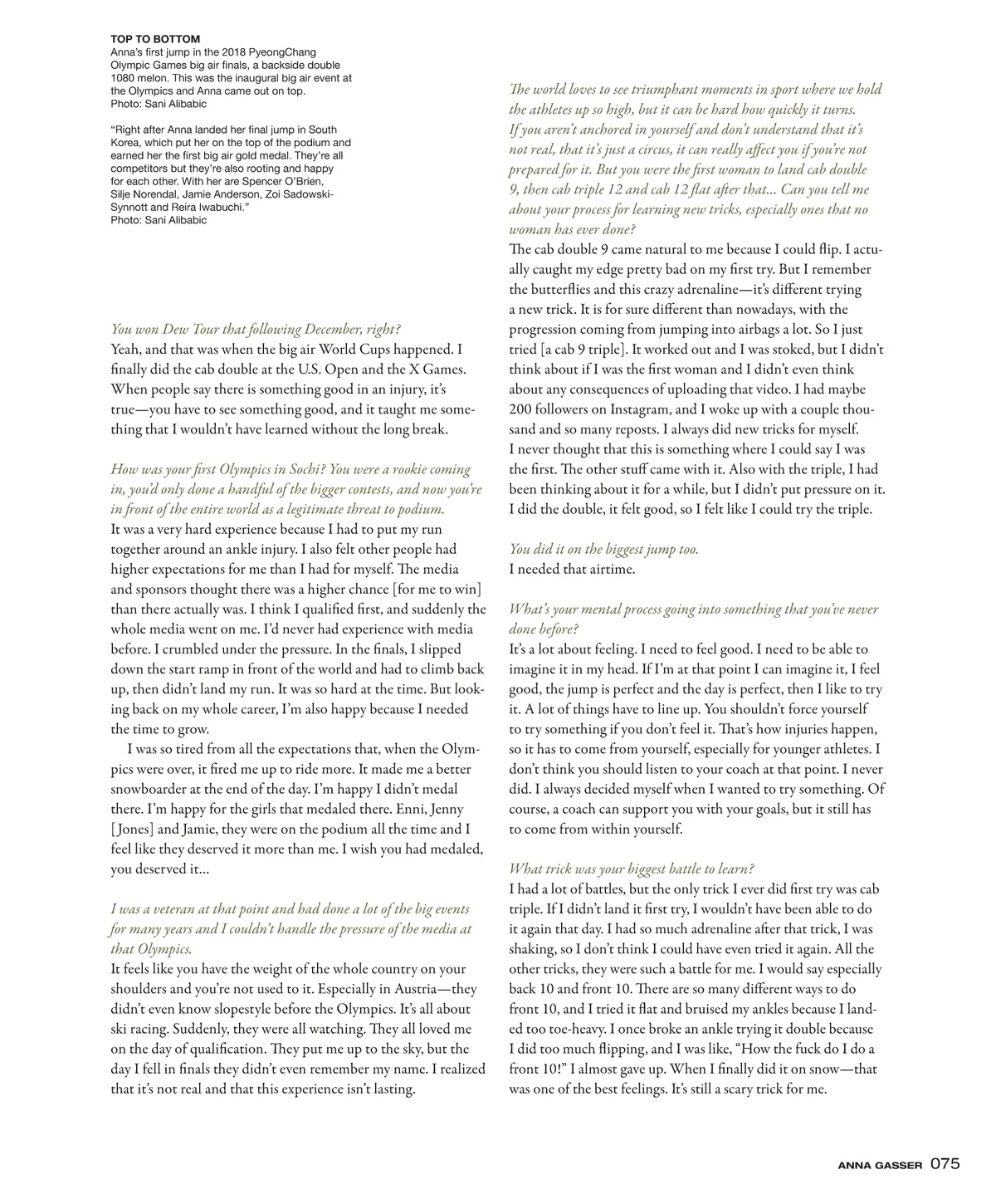
TOP TO BOTTOM Anna’s first jump in the 2018 PyeongChang Olympic Games big air finals, a backside double 1080 melon. This was the inaugural big air event at the Olympics and Anna came out on top. Photo: Sani Alibabic “Right after Anna landed her final jump in South Korea, which put her on the top of the podium and earned her the first big air gold medal. They’re all competitors but they’re also rooting and happy for each other. With her are Spencer O’Brien, Silje Norendal, Jamie Anderson, Zoi Sadowski-Synnott and Reira Iwabuchi.” Photo: Sani Alibabic You won Dew Tour that following December, right? Yeah, and that was when the big air World Cups happened. I finally did the cab double at the U.S. Open and the X Games. When people say there is something good in an injury, it’s true—you have to see something good, and it taught me some-thing that I wouldn’t have learned without the long break. How was your first Olympics in Sochi? You were a rookie coming in, you’d only done a handful of the bigger contests, and now you’re in front of the entire world as a legitimate threat to podium. It was a very hard experience because I had to put my run together around an ankle injury. I also felt other people had higher expectations for me than I had for myself. The media and sponsors thought there was a higher chance [for me to win] than there actually was. I think I qualified first, and suddenly the whole media went on me. I’d never had experience with media before. I crumbled under the pressure. In the finals, I slipped down the start ramp in front of the world and had to climb back up, then didn’t land my run. It was so hard at the time. But look-ing back on my whole career, I’m also happy because I needed the time to grow. I was so tired from all the expectations that, when the Olym-pics were over, it fired me up to ride more. It made me a better snowboarder at the end of the day. I’m happy I didn’t medal there. I’m happy for the girls that medaled there. Enni, Jenny [ Jones] and Jamie, they were on the podium all the time and I feel like they deserved it more than me. I wish you had medaled, you deserved it… I was a veteran at that point and had done a lot of the big events for many years and I couldn’t handle the pressure of the media at that Olympics. It feels like you have the weight of the whole country on your shoulders and you’re not used to it. Especially in Austria—they didn’t even know slopestyle before the Olympics. It’s all about ski racing. Suddenly, they were all watching. They all loved me on the day of qualification. They put me up to the sky, but the day I fell in finals they didn’t even remember my name. I realized that it’s not real and that this experience isn’t lasting. The world loves to see triumphant moments in sport where we hold the athletes up so high, but it can be hard how quickly it turns. If you aren’t anchored in yourself and don’t understand that it’s not real, that it’s just a circus, it can really affect you if you’re not prepared for it. But you were the first woman to land cab double 9, then cab triple 12 and cab 12 flat after that... Can you tell me about your process for learning new tricks, especially ones that no woman has ever done? The cab double 9 came natural to me because I could flip. I actu-ally caught my edge pretty bad on my first try. But I remember the butterflies and this crazy adrenaline—it’s different trying a new trick. It is for sure different than nowadays, with the progression coming from jumping into airbags a lot. So I just tried [a cab 9 triple]. It worked out and I was stoked, but I didn’t think about if I was the first woman and I didn’t even think about any consequences of uploading that video. I had maybe 200 followers on Instagram, and I woke up with a couple thou-sand and so many reposts. I always did new tricks for myself. I never thought that this is something where I could say I was the first. The other stuff came with it. Also with the triple, I had been thinking about it for a while, but I didn’t put pressure on it. I did the double, it felt good, so I felt like I could try the triple. You did it on the biggest jump too. I needed that airtime. What’s your mental process going into something that you’ve never done before? It’s a lot about feeling. I need to feel good. I need to be able to imagine it in my head. If I’m at that point I can imagine it, I feel good, the jump is perfect and the day is perfect, then I like to try it. A lot of things have to line up. You shouldn’t force yourself to try something if you don’t feel it. That’s how injuries happen, so it has to come from yourself, especially for younger athletes. I don’t think you should listen to your coach at that point. I never did. I always decided myself when I wanted to try something. Of course, a coach can support you with your goals, but it still has to come from within yourself. What trick was your biggest battle to learn? I had a lot of battles, but the only trick I ever did first try was cab triple. If I didn’t land it first try, I wouldn’t have been able to do it again that day. I had so much adrenaline after that trick, I was shaking, so I don’t think I could have even tried it again. All the other tricks, they were such a battle for me. I would say especially back 10 and front 10. There are so many different ways to do front 10, and I tried it flat and bruised my ankles because I land-ed too toe-heavy. I once broke an ankle trying it double because I did too much flipping, and I was like, “How the fuck do I do a front 10!” I almost gave up. When I finally did it on snow—that was one of the best feelings. It’s still a scary trick for me. ANNA GASSER 075
The Snowboarder's Journal The Snowboarder's Journal 21.4: Page 75