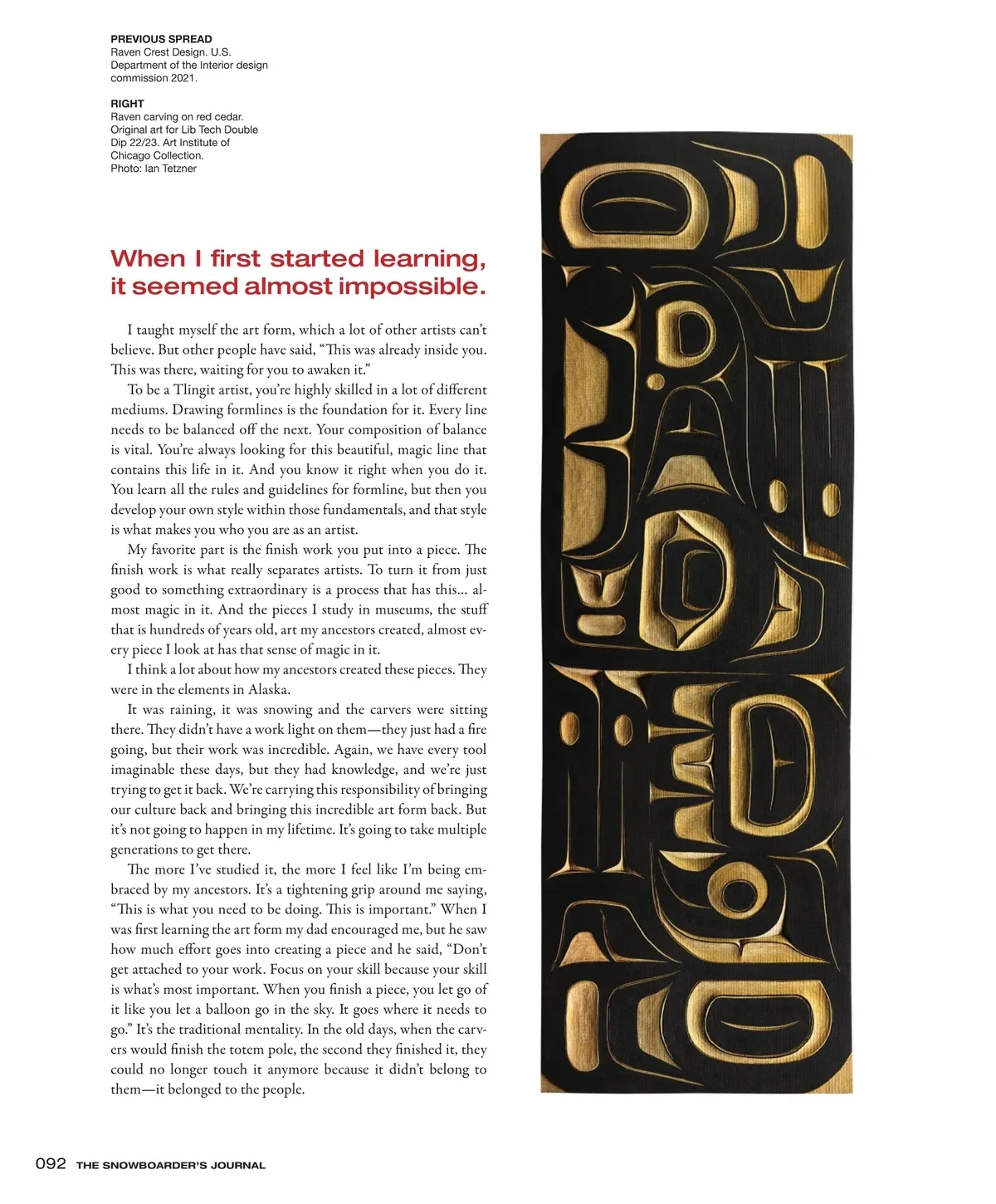
PREVIOUS SPREAD Raven Crest Design. U.S. Department of the Interior design commission 2021. RIGHT Raven carving on red cedar. Original art for Lib Tech Double Dip 22/23. Art Institute of Chicago Collection. Photo: Ian Tetzner When I first started learning, it seemed almost impossible. I taught myself the art form, which a lot of other artists can’t believe. But other people have said, “This was already inside you. This was there, waiting for you to awaken it.” To be a Tlingit artist, you’re highly skilled in a lot of different mediums. Drawing formlines is the foundation for it. Every line needs to be balanced off the next. Your composition of balance is vital. You’re always looking for this beautiful, magic line that contains this life in it. And you know it right when you do it. You learn all the rules and guidelines for formline, but then you develop your own style within those fundamentals, and that style is what makes you who you are as an artist. My favorite part is the finish work you put into a piece. The finish work is what really separates artists. To turn it from just good to something extraordinary is a process that has this… al-most magic in it. And the pieces I study in museums, the stuff that is hundreds of years old, art my ancestors created, almost ev-ery piece I look at has that sense of magic in it. I think a lot about how my ancestors created these pieces. They were in the elements in Alaska. It was raining, it was snowing and the carvers were sitting there. They didn’t have a work light on them—they just had a fire going, but their work was incredible. Again, we have every tool imaginable these days, but they had knowledge, and we’re just trying to get it back. We’re carrying this responsibility of bringing our culture back and bringing this incredible art form back. But it’s not going to happen in my lifetime. It’s going to take multiple generations to get there. The more I’ve studied it, the more I feel like I’m being em-braced by my ancestors. It’s a tightening grip around me saying, “This is what you need to be doing. This is important.” When I was first learning the art form my dad encouraged me, but he saw how much effort goes into creating a piece and he said, “Don’t get attached to your work. Focus on your skill because your skill is what’s most important. When you finish a piece, you let go of it like you let a balloon go in the sky. It goes where it needs to go.” It’s the traditional mentality. In the old days, when the carv-ers would finish the totem pole, the second they finished it, they could no longer touch it anymore because it didn’t belong to them—it belonged to the people. 092 THE SNOWBOARDER’S JOURNAL
The Snowboarder's Journal The Snowboarder's Journal 21.4: Page 92