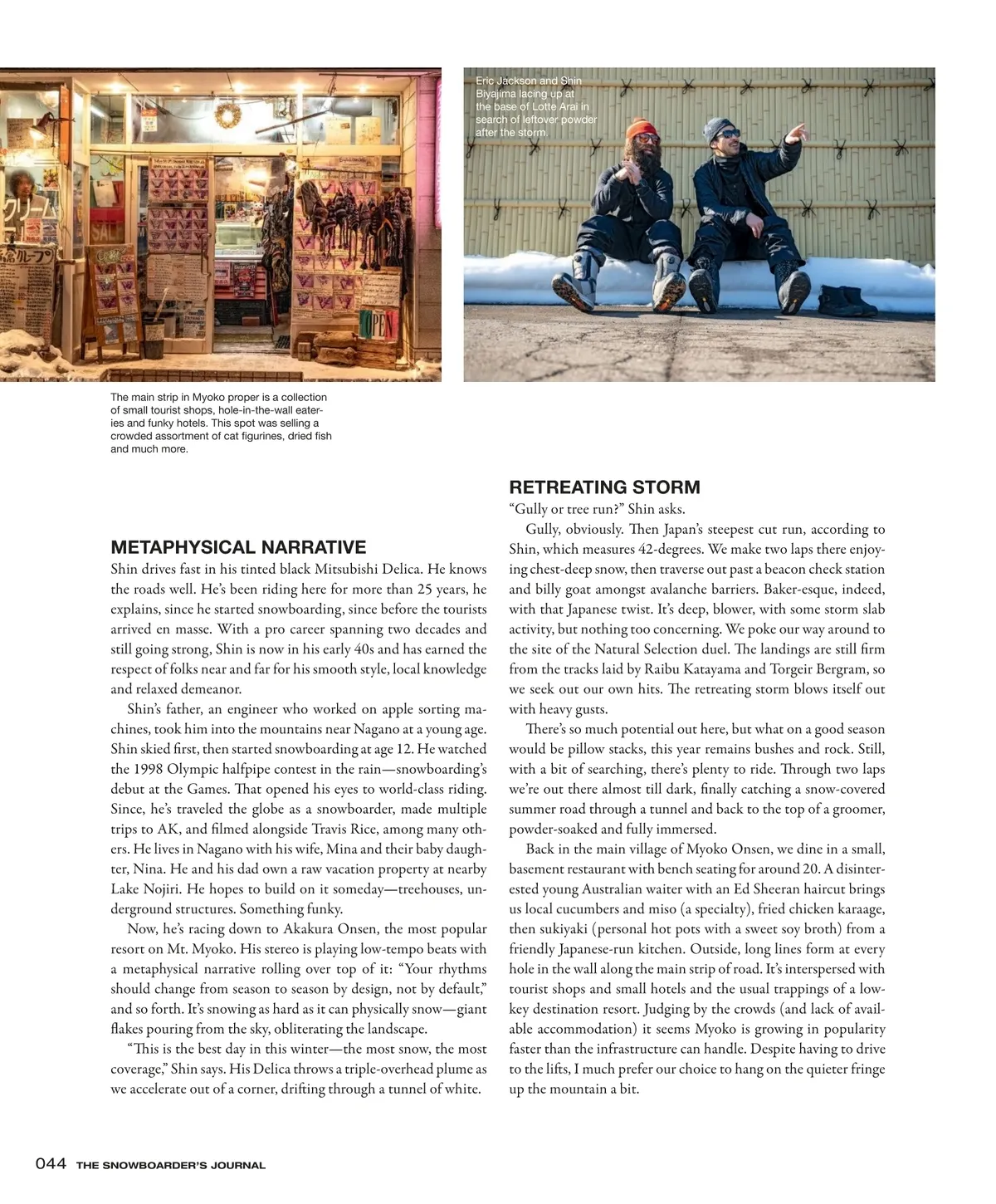
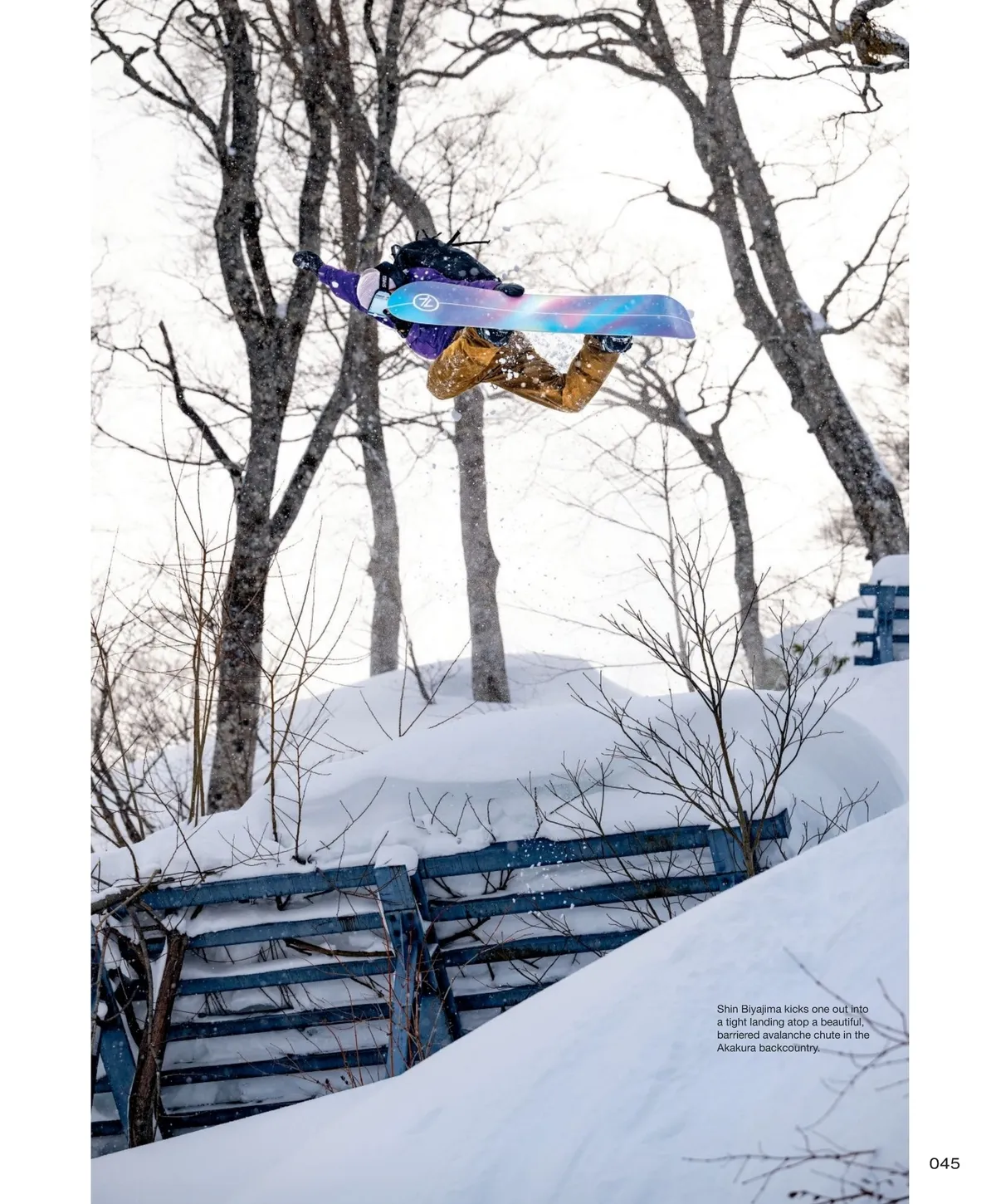
Eric Jackson and Shin Biyajima lacing up at the base of Lotte Arai in search of leftover powder after the storm. The main strip in Myoko proper is a collection of small tourist shops, hole-in-the-wall eater-ies and funky hotels. This spot was selling a crowded assortment of cat figurines, dried fish and much more. RETREATING STORM METAPHYSICAL NARRATIVE Shin drives fast in his tinted black Mitsubishi Delica. He knows the roads well. He’s been riding here for more than 25 years, he explains, since he started snowboarding, since before the tourists arrived en masse. With a pro career spanning two decades and still going strong, Shin is now in his early 40s and has earned the respect of folks near and far for his smooth style, local knowledge and relaxed demeanor. Shin’s father, an engineer who worked on apple sorting ma-chines, took him into the mountains near Nagano at a young age. Shin skied first, then started snowboarding at age 12. He watched the 1998 Olympic halfpipe contest in the rain—snowboarding’s debut at the Games. That opened his eyes to world-class riding. Since, he’s traveled the globe as a snowboarder, made multiple trips to AK, and filmed alongside Travis Rice, among many oth-ers. He lives in Nagano with his wife, Mina and their baby daugh-ter, Nina. He and his dad own a raw vacation property at nearby Lake Nojiri. He hopes to build on it someday—treehouses, un-derground structures. Something funky. Now, he’s racing down to Akakura Onsen, the most popular resort on Mt. Myoko. His stereo is playing low-tempo beats with a metaphysical narrative rolling over top of it: “Your rhythms should change from season to season by design, not by default,” and so forth. It’s snowing as hard as it can physically snow—giant flakes pouring from the sky, obliterating the landscape. “This is the best day in this winter—the most snow, the most coverage,” Shin says. His Delica throws a triple-overhead plume as we accelerate out of a corner, drifting through a tunnel of white. “Gully or tree run?” Shin asks. Gully, obviously. Then Japan’s steepest cut run, according to Shin, which measures 42-degrees. We make two laps there enjoy-ing chest-deep snow, then traverse out past a beacon check station and billy goat amongst avalanche barriers. Baker-esque, indeed, with that Japanese twist. It’s deep, blower, with some storm slab activity, but nothing too concerning. We poke our way around to the site of the Natural Selection duel. The landings are still firm from the tracks laid by Raibu Katayama and Torgeir Bergram, so we seek out our own hits. The retreating storm blows itself out with heavy gusts. There’s so much potential out here, but what on a good season would be pillow stacks, this year remains bushes and rock. Still, with a bit of searching, there’s plenty to ride. Through two laps we’re out there almost till dark, finally catching a snow-covered summer road through a tunnel and back to the top of a groomer, powder-soaked and fully immersed. Back in the main village of Myoko Onsen, we dine in a small, basement restaurant with bench seating for around 20. A disinter-ested young Australian waiter with an Ed Sheeran haircut brings us local cucumbers and miso (a specialty), fried chicken karaage, then sukiyaki (personal hot pots with a sweet soy broth) from a friendly Japanese-run kitchen. Outside, long lines form at every hole in the wall along the main strip of road. It’s interspersed with tourist shops and small hotels and the usual trappings of a low-key destination resort. Judging by the crowds (and lack of avail-able accommodation) it seems Myoko is growing in popularity faster than the infrastructure can handle. Despite having to drive to the lifts, I much prefer our choice to hang on the quieter fringe up the mountain a bit. 044 THE SNOWBOARDER’S JOURNAL
The Snowboarder's Journal The Snowboarder's Journal 22.1: Page 44