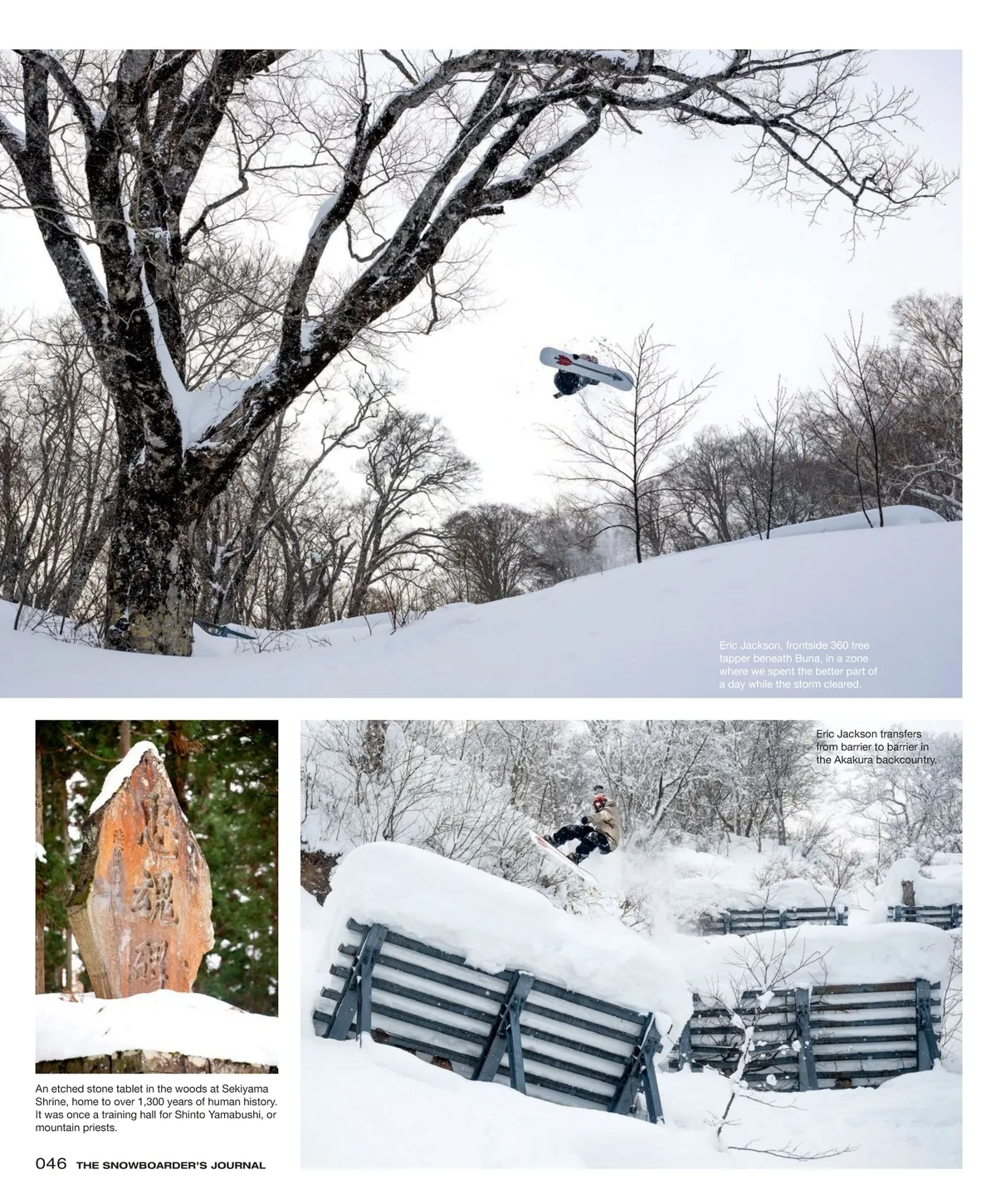
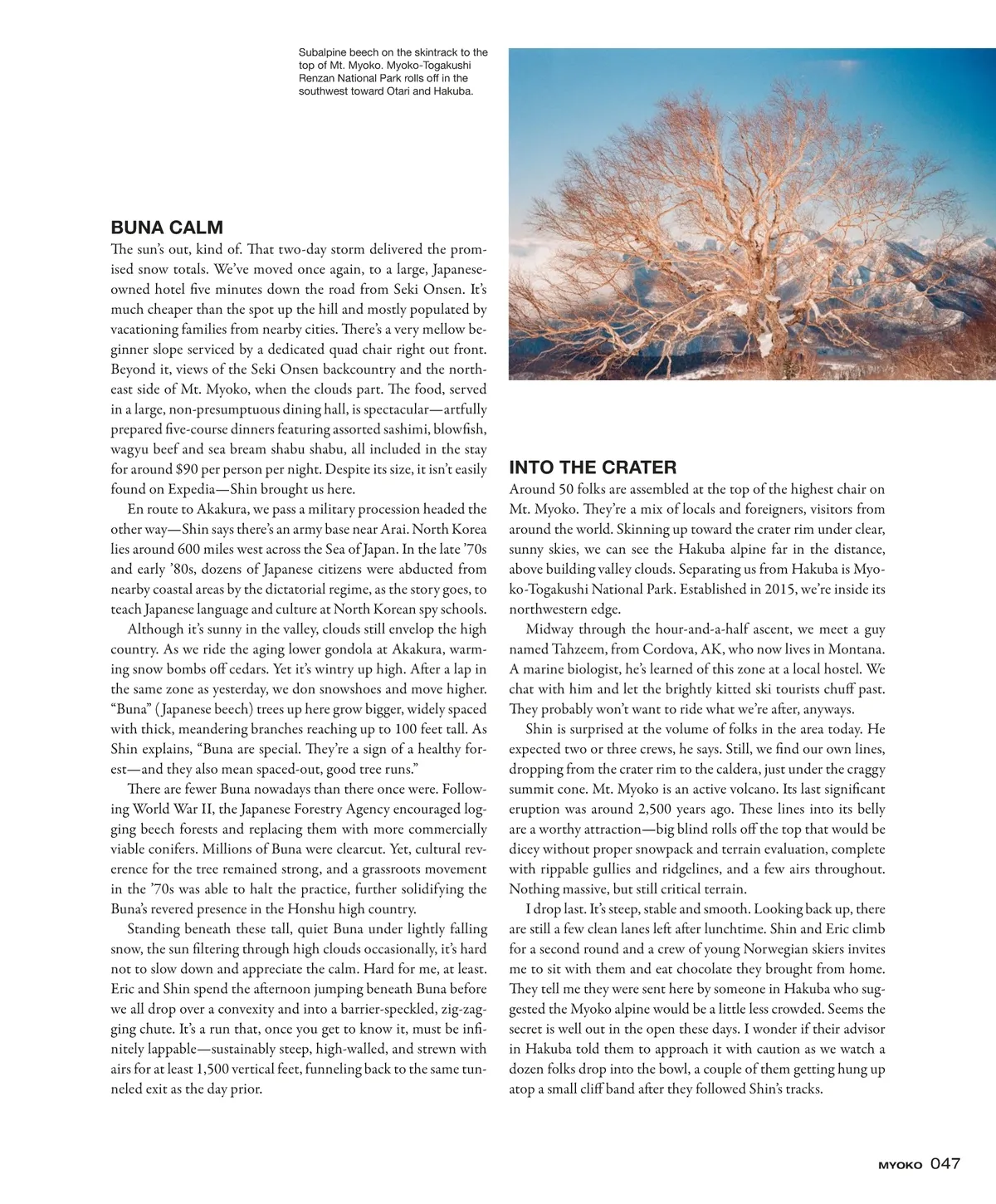
Subalpine beech on the skintrack to the top of Mt. Myoko. Myoko-Togakushi Renzan National Park rolls off in the southwest toward Otari and Hakuba. BUNA CALM The sun’s out, kind of. That two-day storm delivered the prom-ised snow totals. We’ve moved once again, to a large, Japanese-owned hotel five minutes down the road from Seki Onsen. It’s much cheaper than the spot up the hill and mostly populated by vacationing families from nearby cities. There’s a very mellow be-ginner slope serviced by a dedicated quad chair right out front. Beyond it, views of the Seki Onsen backcountry and the north-east side of Mt. Myoko, when the clouds part. The food, served in a large, non-presumptuous dining hall, is spectacular—artfully prepared five-course dinners featuring assorted sashimi, blowfish, wagyu beef and sea bream shabu shabu, all included in the stay for around $90 per person per night. Despite its size, it isn’t easily found on Expedia—Shin brought us here. En route to Akakura, we pass a military procession headed the other way—Shin says there’s an army base near Arai. North Korea lies around 600 miles west across the Sea of Japan. In the late ’70s and early ’80s, dozens of Japanese citizens were abducted from nearby coastal areas by the dictatorial regime, as the story goes, to teach Japanese language and culture at North Korean spy schools. Although it’s sunny in the valley, clouds still envelop the high country. As we ride the aging lower gondola at Akakura, warm-ing snow bombs off cedars. Yet it’s wintry up high. After a lap in the same zone as yesterday, we don snowshoes and move higher. “Buna” ( Japanese beech) trees up here grow bigger, widely spaced with thick, meandering branches reaching up to 100 feet tall. As Shin explains, “Buna are special. They’re a sign of a healthy for-est—and they also mean spaced-out, good tree runs.” There are fewer Buna nowadays than there once were. Follow-ing World War II, the Japanese Forestry Agency encouraged log-ging beech forests and replacing them with more commercially viable conifers. Millions of Buna were clearcut. Yet, cultural rev-erence for the tree remained strong, and a grassroots movement in the ’70s was able to halt the practice, further solidifying the Buna’s revered presence in the Honshu high country. Standing beneath these tall, quiet Buna under lightly falling snow, the sun filtering through high clouds occasionally, it’s hard not to slow down and appreciate the calm. Hard for me, at least. Eric and Shin spend the afternoon jumping beneath Buna before we all drop over a convexity and into a barrier-speckled, zig-zag-ging chute. It’s a run that, once you get to know it, must be infi-nitely lappable—sustainably steep, high-walled, and strewn with airs for at least 1,500 vertical feet, funneling back to the same tun-neled exit as the day prior. INTO THE CRATER Around 50 folks are assembled at the top of the highest chair on Mt. Myoko. They’re a mix of locals and foreigners, visitors from around the world. Skinning up toward the crater rim under clear, sunny skies, we can see the Hakuba alpine far in the distance, above building valley clouds. Separating us from Hakuba is Myo-ko-Togakushi National Park. Established in 2015, we’re inside its northwestern edge. Midway through the hour-and-a-half ascent, we meet a guy named Tahzeem, from Cordova, AK, who now lives in Montana. A marine biologist, he’s learned of this zone at a local hostel. We chat with him and let the brightly kitted ski tourists chuff past. They probably won’t want to ride what we’re after, anyways. Shin is surprised at the volume of folks in the area today. He expected two or three crews, he says. Still, we find our own lines, dropping from the crater rim to the caldera, just under the craggy summit cone. Mt. Myoko is an active volcano. Its last significant eruption was around 2,500 years ago. These lines into its belly are a worthy attraction—big blind rolls off the top that would be dicey without proper snowpack and terrain evaluation, complete with rippable gullies and ridgelines, and a few airs throughout. Nothing massive, but still critical terrain. I drop last. It’s steep, stable and smooth. Looking back up, there are still a few clean lanes left after lunchtime. Shin and Eric climb for a second round and a crew of young Norwegian skiers invites me to sit with them and eat chocolate they brought from home. They tell me they were sent here by someone in Hakuba who sug-gested the Myoko alpine would be a little less crowded. Seems the secret is well out in the open these days. I wonder if their advisor in Hakuba told them to approach it with caution as we watch a dozen folks drop into the bowl, a couple of them getting hung up atop a small cliff band after they followed Shin’s tracks. MYOKO 047
The Snowboarder's Journal The Snowboarder's Journal 22.1: Page 47