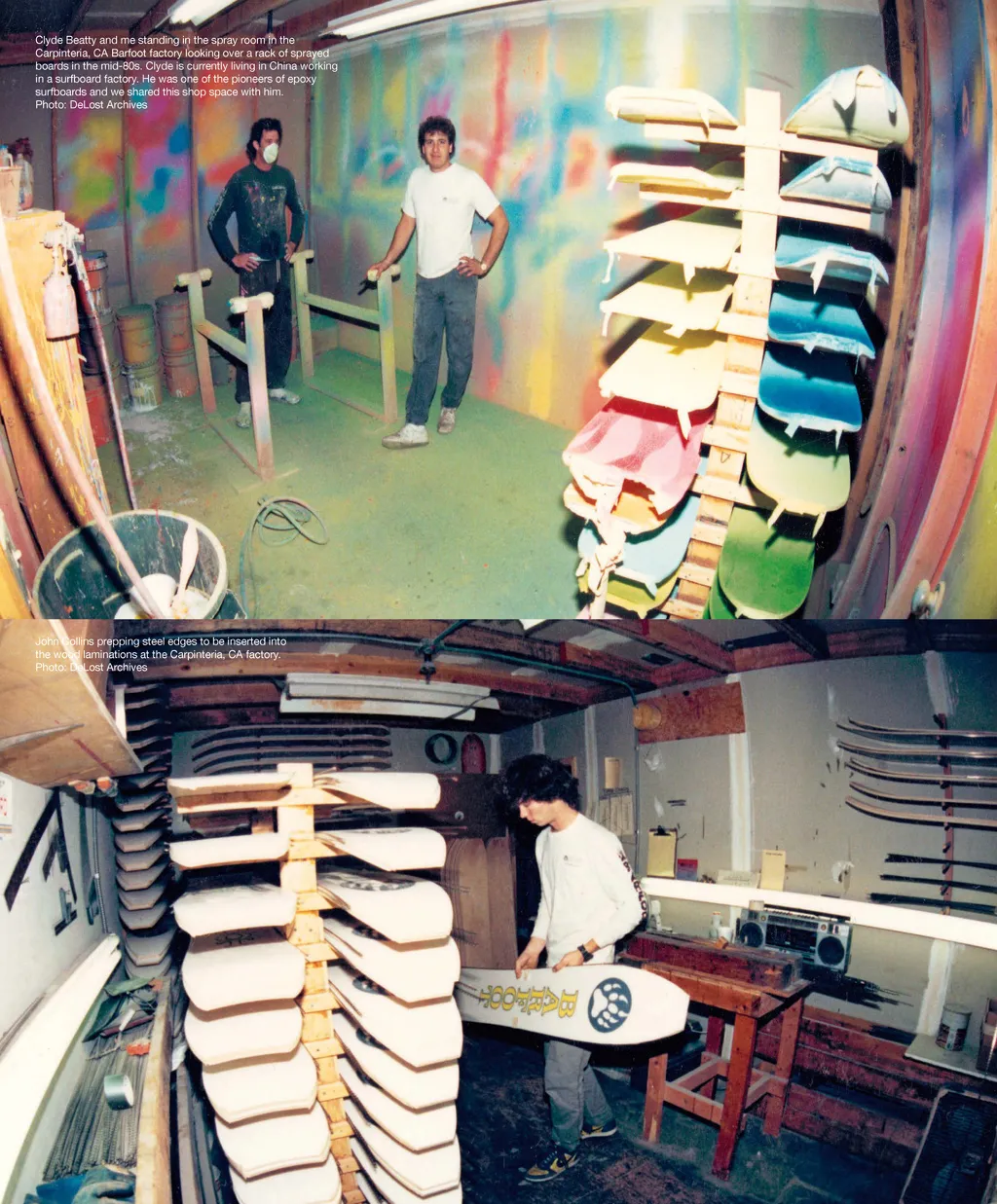
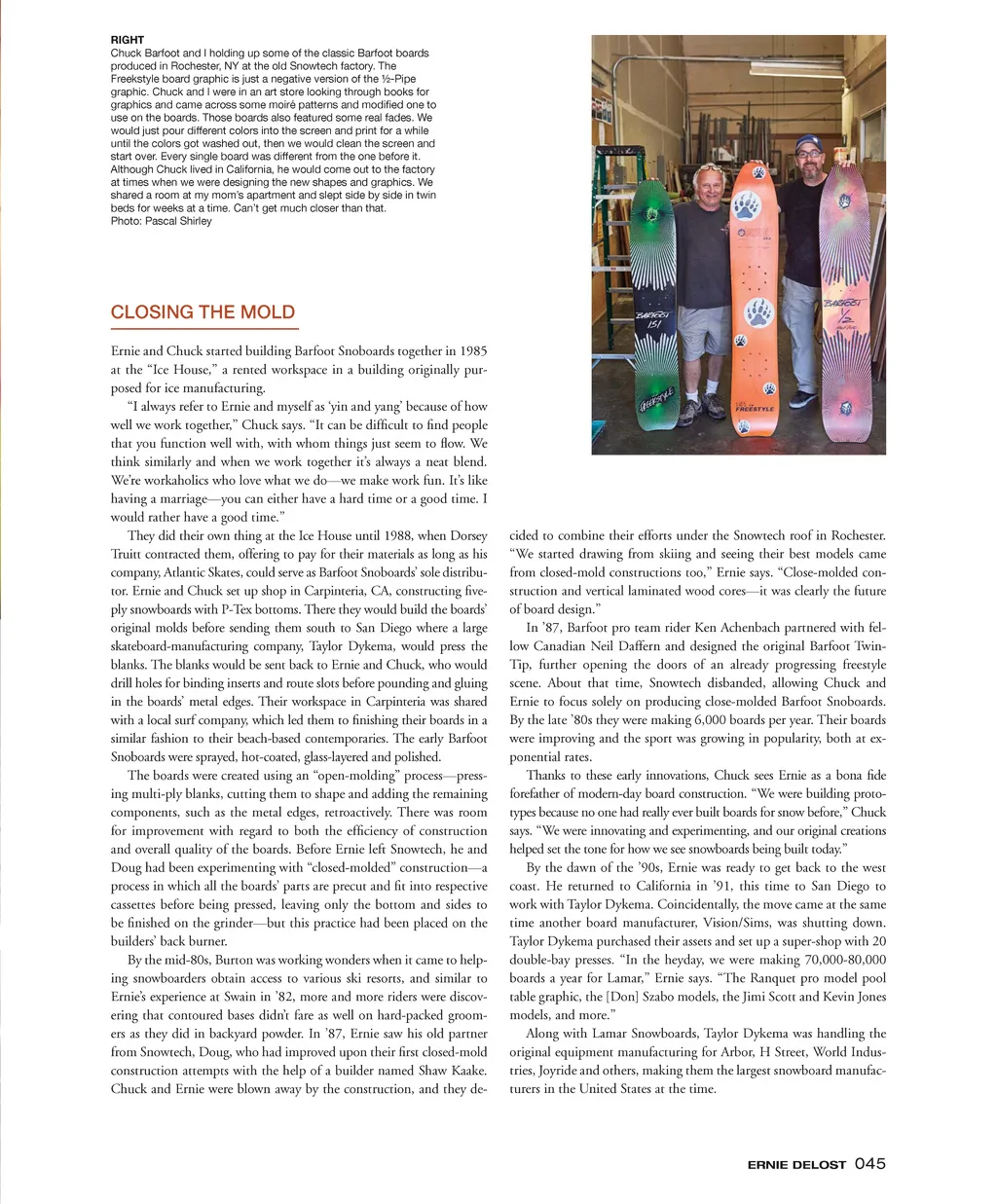
RIGHT Chuck Barfoot and I holding up some of the classic Barfoot boards produced in Rochester, NY at the old Snowtech factory. The Freekstyle board graphic is just a negative version of the ½-Pipe graphic. Chuck and I were in an art store looking through books for graphics and came across some moiré patterns and modified one to use on the boards. Those boards also featured some real fades. We would just pour different colors into the screen and print for a while until the colors got washed out, then we would clean the screen and start over. Every single board was different from the one before it. Although Chuck lived in California, he would come out to the factory at times when we were designing the new shapes and graphics. We shared a room at my mom’s apartment and slept side by side in twin beds for weeks at a time. Can’t get much closer than that. Photo: Pascal Shirley CLOSING THE MOLD Ernie and Chuck started building Barfoot Snoboards together in 1985 at the “Ice House,” a rented workspace in a building originally pur-posed for ice manufacturing. “I always refer to Ernie and myself as ‘yin and yang’ because of how well we work together,” Chuck says. “It can be difficult to find people that you function well with, with whom things just seem to flow. We think similarly and when we work together it’s always a neat blend. We’re workaholics who love what we do—we make work fun. It’s like having a marriage—you can either have a hard time or a good time. I would rather have a good time.” They did their own thing at the Ice House until 1988, when Dorsey Truitt contracted them, offering to pay for their materials as long as his company, Atlantic Skates, could serve as Barfoot Snoboards’ sole distribu-tor. Ernie and Chuck set up shop in Carpinteria, CA, constructing five-ply snowboards with P-Tex bottoms. There they would build the boards’ original molds before sending them south to San Diego where a large skateboard-manufacturing company, Taylor Dykema, would press the blanks. The blanks would be sent back to Ernie and Chuck, who would drill holes for binding inserts and route slots before pounding and gluing in the boards’ metal edges. Their workspace in Carpinteria was shared with a local surf company, which led them to finishing their boards in a similar fashion to their beach-based contemporaries. The early Barfoot Snoboards were sprayed, hot-coated, glass-layered and polished. The boards were created using an “open-molding” process—press-ing multi-ply blanks, cutting them to shape and adding the remaining components, such as the metal edges, retroactively. There was room for improvement with regard to both the efficiency of construction and overall quality of the boards. Before Ernie left Snowtech, he and Doug had been experimenting with “closed-molded” construction—a process in which all the boards’ parts are precut and fit into respective cassettes before being pressed, leaving only the bottom and sides to be finished on the grinder—but this practice had been placed on the builders’ back burner. By the mid-80s, Burton was working wonders when it came to help-ing snowboarders obtain access to various ski resorts, and similar to Ernie’s experience at Swain in ’82, more and more riders were discov-ering that contoured bases didn’t fare as well on hard-packed groom-ers as they did in backyard powder. In ’87, Ernie saw his old partner from Snowtech, Doug, who had improved upon their first closed-mold construction attempts with the help of a builder named Shaw Kaake. Chuck and Ernie were blown away by the construction, and they de-cided to combine their efforts under the Snowtech roof in Rochester. “We started drawing from skiing and seeing their best models came from closed-mold constructions too,” Ernie says. “Close-molded con-struction and vertical laminated wood cores—it was clearly the future of board design.” In ’87, Barfoot pro team rider Ken Achenbach partnered with fel-low Canadian Neil Daffern and designed the original Barfoot Twin-Tip, further opening the doors of an already progressing freestyle scene. About that time, Snowtech disbanded, allowing Chuck and Ernie to focus solely on producing close-molded Barfoot Snoboards. By the late ’80s they were making 6,000 boards per year. Their boards were improving and the sport was growing in popularity, both at ex-ponential rates. Thanks to these early innovations, Chuck sees Ernie as a bona fide forefather of modern-day board construction. “We were building proto-types because no one had really ever built boards for snow before,” Chuck says. “We were innovating and experimenting, and our original creations helped set the tone for how we see snowboards being built today.” By the dawn of the ’90s, Ernie was ready to get back to the west coast. He returned to California in ’91, this time to San Diego to work with Taylor Dykema. Coincidentally, the move came at the same time another board manufacturer, Vision/Sims, was shutting down. Taylor Dykema purchased their assets and set up a super-shop with 20 double-bay presses. “In the heyday, we were making 70,000-80,000 boards a year for Lamar,” Ernie says. “The Ranquet pro model pool table graphic, the [Don] Szabo models, the Jimi Scott and Kevin Jones models, and more.” Along with Lamar Snowboards, Taylor Dykema was handling the original equipment manufacturing for Arbor, H Street, World Indus-tries, Joyride and others, making them the largest snowboard manufac-turers in the United States at the time. ERNIE DELOST 045
The Snowboarder's Journal frequency 14.1: Page 45