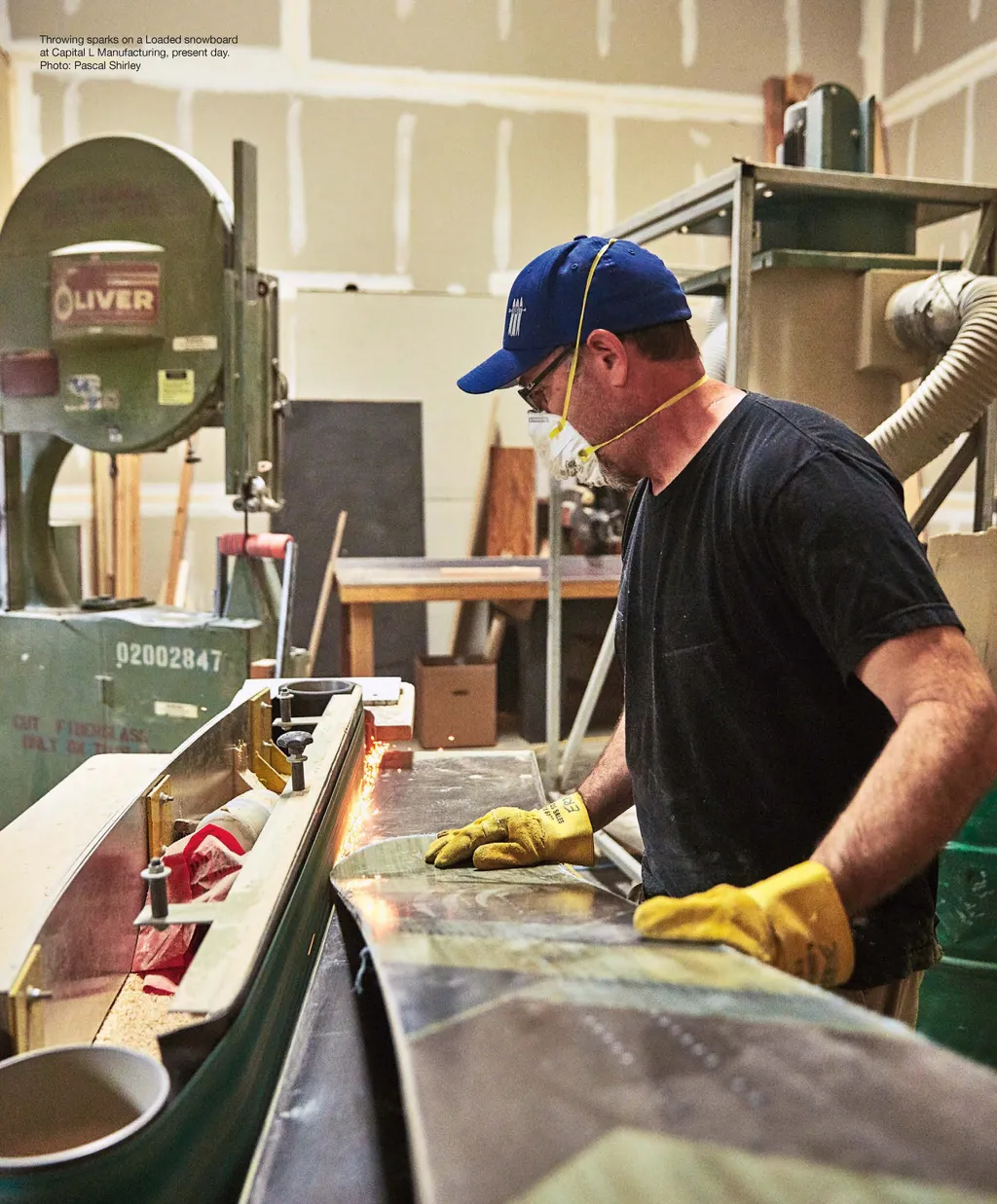
“Once you know how to build a snowboard really well, it opens the doors up to building everything else, because nothing is as difficult to build as a good snowboard.” CAPITAL L It’s a bright, sunny day in the spring of 2016. A cool breeze dances through the open doors at the Capital L Manufacturing headquarters in San Diego, and Ernie is walking with a smile, his employees return-ing it with grins of their own. “I’d always have to spell that part of my last name out to people,” Ernie says with a laugh. “That’s why I decided to name my company ‘Capital L.’” Ernie founded his own manufacturing company in 2003 with his wife, Connie, who he met in ’92 and married in ’99. Connie handles Capital L’s bookkeeping, accounting and the like, freeing up Ernie to focus on designing and constructing boards, which he still spends more than 60 hours per week doing. When their 13-year-old daughter, Corinna, isn’t playing soccer, she occasionally comes to the factory and works on various projects with her dad. Ernie says she’s the “spitting image of her mother,” and a very bright student who particularly excels in math and science. “She has a real aptitude for how things work,” Ernie says. No surprise there. Capital L’s first clients were kite and wakeboard companies, Sling-shot and Liquid Force, and, in 2006, Ernie was approached by Loaded Boards and asked to build the skate company’s longboards. “Once you know how to build a snowboard really well, it opens the doors up to building everything else, because nothing is as difficult to build as a good snowboard,” Ernie says. But apparently no other board is as sat-isfying to build as one destined for snow either. Ernie had stayed in contact with Barfoot, who was “still grinding away up in Santa Barbara making these real nice-looking, surf-shape-inspired longboards,” Ernie says. “But we were still always saying, ‘We should build snowboards.’” In 2010, Ernie, Matt Nipper of Aggression Snowboards and the Loaded crew, Don Tashman and Danny Carper, started building pro-totypes of a Loaded-branded snowboard. They launched in 2014 with a high-end model utilizing cork and bamboo as building materials, and this fall Ernie and Chuck will be relaunching Barfoot. Chuck says he’s ecstatic to be working on boards with Ernie again, expressing that Ernie brings out the best in him both in-shop and on-hill. During last year’s SIA, the two took to Copper Mountain, CO, following a storm that had graced the slopes with nearly two feet of fresh. “I hadn’t rid-den in over a year but we were laying out some turns like I couldn’t believe,” Chuck says. “Halfway through our first run Ernie and I were screaming our heads off in excitement over the perfect conditions and the new all-mountain design we were testing.” Chuck describes it as an all-inclusive lifestyle for him and Ernie: designing, constructing and riding. So while the technology these vanguards work with may be ever-evolving, it’s clear the bond they share hasn’t much changed in their 30-plus years of friendship. Ernie says he’s also considering creating a few models under the Snowtech name that will speak to the company’s original designs, but incorporate contemporary construction techniques and materials. Past creating a self-sustaining company, he says he doesn’t have any monu-mental marketing aspirations for either brand; he just wants to make good, reliable snowboards. “It’s fun—I’ve essentially spent my whole life figuring out how to build toys,” Ernie says. “I run with blinders on. I know what’s going on around the industry, but try not to be too influenced by any of it. If you know what you’re working on is a good idea, you should run with it. It’s never been about the fame on my end; I just like building stuff that I like to use. And I’ll keep doing it for as long as I can.” 046 THE SNOWBOARDER’S JOURNAL
The Snowboarder's Journal frequency 14.1: Page 46