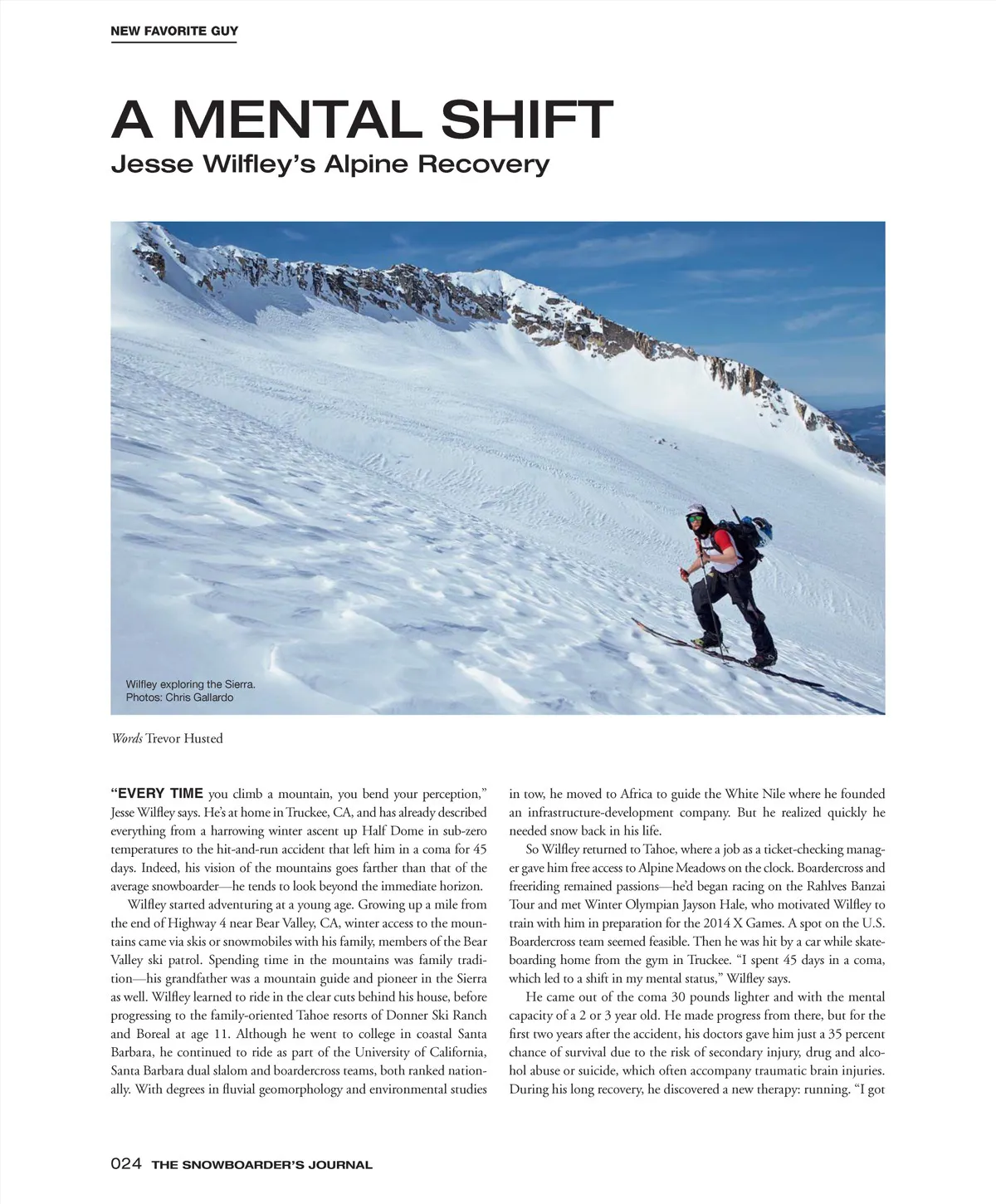
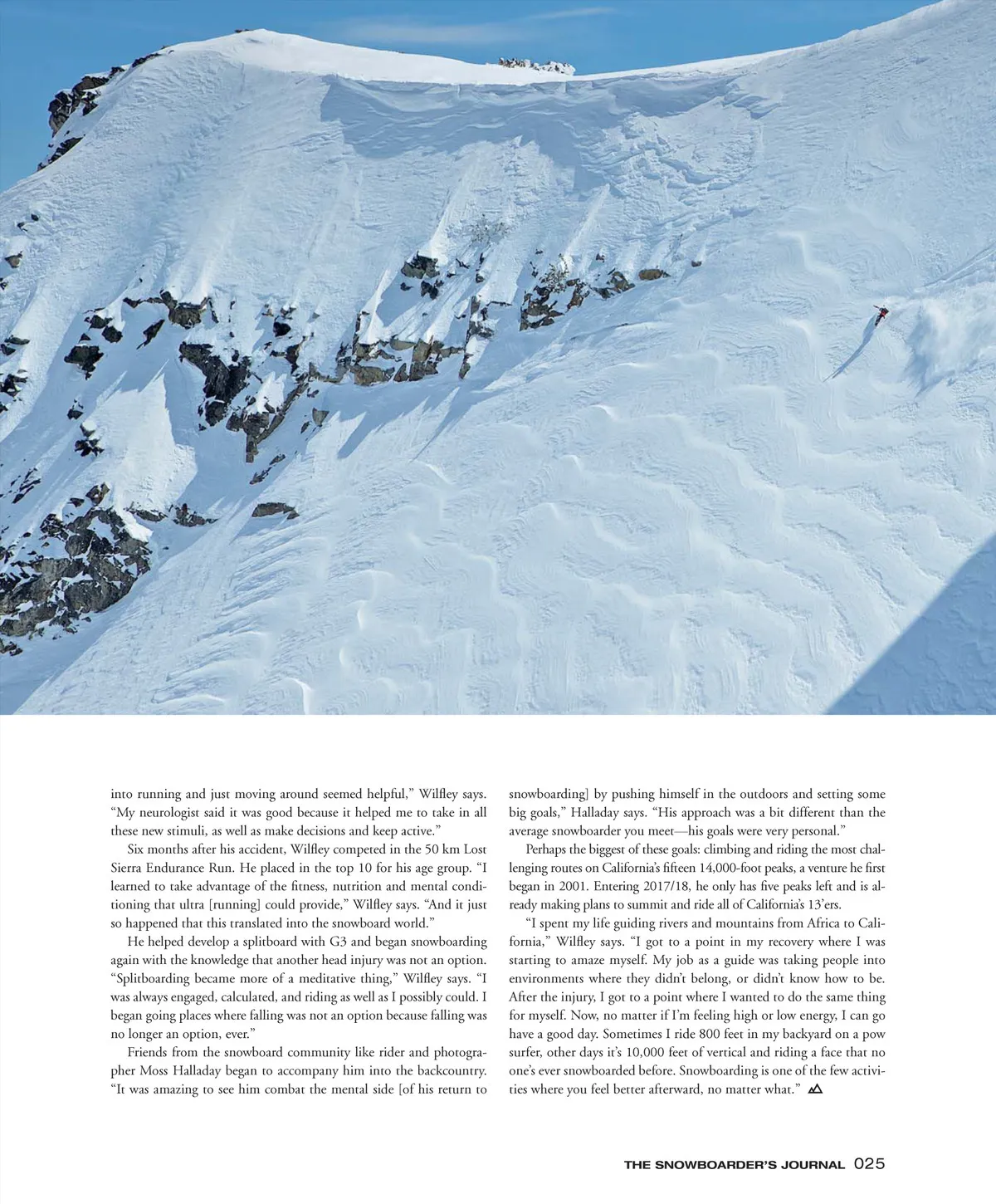
NEW FAVORITE GUY A MENTAL SHIFT Jesse Wilfley’s Alpine Recovery Wilfley exploring the Sierra. Photos: Chris Gallardo Words Trevor Husted “EVERY TIME you climb a mountain, you bend your perception,” Jesse Wilfley says. He’s at home in Truckee, CA, and has already described everything from a harrowing winter ascent up Half Dome in sub-zero temperatures to the hit-and-run accident that left him in a coma for 45 days. Indeed, his vision of the mountains goes farther than that of the average snowboarder—he tends to look beyond the immediate horizon. Wilfley started adventuring at a young age. Growing up a mile from the end of Highway 4 near Bear Valley, CA, winter access to the moun-tains came via skis or snowmobiles with his family, members of the Bear Valley ski patrol. Spending time in the mountains was family tradi-tion—his grandfather was a mountain guide and pioneer in the Sierra as well. Wilfley learned to ride in the clear cuts behind his house, before progressing to the family-oriented Tahoe resorts of Donner Ski Ranch and Boreal at age 11. Although he went to college in coastal Santa Barbara, he continued to ride as part of the University of California, Santa Barbara dual slalom and boardercross teams, both ranked nation-ally. With degrees in fluvial geomorphology and environmental studies in tow, he moved to Africa to guide the White Nile where he founded an infrastructure-development company. But he realized quickly he needed snow back in his life. So Wilfley returned to Tahoe, where a job as a ticket-checking manag-er gave him free access to Alpine Meadows on the clock. Boardercross and freeriding remained passions—he’d began racing on the Rahlves Banzai Tour and met Winter Olympian Jayson Hale, who motivated Wilfley to train with him in preparation for the 2014 X Games. A spot on the U.S. Boardercross team seemed feasible. Then he was hit by a car while skate-boarding home from the gym in Truckee. “I spent 45 days in a coma, which led to a shift in my mental status,” Wilfley says. He came out of the coma 30 pounds lighter and with the mental capacity of a 2 or 3 year old. He made progress from there, but for the first two years after the accident, his doctors gave him just a 35 percent chance of survival due to the risk of secondary injury, drug and alco-hol abuse or suicide, which often accompany traumatic brain injuries. During his long recovery, he discovered a new therapy: running. “I got 024 THE SNOWBOARDER’S JOURNAL
The Snowboarder's Journal frequency 15.3 : Page 24