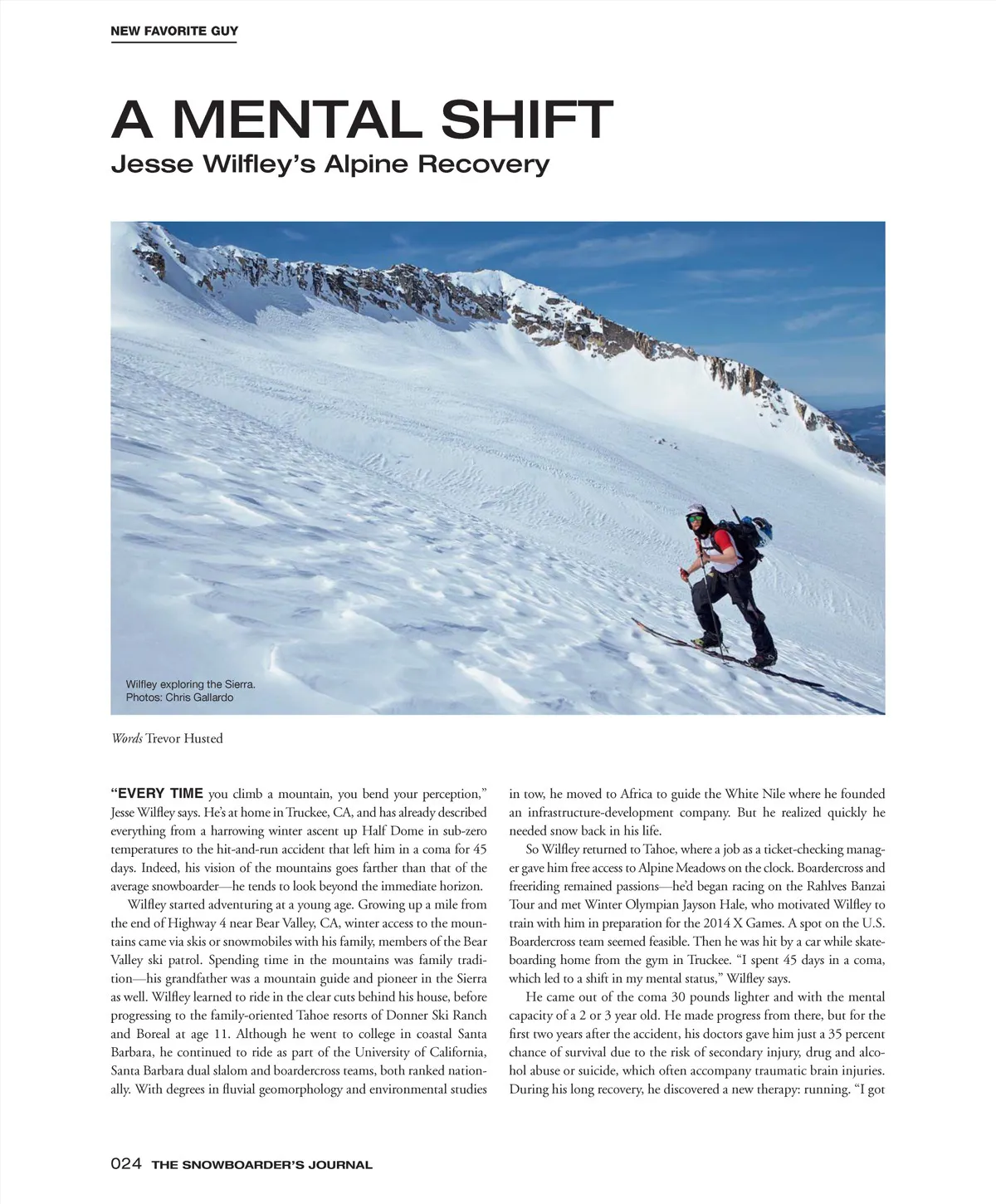
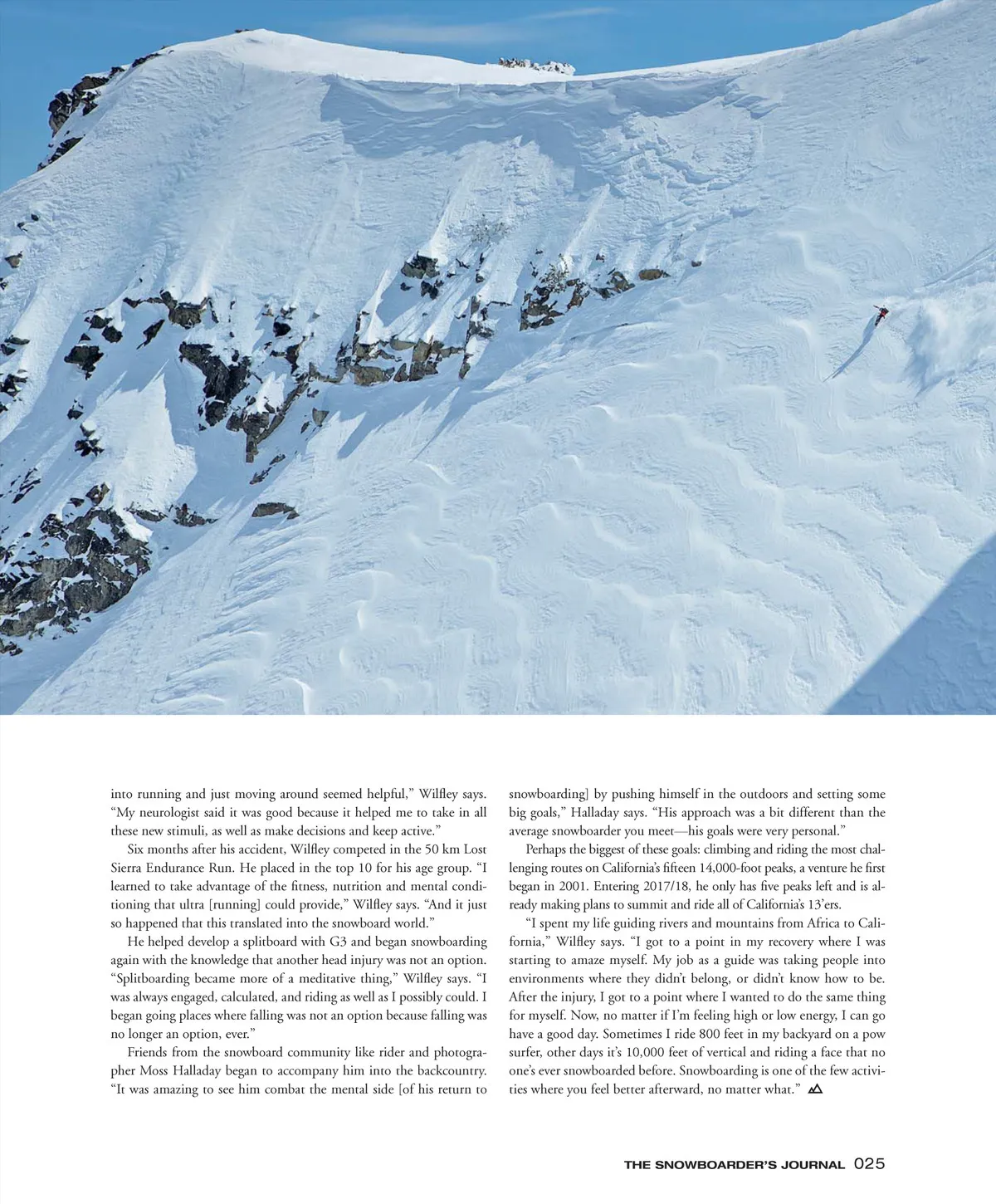
into running and just moving around seemed helpful,” Wilfley says. “My neurologist said it was good because it helped me to take in all these new stimuli, as well as make decisions and keep active.” Six months after his accident, Wilfley competed in the 50 km Lost Sierra Endurance Run. He placed in the top 10 for his age group. “I learned to take advantage of the fitness, nutrition and mental condi-tioning that ultra [running] could provide,” Wilfley says. “And it just so happened that this translated into the snowboard world.” He helped develop a splitboard with G3 and began snowboarding again with the knowledge that another head injury was not an option. “Splitboarding became more of a meditative thing,” Wilfley says. “I was always engaged, calculated, and riding as well as I possibly could. I began going places where falling was not an option because falling was no longer an option, ever.” Friends from the snowboard community like rider and photogra-pher Moss Halladay began to accompany him into the backcountry. “It was amazing to see him combat the mental side [of his return to snowboarding] by pushing himself in the outdoors and setting some big goals,” Halladay says. “His approach was a bit different than the average snowboarder you meet—his goals were very personal.” Perhaps the biggest of these goals: climbing and riding the most chal-lenging routes on California’s fifteen 14,000-foot peaks, a venture he first began in 2001. Entering 2017/18, he only has five peaks left and is al-ready making plans to summit and ride all of California’s 13’ers. “I spent my life guiding rivers and mountains from Africa to Cali-fornia,” Wilfley says. “I got to a point in my recovery where I was starting to amaze myself. My job as a guide was taking people into environments where they didn’t belong, or didn’t know how to be. After the injury, I got to a point where I wanted to do the same thing for myself. Now, no matter if I’m feeling high or low energy, I can go have a good day. Sometimes I ride 800 feet in my backyard on a pow surfer, other days it’s 10,000 feet of vertical and riding a face that no one’s ever snowboarded before. Snowboarding is one of the few activi-ties where you feel better afterward, no matter what.” THE SNOWBOARDER’S JOURNAL 025
The Snowboarder's Journal frequency 15.3 : Page 25