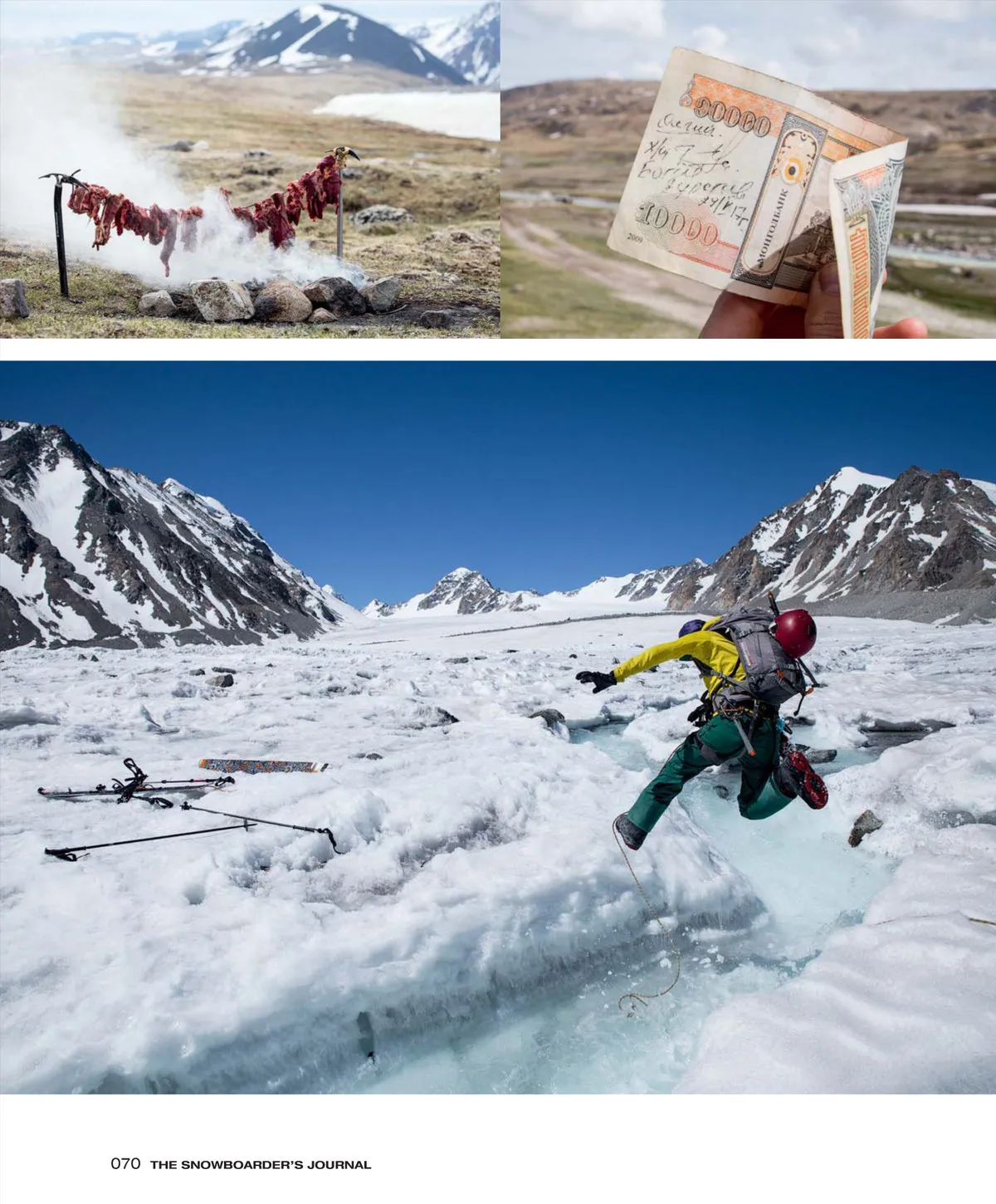
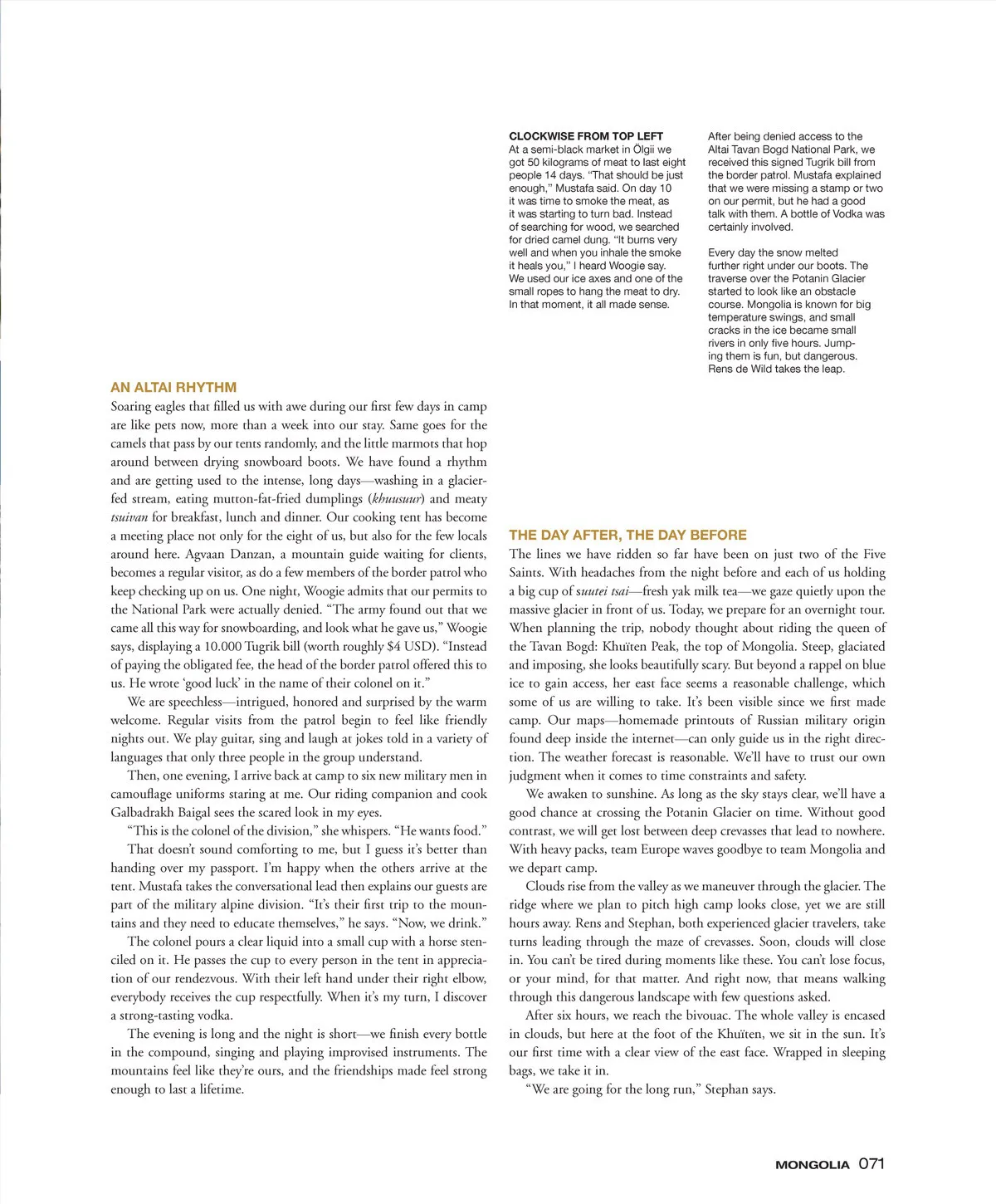
CLOCKWISE FROM TOP LEFT At a semi-black market in Ölgii we got 50 kilograms of meat to last eight people 14 days. “That should be just enough,” Mustafa said. On day 10 it was time to smoke the meat, as it was starting to turn bad. Instead of searching for wood, we searched for dried camel dung. “It burns very well and when you inhale the smoke it heals you,” I heard Woogie say. We used our ice axes and one of the small ropes to hang the meat to dry. In that moment, it all made sense. After being denied access to the Altai Tavan Bogd National Park, we received this signed Tugrik bill from the border patrol. Mustafa explained that we were missing a stamp or two on our permit, but he had a good talk with them. A bottle of Vodka was certainly involved. Every day the snow melted further right under our boots. The traverse over the Potanin Glacier started to look like an obstacle course. Mongolia is known for big temperature swings, and small cracks in the ice became small rivers in only five hours. Jump-ing them is fun, but dangerous. Rens de Wild takes the leap. AN ALTAI RHYTHM Soaring eagles that filled us with awe during our first few days in camp are like pets now, more than a week into our stay. Same goes for the camels that pass by our tents randomly, and the little marmots that hop around between drying snowboard boots. We have found a rhythm and are getting used to the intense, long days—washing in a glacier-fed stream, eating mutton-fat-fried dumplings ( khuusuur ) and meaty tsuivan for breakfast, lunch and dinner. Our cooking tent has become a meeting place not only for the eight of us, but also for the few locals around here. Agvaan Danzan, a mountain guide waiting for clients, becomes a regular visitor, as do a few members of the border patrol who keep checking up on us. One night, Woogie admits that our permits to the National Park were actually denied. “The army found out that we came all this way for snowboarding, and look what he gave us,” Woogie says, displaying a 10.000 Tugrik bill (worth roughly $4 USD). “Instead of paying the obligated fee, the head of the border patrol offered this to us. He wrote ‘good luck’ in the name of their colonel on it.” We are speechless—intrigued, honored and surprised by the warm welcome. Regular visits from the patrol begin to feel like friendly nights out. We play guitar, sing and laugh at jokes told in a variety of languages that only three people in the group understand. Then, one evening, I arrive back at camp to six new military men in camouflage uniforms staring at me. Our riding companion and cook Galbadrakh Baigal sees the scared look in my eyes. “This is the colonel of the division,” she whispers. “He wants food.” That doesn’t sound comforting to me, but I guess it’s better than handing over my passport. I’m happy when the others arrive at the tent. Mustafa takes the conversational lead then explains our guests are part of the military alpine division. “It’s their first trip to the moun-tains and they need to educate themselves,” he says. “Now, we drink.” The colonel pours a clear liquid into a small cup with a horse sten-ciled on it. He passes the cup to every person in the tent in apprecia-tion of our rendezvous. With their left hand under their right elbow, everybody receives the cup respectfully. When it’s my turn, I discover a strong-tasting vodka. The evening is long and the night is short—we finish every bottle in the compound, singing and playing improvised instruments. The mountains feel like they’re ours, and the friendships made feel strong enough to last a lifetime. THE DAY AFTER, THE DAY BEFORE The lines we have ridden so far have been on just two of the Five Saints. With headaches from the night before and each of us holding a big cup of s uutei tsai —fresh yak milk tea—we gaze quietly upon the massive glacier in front of us. Today, we prepare for an overnight tour. When planning the trip, nobody thought about riding the queen of the Tavan Bogd: Khuïten Peak, the top of Mongolia. Steep, glaciated and imposing, she looks beautifully scary. But beyond a rappel on blue ice to gain access, her east face seems a reasonable challenge, which some of us are willing to take. It’s been visible since we first made camp. Our maps—homemade printouts of Russian military origin found deep inside the internet—can only guide us in the right direc-tion. The weather forecast is reasonable. We’ll have to trust our own judgment when it comes to time constraints and safety. We awaken to sunshine. As long as the sky stays clear, we’ll have a good chance at crossing the Potanin Glacier on time. Without good contrast, we will get lost between deep crevasses that lead to nowhere. With heavy packs, team Europe waves goodbye to team Mongolia and we depart camp. Clouds rise from the valley as we maneuver through the glacier. The ridge where we plan to pitch high camp looks close, yet we are still hours away. Rens and Stephan, both experienced glacier travelers, take turns leading through the maze of crevasses. Soon, clouds will close in. You can’t be tired during moments like these. You can’t lose focus, or your mind, for that matter. And right now, that means walking through this dangerous landscape with few questions asked. After six hours, we reach the bivouac. The whole valley is encased in clouds, but here at the foot of the Khuïten, we sit in the sun. It’s our first time with a clear view of the east face. Wrapped in sleeping bags, we take it in. “We are going for the long run,” Stephan says. MONGOLIA 071
The Snowboarder's Journal frequency 15.4: Page 71